Chaos Theory
The study of deterministic nonlinear systems whose trajectories can become unpredictable through sensitive dependence on initial conditions.
- Revision
- 1
- Created by
- SCIENDIA Knowledge Desk
- Updated by
- SCIENDIA Knowledge Desk
- Last updated
- 18.08.2026 11:45
Built by the community
Members can improve this article. Every saved change remains visible in the revision ledger.
Overview
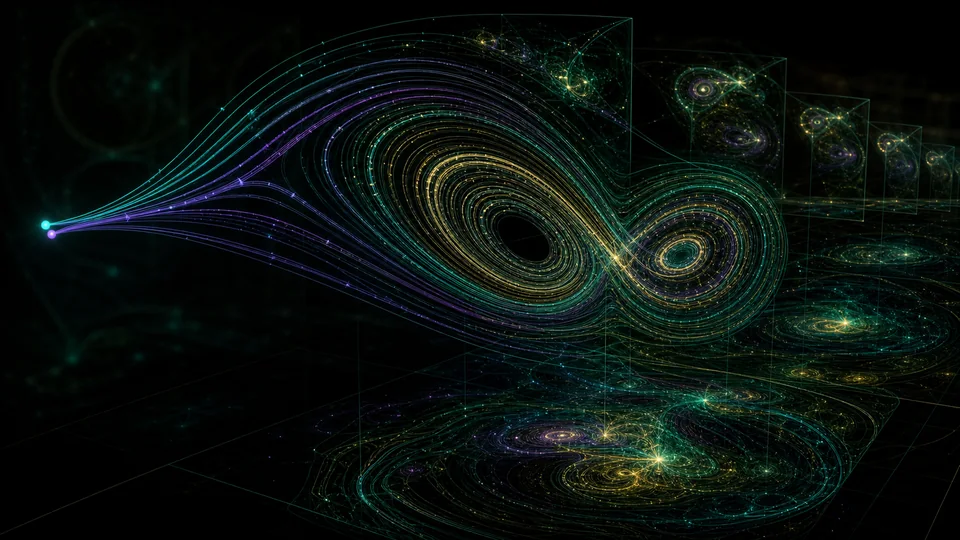
Chaotic systems follow definite evolution rules yet can separate exponentially from nearly identical starting states. Long-term point prediction then becomes impossible beyond a finite horizon even without external randomness. The resulting motion can remain bounded around a structured strange attractor rather than settling to equilibrium or repeating periodically.
Technical foundations
A continuous dynamical system evolves in phase space under differential equations, while discrete systems use iterated maps. Chaos typically combines bounded motion, aperiodicity and sensitive dependence. Lyapunov exponents measure average perturbation growth; at least one positive exponent indicates expanding directions, balanced by contraction that can form a fractal attractor. Poincare sections reduce a flow to a map, and bifurcation analysis tracks how equilibria or periodic orbits change stability. Deterministic chaos differs from stochastic forcing even when both produce irregular observations.
How it works
A system's state evolves through differential equations or an iterated map. Researchers reconstruct phase space, locate fixed points and periodic orbits and measure how perturbations grow. Parameter changes can generate bifurcations from stable motion to cycles and chaos, with recurring geometric structure across scales.
Measurement and research methods
Experimental analysis reconstructs state space from simultaneous variables or delay coordinates derived from one time series. False-nearest-neighbour and mutual-information methods guide embedding choices, while recurrence plots and surrogate-data tests compare observations with linear stochastic alternatives. Estimates of correlation dimension and Lyapunov exponents require long, stationary, well-sampled records and can be biased by noise. Forecast skill should be tested out of sample against statistical baselines. Controlled perturbations or known governing equations provide stronger evidence than visually matching a famous attractor.
Key ideas
- Deterministic dynamics can be practically unpredictable without being random.
- Positive Lyapunov exponents quantify average exponential separation of nearby trajectories.
- A single irregular time series does not prove low-dimensional deterministic chaos.
Current research frontier
Current work studies transient chaos, tipping, synchronisation and control of nonlinear systems with limited observations. Data assimilation continually combines forecasts with measurements to remain useful despite error growth, as in weather prediction. Koopman operators and machine learning seek coordinates with simpler evolution, but learned models can invent unstable attractors outside training data. Open questions concern high-dimensional turbulence, networked systems and distinguishing early-warning signals from changing noise. Practical applications require ensembles and probabilistic horizons, because chaos limits precise long-range trajectories without making every statistical property unknowable.
Why it matters
Chaos theory explains limits of weather forecasts and patterns in fluids, populations, circuits and celestial dynamics. It also supplies tools for nonlinear control, data assimilation and reasoning about predictability itself.
Limits and open questions
Noise, short records and hidden variables can imitate chaotic signatures. Estimated attractor dimensions and exponents depend on sampling and reconstruction choices, while high-dimensional real systems may not reduce to a simple textbook attractor.
Explore through connected concepts
This article is indexed with 20 technical tags. Select a tag to explore the Wiki by concept.
You may also explore
Recommended from the technical tags shared with this article.
Optimal Transport
A mathematical framework for transforming one distribution into another while minimising a defined movement cost.
Read article →