Graph Neural Networks
Machine-learning architectures that learn representations from entities connected by relational structure.
- Revision
- 1
- Created by
- SCIENDIA Knowledge Desk
- Updated by
- SCIENDIA Knowledge Desk
- Last updated
- 18.08.2026 10:51
Built by the community
Members can improve this article. Every saved change remains visible in the revision ledger.
Overview
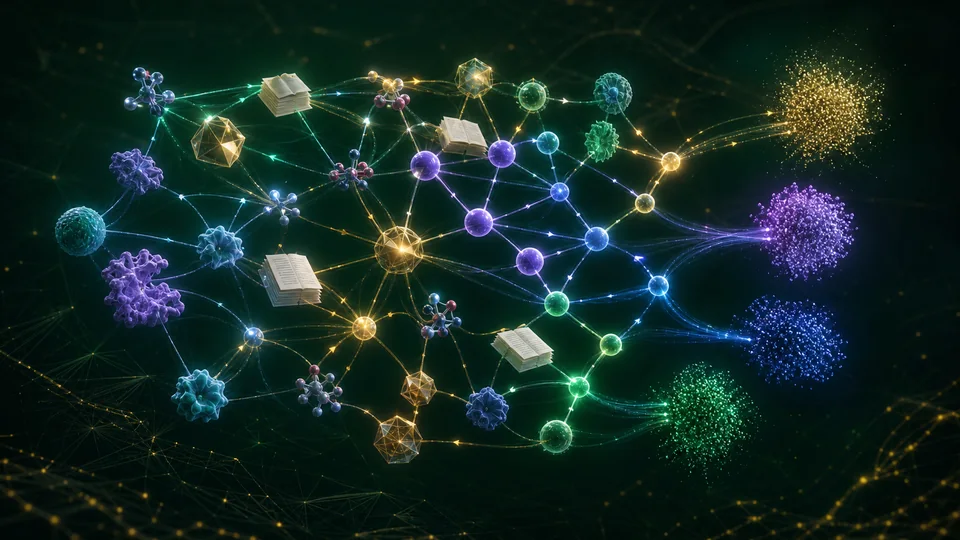
Graph neural networks process data whose elements are linked by edges, such as atoms in a molecule, users in a social system or papers in a citation network. Instead of assuming a regular pixel grid or sequence, these models update node, edge or graph representations using information from local neighbourhoods.
Technical foundations
A message-passing graph neural network updates a node representation by aggregating functions of neighbouring node and edge states, then applies a learned update map. Sum aggregation can approximate expressive set functions, while normalised convolution averages neighbourhood information. Attention learns edge weights from features. Equivariant models preserve rotations or translations and are especially valuable for molecules and physical systems. The Weisfeiler-Lehman hierarchy provides one reference for distinguishing graph structures, but standard message passing cannot separate every non-isomorphic graph and may compress distant information through narrow computational bottlenecks.
How it works
A message-passing layer constructs messages from neighbouring features, aggregates them with a permutation-invariant operation and updates each node state. Repeating layers expands the receptive field. Pooling produces a graph-level representation, while attention, geometric constraints or temporal modules adapt the framework to specialised data.
Measurement and research methods
Evaluation must define how graphs are split. Randomly separating connected nodes can leak neighbourhood or identity information, so temporal, scaffold, geographic or entity-disjoint splits may be more realistic. Baselines should include non-graph models to test whether edges add value. Metrics depend on class imbalance and task cost, and uncertainty should be assessed under distribution shift. Interpretability approaches identify influential subgraphs, features or counterfactual edges, but explanations require fidelity tests. For large graphs, neighbour sampling, subgraph batching and distributed sparse operations trade variance, memory and communication cost.
Key ideas
- Graph construction encodes assumptions and can dominate model behaviour.
- Permutation invariance is required when node ordering has no physical meaning.
- More layers do not guarantee more information because oversmoothing and oversquashing can degrade representations.
Current research frontier
Research explores graph transformers, learned graph construction, dynamic networks and foundation models spanning molecular or knowledge domains. Physics-informed graph networks approximate simulators on meshes or particles while respecting conservation and symmetry. In drug and materials discovery, predictions are coupled to uncertainty-guided experiments rather than treated as replacements for measurement. Open problems include long-range reasoning, heterophilous graphs, causal structure and robustness to missing or manipulated edges. Fairness is complicated because relational data can propagate sensitive information through neighbours. Reliable deployment therefore requires monitoring both feature drift and changes in graph connectivity.
Why it matters
Graph networks support molecular property prediction, materials discovery, recommender systems, traffic modelling and knowledge-graph reasoning. They offer a natural way to incorporate relational and physical inductive biases.
Limits and open questions
Performance can fail under changing graph structure, biased links or adversarial edge manipulation. Expressive power is limited for some graph distinctions, while scalability, uncertainty, causal interpretation and leakage across connected train-test samples require careful evaluation.
Explore through connected concepts
This article is indexed with 20 technical tags. Select a tag to explore the Wiki by concept.
You may also explore
Recommended from the technical tags shared with this article.
Artificial Neural Networks
Layered computational models that learn distributed representations by adjusting weighted connections from data.
Read article →