Neuromorphic Computing
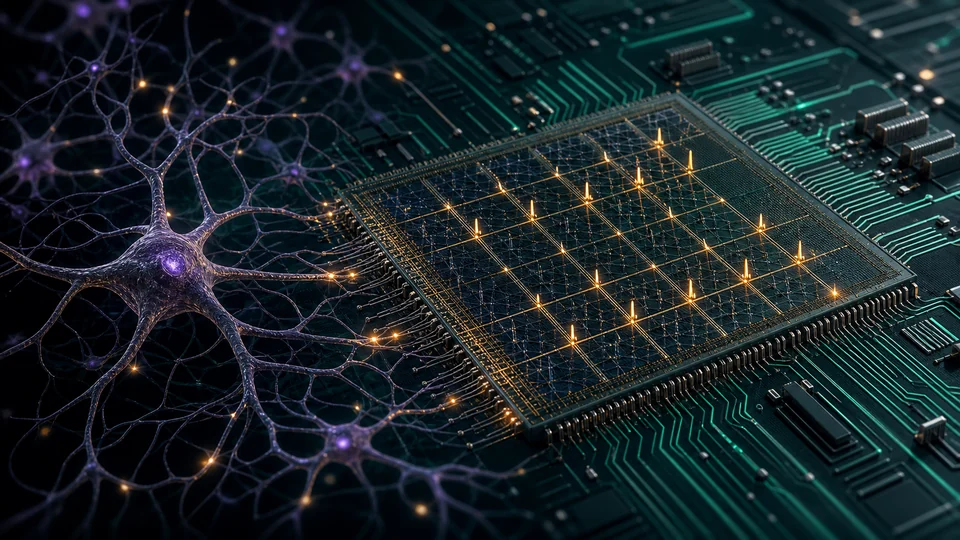
Computing architectures that use brain-inspired event-driven neurons, synapses and memory-compute integration.
- Revision
- 1
- Created by
- SCIENDIA Knowledge Desk
- Updated by
- SCIENDIA Knowledge Desk
- Last updated
- 18.08.2026 14:57
Built by the community
Members can improve this article. Every saved change remains visible in the revision ledger.
Overview
Neuromorphic systems represent information through sparse events and distributed state rather than continuously clocking every operation. Hardware neurons integrate incoming signals and emit spikes after a threshold or dynamical rule is met. Synaptic weights shape communication, enabling temporal sensing, adaptive control and inference with potentially low latency and energy.
Technical foundations
Spiking neuron models integrate weighted events and emit a discrete spike when membrane state crosses a threshold, then reset or adapt. Time itself can encode information through latency, rate or synchrony. Event-driven hardware activates only affected circuits, reducing data movement. Synaptic crossbars perform parallel weighted accumulation using digital memories, analogue conductance or emerging resistive devices. Co-locating state and arithmetic addresses the von Neumann bottleneck, although peripheral conversion, routing and learning circuits still consume energy.
How it works
Digital, analogue or mixed-signal circuits implement neuronal dynamics, while crossbar memories or local SRAM store synaptic parameters near computation. Sensors may output events only when brightness, sound or another quantity changes. Networks are trained by surrogate gradients, converted from conventional models or adapted with local plasticity rules. Routing fabrics deliver spikes asynchronously among cores.
Measurement and research methods
Benchmarks measure end-to-end energy, latency and accuracy on event streams such as dynamic vision, audio or tactile sensing. Power instrumentation must include sensor interfaces and host communication. Training can use backpropagation through surrogate derivatives, local spike-timing plasticity or conversion from rectified neural networks. Hardware-aware simulation models limited weight precision, device mismatch and spike congestion before deployment. Calibration and homeostatic mechanisms compensate analogue drift, while fault injection tests robustness to stuck synapses and dropped events.
Key ideas
- Neuromorphic describes an architectural family, not one universal neuron model or performance guarantee.
- Energy comparisons require the same task, accuracy, latency and measurement boundary.
- Sparse event streams offer the greatest advantage when the underlying signal and workload are also sparse.
Current research frontier
The frontier includes on-chip continual learning, dendritic computation and hybrid systems combining neuromorphic front ends with conventional accelerators. Memristive synapses promise dense analogue storage but face endurance, variability and nonlinear update. Sensor-compute co-design may deliver larger gains than copying biological detail in isolation. Common benchmarks are needed to avoid demonstrations tuned to one device. Open questions concern scalable software abstractions, stability of online plasticity and security of event-based systems. Neuromorphic processors are likely specialised components, so fair evaluation compares complete heterogeneous systems under real duty cycles.
Why it matters
The approach may enable always-on perception, robotics and edge intelligence where power and response time are constrained. It also provides experimental platforms for computational neuroscience and online adaptation.
Limits and open questions
Programming tools and benchmarks remain fragmented, analogue devices drift and large networks face routing limits. Many mainstream workloads are dense, reducing benefit, and biological inspiration alone does not ensure correctness. Deployment requires calibrated sensors, fault handling and task-level evidence against efficient conventional accelerators.
Explore through connected concepts
This article is indexed with 20 technical tags. Select a tag to explore the Wiki by concept.
You may also explore
Recommended from the technical tags shared with this article.
Artificial Neural Networks
Layered computational models that learn distributed representations by adjusting weighted connections from data.
Read article →