Ocean Circulation
The wind-, buoyancy- and tide-driven movement of seawater that redistributes heat, carbon, nutrients and momentum.
- Revision
- 1
- Created by
- SCIENDIA Knowledge Desk
- Updated by
- SCIENDIA Knowledge Desk
- Last updated
- 18.08.2026 10:51
Built by the community
Members can improve this article. Every saved change remains visible in the revision ledger.
Overview
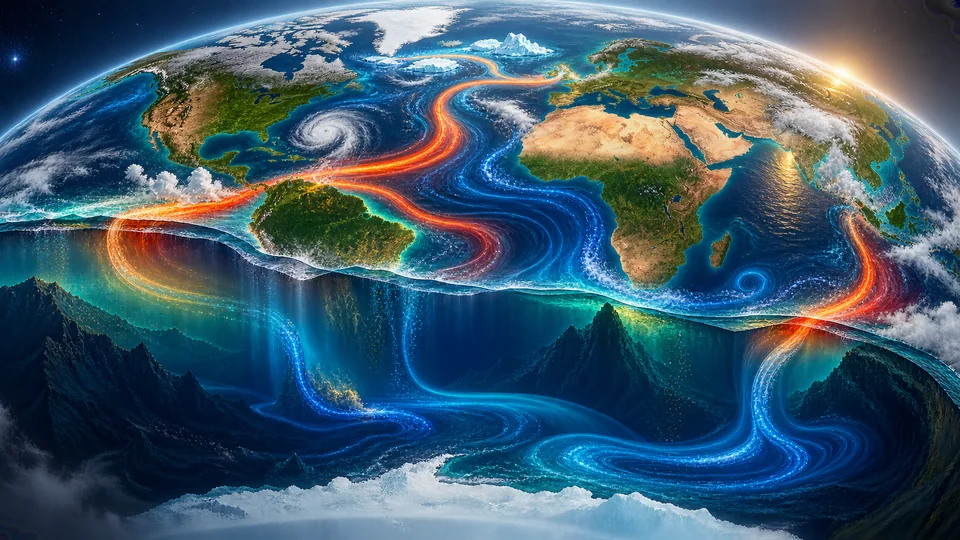
Ocean circulation spans turbulent centimetre-scale mixing, basin-scale gyres and a global overturning system. Surface winds drive currents that are deflected by Earth's rotation, while differences in temperature and salinity create density gradients. Dense water formed at high latitudes can sink and spread through the deep ocean before returning toward the surface elsewhere.
Technical foundations
Large-scale ocean motion follows conservation of momentum, mass, heat and salt under rotation and stratification. Away from boundaries, horizontal pressure gradients can balance the Coriolis force, producing geostrophic flow. Wind-stress curl drives Sverdrup transport in basin interiors, and narrow western boundary currents close gyre circulation through frictional and nonlinear processes. Buoyancy loss at high latitudes forms dense waters, while diapycnal mixing permits deep water to cross density surfaces. Mesoscale eddies transfer heat, salt and momentum and frequently oppose the mean overturning induced by winds.
How it works
Wind stress transfers momentum into the upper ocean and generates Ekman transport, convergence and upwelling. Pressure gradients and the Coriolis effect support approximately geostrophic currents. In the interior, water masses follow pathways shaped by topography and mixing; tides and breaking internal waves supply energy that helps return deep water upward.
Measurement and research methods
Observations combine satellite altimetry, sea-surface temperature and gravity with drifting floats, moorings, ship sections and autonomous vehicles. Argo profiles temperature and salinity through the upper ocean, while specialised floats extend sampling into deep and ice-covered regions. Current meters and acoustic instruments measure velocity; transient tracers constrain ventilation age. State-estimation systems assimilate heterogeneous data into dynamical models. Heat and freshwater budgets require careful treatment of reference levels, unresolved mixing and sampling aliases, especially where narrow currents or intermittent convection dominate transport.
Key ideas
- The global overturning circulation is a connected three-dimensional flow, not a single rigid conveyor belt.
- Heat transport depends on both mean currents and variable eddies.
- Salinity, sea ice, precipitation and freshwater input influence density alongside temperature.
Current research frontier
Research examines changes in the Atlantic overturning circulation, Southern Ocean upwelling, boundary-current shifts and ocean uptake of anthropogenic heat and carbon. High-resolution models resolve more eddies but remain limited in their treatment of small-scale mixing, ice-ocean interaction and bathymetric roughness. Paleoclimate proxies extend evidence beyond instrumental records, although dating and proxy interpretation add uncertainty. Forecasts increasingly combine physics-based ensembles with machine learning for parameterisation and data reconstruction. Detecting a forced trend requires separating it from decadal variability and recognising that different observational indices may represent different parts of a three-dimensional circulation.
Why it matters
Circulation moderates regional climate, ventilates the deep ocean and controls access to nutrients and oxygen. It also determines how rapidly anthropogenic heat and carbon dioxide enter and move through the ocean.
Limits and open questions
Sparse observations and internal variability make long-term trends difficult to estimate. Freshwater forcing and warming may alter overturning, but regional consequences depend on atmospheric feedbacks, eddies, mixing and model resolution rather than one circulation index alone.
Explore through connected concepts
This article is indexed with 20 technical tags. Select a tag to explore the Wiki by concept.
You may also explore
Recommended from the technical tags shared with this article.
Climate Feedback Loops
Processes that amplify or reduce an initial change in Earth's climate system.
Read article →