Permafrost Carbon Feedback
The climate interaction in which thaw exposes frozen organic matter to decomposition and releases additional greenhouse gases.
- Revision
- 1
- Created by
- SCIENDIA Knowledge Desk
- Updated by
- SCIENDIA Knowledge Desk
- Last updated
- 18.08.2026 14:57
Built by the community
Members can improve this article. Every saved change remains visible in the revision ledger.
Overview
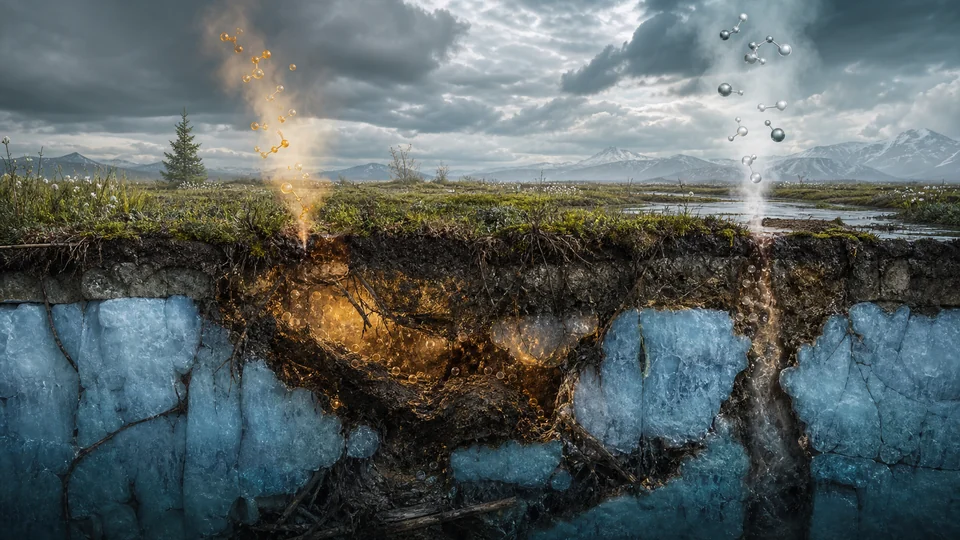
Permafrost soils store organic carbon accumulated over long periods because cold and frozen conditions slow decomposition. Warming deepens the seasonally thawed active layer and can trigger ground collapse, erosion, wildfire and abrupt lake formation. Once previously frozen material becomes biologically available, microbes convert part of it to carbon dioxide or methane, reinforcing climate warming.
Technical foundations
Permafrost is ground remaining at or below zero degrees Celsius for at least two consecutive years, but thermal state depends on snow insulation, vegetation and soil properties. Ice wedges and pore ice can occupy large volume; melting causes subsidence and alters drainage. Organic matter ranges from recent surface inputs to deeply buried Pleistocene deposits. Decomposition rate follows temperature, substrate quality and oxygen. Methanogens operate under anoxic conditions, while methane oxidation in soil and water consumes part of the produced gas before atmospheric release.
How it works
Heat moves through snow, vegetation, soil and ice-rich ground, while hydrology controls oxygen availability and transport. Aerobic decomposition favours carbon dioxide; waterlogged anoxic conditions can produce methane. Field chambers, eddy-covariance towers, boreholes, remote sensing and radiocarbon measurements quantify fluxes and carbon age. Land models couple thaw, vegetation, fire and microbial kinetics to estimate regional feedback.
Measurement and research methods
Borehole temperature records, active-layer grids and electrical or seismic geophysics track thaw. Eddy covariance integrates net ecosystem exchange over a footprint, chambers resolve small patches and radiocarbon distinguishes old carbon from contemporary plant respiration. Aircraft and satellites map thermokarst, fire scars and methane hotspots but require ground validation. Incubations parameterise microbial response, while land models represent soil layers, hydrology and snow. Upscaling must preserve landscape fractions because wetlands, drained slopes and eroding coasts have fundamentally different fluxes.
Key ideas
- Permafrost carbon release is a gradual and heterogeneous feedback, not a single instantaneous global pulse.
- Methane has strong near-term warming influence, while carbon dioxide persists through different carbon-cycle timescales.
- Ground ice, drainage and disturbance determine whether warming produces dry decomposition or wet thermokarst.
Current research frontier
The research frontier adds abrupt thaw, wildfire and lateral carbon transport to Earth-system models that historically emphasised gradual active-layer deepening. Snow and shrub changes can either warm or cool soil seasonally. Methane emissions from lakes depend on ebullition that sparse sampling can miss. Key uncertainties include deep carbon accessibility, post-thaw plant productivity and regional hydrology. Observational networks need winter measurements because cold-season emissions are nonzero. Permafrost feedback does not remove human agency: every avoided increment of warming reduces exposed carbon, even though some committed thaw and long recovery times make the response partly irreversible on policy timescales.
Why it matters
Including permafrost improves remaining-carbon-budget estimates and guides northern infrastructure and ecosystem planning. Observations also reveal where abrupt thaw creates impacts that coarse global models may miss.
Limits and open questions
Carbon inventories and deep-soil processes remain uncertain across vast inaccessible regions. Vegetation growth can offset some losses but not uniformly, and models differ in hydrology and abrupt thaw. Local adaptation reduces damage but only broad emission reductions limit the warming that drives the feedback.
Explore through connected concepts
This article is indexed with 20 technical tags. Select a tag to explore the Wiki by concept.
You may also explore
Recommended from the technical tags shared with this article.
Climate Feedback Loops
Processes that amplify or reduce an initial change in Earth's climate system.
Read article →