Photonic Quantum Computing
Quantum information processing that encodes, transforms and measures qubits in individual photons and optical modes.
- Revision
- 1
- Created by
- SCIENDIA Knowledge Desk
- Updated by
- SCIENDIA Knowledge Desk
- Last updated
- 19.08.2026 09:05
Built by the community
Members can improve this article. Every saved change remains visible in the revision ledger.
Overview
Photonic quantum computing uses light as a carrier of quantum information. Qubits may be encoded in path, polarisation, time bin or photon number, while continuous-variable systems use field quadratures. Photons interact weakly with the environment and travel readily through fibre, making them natural for networking, but the same weak interaction makes deterministic two-qubit gates difficult.
Technical foundations
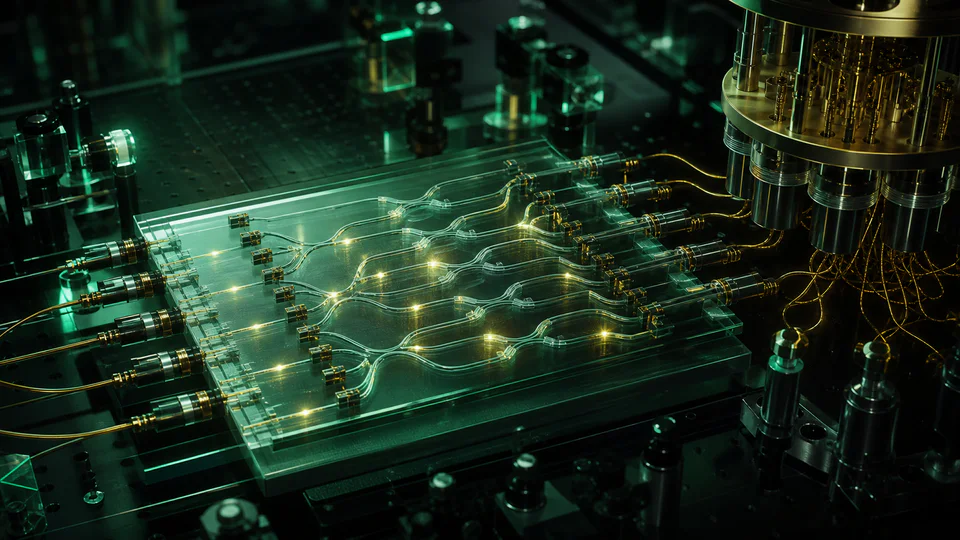
A single photon distributed across two paths provides a dual-rail qubit, while time-bin and polarisation encodings use other orthogonal modes. Beam splitters and phase shifters implement linear transformations of creation operators. Two indistinguishable photons incident on a balanced beam splitter exhibit Hong-Ou-Mandel interference, a foundational resource for entangling measurements. Because passive optics alone does not create a deterministic photon-photon interaction, architectures use measurement-induced nonlinearities, multiplexed entangled-state sources or continuous-variable cluster states. Error-correcting codes are designed around erasure-like photon loss and operational noise.
How it works
Sources create single photons or entangled optical states, interferometers implement unitary transformations and number-resolving detectors convert optical outcomes into classical records. Measurement-based architectures first prepare a large entangled cluster state and then perform adaptive measurements. Linear-optical protocols obtain effective interactions through interference, ancillary photons and feed-forward, whereas specialised emitters or nonlinear materials can provide stronger deterministic operations.
Measurement and research methods
Sources are characterised by brightness, heralding efficiency, multiphoton contamination and indistinguishability across repeated emissions. Integrated circuits are tested with classical light before quantum process tomography or stabiliser measurements. Superconducting nanowire detectors report efficiency, timing jitter, dark counts and number resolution. Experiments measure total transmission from source through packaging to detector rather than quoting isolated component records. Large circuits need active phase locking, low-latency electronics and time-tagged data analysis that verifies interference visibility and accounts for distinguishability and drift.
Key ideas
- Indistinguishability in spectrum, arrival time and polarisation is essential for high-visibility quantum interference.
- Photon loss is an error that must be detected and corrected rather than treated as ordinary attenuation.
- Scalability depends on sources, switching, interferometric stability, detectors and packaging as one integrated system.
Current research frontier
The frontier combines deterministic quantum emitters, low-loss silicon or compound-semiconductor photonics, fast switches and cryogenic control. Fusion-based schemes build large resource states from smaller entangled components and tolerate failed probabilistic operations through graph-state structure. Boson-sampling devices probe specialised distributions, while fault-tolerant roadmaps target universal logical gates. Open questions include the most resource-efficient loss code, manufacturable coupling between dissimilar materials and whether end-to-end photonic systems can maintain source uniformity and feed-forward performance across millions of modes.
Why it matters
Optical platforms can operate at room temperature in parts of the system and connect processors over existing communications infrastructure. They support quantum networking, secure communications, sampling experiments and potential fault-tolerant computation with architectures tailored to photon loss.
Limits and open questions
Probabilistic generation, coupling loss, detector inefficiency and optical drift compound rapidly as circuits grow. Error-corrected machines require large entangled resources and fast feed-forward. Claims of advantage depend on a clearly defined task and classical baseline, while practical systems must also integrate cryogenic detectors, low-loss switching and manufacturable photonics.
Explore through connected concepts
This article is indexed with 20 technical tags. Select a tag to explore the Wiki by concept.
You may also explore
Recommended from the technical tags shared with this article.
Quantum Computing
Computation that controls quantum states to process information using interference, entanglement and measurement.
Read article →