Quantum Entanglement
How composite quantum systems exhibit correlations that cannot be reproduced by classical local models.
- Revision
- 2
- Created by
- SCIENDIA Knowledge Desk
- Updated by
- SCIENDIA Knowledge Desk
- Last updated
- 17.08.2026 18:43
Built by the community
Members can improve this article. Every saved change remains visible in the revision ledger.
Overview
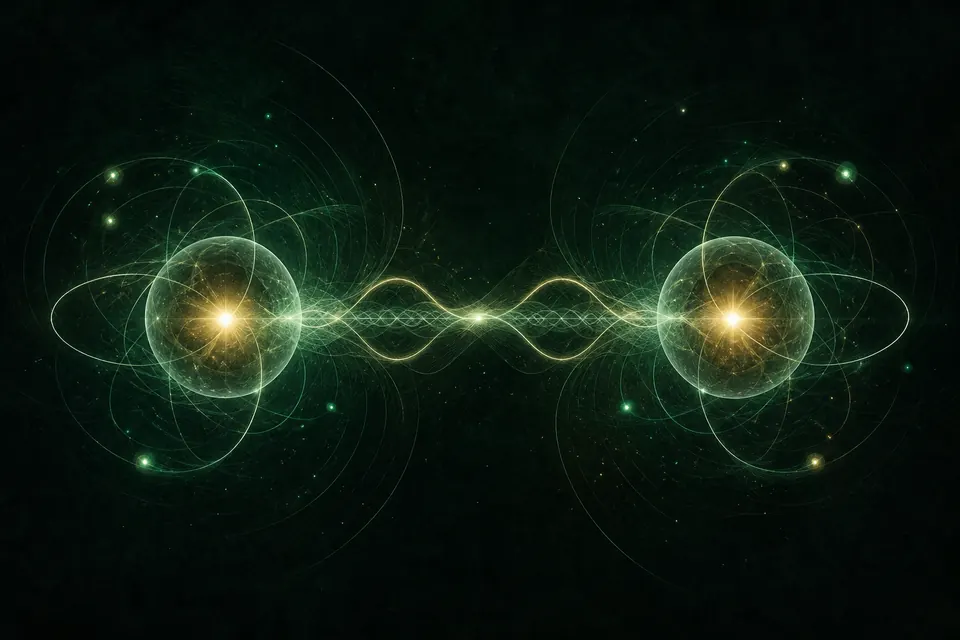
Quantum entanglement occurs when the state of a composite system cannot be written as independent states for its parts. Measurements on the parts can then display correlations stronger than any classical theory based on local hidden variables permits.
Technical foundations
Mathematically, a pure bipartite state is entangled when its state vector cannot be factorised as a tensor product of states assigned to the two subsystems. The Schmidt decomposition makes this criterion explicit: more than one non-zero Schmidt coefficient implies entanglement. For mixed states, the density operator must be tested for whether it can be written as a convex mixture of product states. Entanglement entropy, concurrence, negativity and related quantities describe different aspects of this non-classical resource, while reduced density matrices encode the locally accessible statistics.
How it works
An entangled state is prepared through an interaction or a shared quantum process. When observers choose measurement settings, quantum theory predicts a joint probability distribution for their outcomes. Bell tests compare those correlations with bounds obeyed by local realistic models; repeated experiments have found violations consistent with quantum mechanics.
Measurement and research methods
Experimental platforms create entanglement through controlled interactions, common emission processes or measurement-induced protocols. Verification may use full quantum-state tomography, an entanglement witness or violation of a Bell inequality such as CHSH. A valid Bell test requires independently selected measurement settings, space-like separation when locality is tested, high detection efficiency and a statistical analysis that does not assume identically distributed trials without justification. Decoherence is characterised through visibility, fidelity, purity and process-tomography measurements, with calibration errors included in the uncertainty model.
Key ideas
- Entanglement describes a joint quantum state, not a signal travelling between particles.
- Measurement outcomes are individually random even when their correlations are highly structured.
- The resource can be distributed, transformed and consumed in quantum-information protocols.
Current research frontier
Current research studies multipartite entanglement, network distribution and fault-tolerant manipulation under realistic noise. Monogamy restricts how strongly one system can share certain correlations with several partners, an important property for cryptographic security. Entanglement distillation trades several noisy pairs for fewer higher-fidelity pairs, while quantum repeaters combine storage, swapping and purification to extend range. Open problems include scalable certification of large many-body states, device-independent protocols with practical rates, and determining which forms of entanglement provide a demonstrable computational or metrological advantage in a specified physical architecture.
Why it matters
Entanglement underlies quantum teleportation, device-independent security, precision sensing and many quantum-computing advantages. It also provides one of the clearest experimental boundaries between classical intuition and quantum theory.
Limits and open questions
Entanglement does not enable faster-than-light communication. Real devices also lose useful coherence through noise and interaction with the environment, so creating and verifying large entangled systems remains technically demanding.
Explore through connected concepts
This article is indexed with 20 technical tags. Select a tag to explore the Wiki by concept.
You may also explore
Recommended from the technical tags shared with this article.
Quantum Computing
Computation that controls quantum states to process information using interference, entanglement and measurement.
Read article →