Social Network Analysis
The quantitative study of relationships among people, organisations or communities and how network structure shapes social processes.
- Revision
- 1
- Created by
- SCIENDIA Knowledge Desk
- Updated by
- SCIENDIA Knowledge Desk
- Last updated
- 19.08.2026 09:05
Built by the community
Members can improve this article. Every saved change remains visible in the revision ledger.
Overview
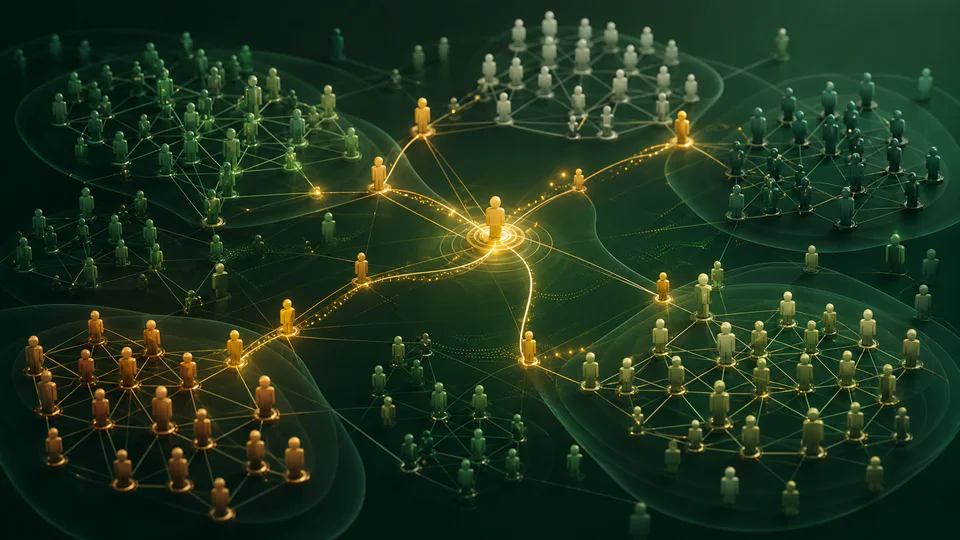
Social network analysis represents actors as nodes and relationships as edges. The relation may encode communication, friendship, collaboration, trade or observed interaction, and it can be directed, weighted, signed or time-varying. Network structure affects access to information, diffusion, coordination and inequality but does not determine behaviour independently of institutions and individual choices.
Technical foundations
A graph may contain several relation layers and attributes on nodes and edges. Degree counts immediate ties, betweenness measures participation in shortest paths and eigenvector-like scores weight connection to already central nodes. Clustering describes closed triads, while modularity and statistical block models identify community structure under different assumptions. Exponential random graph models represent local dependence in a cross-section, and stochastic actor-oriented or relational-event models describe network change over time.
How it works
Analysts construct networks from surveys, archives, digital traces or administrative data, then examine degree, centrality, clustering, communities and paths. Statistical network models test tie formation while accounting for dependence between edges. Diffusion studies trace adoption or exposure over time, and causal designs attempt to distinguish peer influence from homophily and shared environments.
Measurement and research methods
Network data collection defines a population boundary, relation meaning and observation window before analysis. Surveys can capture perceived ties but suffer recall and nonresponse; digital logs are precise about recorded actions but omit unobserved channels. Sensitivity analysis examines missing nodes and alternative edge thresholds. Diffusion studies need timestamps and exposure definitions, while experiments or credible instruments help identify peer effects. Results report uncertainty and avoid selecting one centrality measure after seeing which ranking appears most persuasive.
Key ideas
- A missing or misclassified tie can change centrality and community results, especially in incomplete networks.
- Correlation between connected people does not by itself prove social influence.
- Platform-generated networks reflect product design, ranking and data-access rules as well as human relations.
Current research frontier
Research analyses multiplex networks linking online and offline relationships, dynamic communities and interactions between network position and algorithmic recommendation. Privacy-preserving computation may permit aggregate analysis across organisations. Intervention studies test seeding, peer support and misinformation correction while monitoring spillovers and inequity. Open challenges include causal inference under interference, representative sampling when platform access is restricted and modelling strategic actors who change behaviour because they know the network is being measured.
Why it matters
Network analysis helps study collaboration, epidemics, political communication, labour markets and knowledge diffusion. It can identify structural bottlenecks, underserved groups and intervention pathways that individual-level data alone do not reveal.
Limits and open questions
Privacy risk is high because relationship patterns can re-identify people even after names are removed. Sampling boundaries are often arbitrary, digital traces exclude offline ties and centrality can be misused as a measure of importance. Ethical work requires data minimisation, contextual interpretation and protection against interventions that unfairly target communities.
Explore through connected concepts
This article is indexed with 20 technical tags. Select a tag to explore the Wiki by concept.
You may also explore
Recommended from the technical tags shared with this article.
Artificial Neural Networks
Layered computational models that learn distributed representations by adjusting weighted connections from data.
Read article →