Stellar Nucleosynthesis
The production and transformation of atomic nuclei through fusion, capture and decay processes inside stars and stellar explosions.
- Revision
- 1
- Created by
- SCIENDIA Knowledge Desk
- Updated by
- SCIENDIA Knowledge Desk
- Last updated
- 18.08.2026 12:20
Built by the community
Members can improve this article. Every saved change remains visible in the revision ledger.
Overview
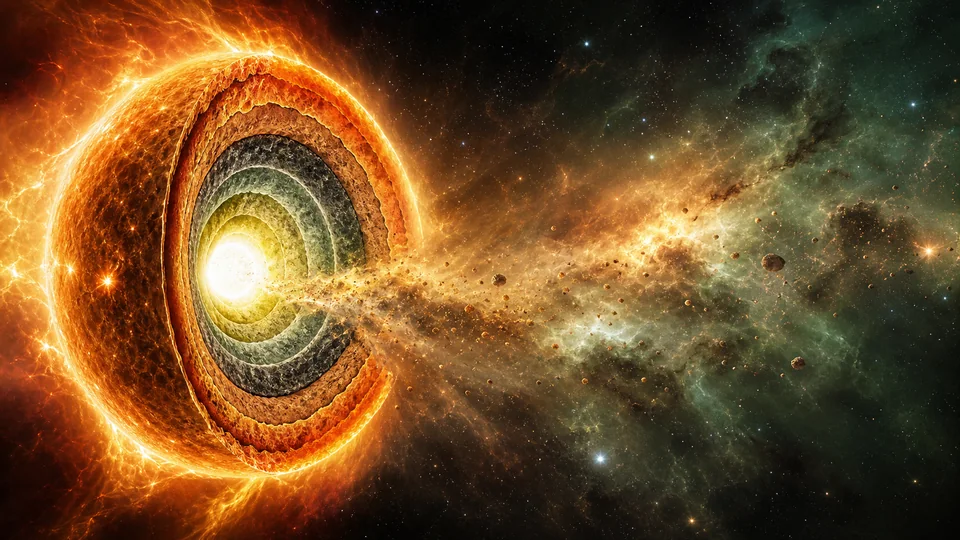
Stars convert light nuclei into heavier species as temperature and density open successive reaction pathways. Hydrogen and helium burning power most stellar lifetimes, while evolved massive stars build layered shells that synthesize nuclei toward the iron group before collapse.
Technical foundations
Stellar reaction networks couple isotope abundances through thermonuclear rates. Hydrogen burning proceeds through proton-proton chains or catalytic carbon-nitrogen-oxygen cycles, while helium burning combines three alpha particles into carbon and adds alpha captures. Massive stars later burn carbon, neon, oxygen and silicon under increasing temperature until nuclear statistical equilibrium favours iron-group nuclei. Because fusion beyond iron consumes energy, further heavy-element production relies largely on neutron capture, proton-rich pathways and explosive nonequilibrium reactions.
How it works
Charged nuclei tunnel through electrostatic barriers and react at rates set by temperature, density and quantum resonances. Slow and rapid neutron capture extend synthesis beyond iron. Convection and explosive shocks transport material across burning zones, and winds or supernova ejecta return enriched matter to galaxies.
Measurement and research methods
Laboratory accelerators measure cross sections near the Gamow energy window, often extrapolating from higher energies with theoretical models. Stellar spectroscopy derives elemental abundances from absorption lines using atmosphere models, while presolar grains and meteorites preserve isotopic anomalies. Neutrino observations probe core reactions directly. Evolution codes combine nuclear networks with convection, rotation and mass loss, then yield tables feed galactic chemical-evolution models. Uncertainty studies vary reaction rates and mixing prescriptions to identify which measurements most strongly affect predicted abundance ratios.
Key ideas
- Nuclear binding energy determines which reactions release or consume energy.
- Element yields depend on stellar mass, composition, mixing and mass loss.
- Heavy-element abundance patterns preserve evidence of multiple astrophysical sites.
Current research frontier
Current research locates rapid neutron-capture production among neutron-star mergers and selected stellar explosions, and studies whether multiple sites contribute across cosmic time. Multimessenger observations connect kilonova spectra, gravitational waves and radioactive heating. Three-dimensional simulations challenge one-dimensional mixing and explosion prescriptions, while rare-isotope facilities measure nuclei far from stability. Major uncertainties include convective boundary mixing, supernova engine dynamics and key short-lived nuclear properties. Future abundance surveys may reconstruct how early stellar generations enriched galaxies before direct observations were possible.
Why it matters
Nucleosynthesis explains the cosmic origin of the elements in planets, organisms and technology. Abundance measurements also probe stellar interiors, supernova mechanisms and the chemical evolution of galaxies.
Limits and open questions
Many key reaction rates remain uncertain at stellar energies, while mixing and explosion physics are difficult to simulate. Observed abundances combine several generations of sources, complicating assignment of one isotope to one event class.
Explore through connected concepts
This article is indexed with 20 technical tags. Select a tag to explore the Wiki by concept.
You may also explore
Recommended from the technical tags shared with this article.

Black Hole Accretion Disks
Rotating, heated flows of matter that release energy while spiralling toward a black hole.
Read article →