Axion Dark Matter Searches
Experiments that test whether extremely light, weakly interacting axions or axion-like particles constitute the unseen matter in galaxies.
- Revision
- 1
- Created by
- SCIENDIA Knowledge Desk
- Updated by
- SCIENDIA Knowledge Desk
- Last updated
- 19.08.2026 09:05
Built by the community
Members can improve this article. Every saved change remains visible in the revision ledger.
Overview
Axions were proposed to explain why the strong nuclear interaction appears to preserve charge-parity symmetry far more accurately than expected. The same particle could have been produced non-thermally in the early universe and survive as cold dark matter. Axion-like particles generalise this idea by allowing mass and coupling to vary more independently, creating a broad experimental search landscape.
Technical foundations
The quantum chromodynamics axion emerges when a dynamical angular field relaxes the effective strong-interaction charge-parity phase toward zero. Its mass and two-photon coupling are related for benchmark QCD axion families, whereas generic axion-like particles occupy a wider plane. In the Milky Way halo, a sufficiently light field behaves as a coherent classical oscillation with frequency set mainly by its rest mass and a linewidth determined by the local velocity distribution. In a static magnetic field, the axion-photon term permits conversion into an electromagnetic excitation whose frequency and spatial mode carry information about the field.
How it works
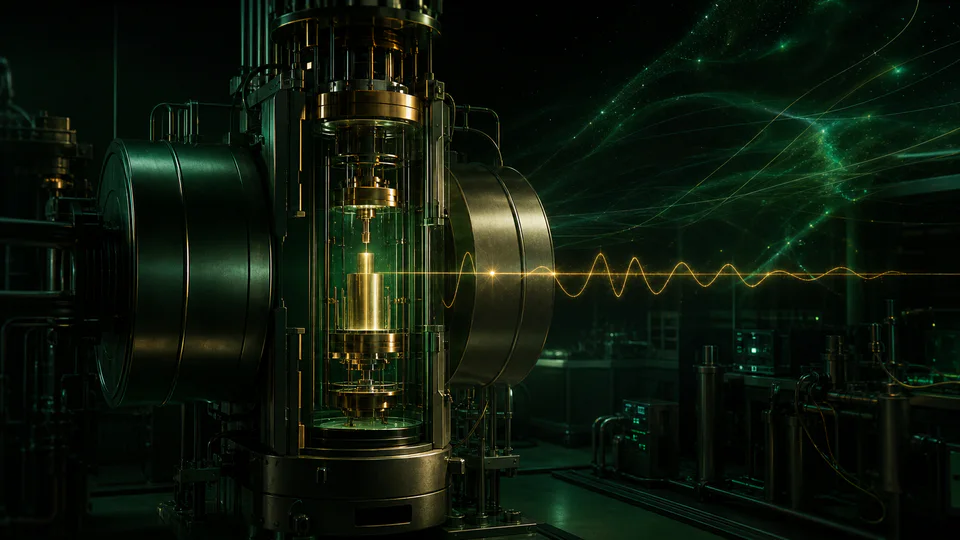
Most searches exploit a predicted conversion between axions and photons in a strong magnetic field. Resonant haloscopes seek microwave photons generated by galactic axions inside a tunable cavity, while dielectric and lumped-element detectors target other mass ranges. Helioscopes point magnets toward the Sun to search for axions produced in stellar plasma, and precision experiments test axion-induced spin precession or oscillating electromagnetic effects.
Measurement and research methods
A cavity haloscope tunes a high-quality-factor resonator through successive frequencies inside a strong magnet and amplifies the extracted microwave power with near-quantum-limited receivers. Calibration measures gain, noise and cavity coupling at each step, while synthetic signals test recovery efficiency. Broadband searches use toroidal pickups, dielectric layers, plasma resonators or dish antennas. Nuclear-magnetic-resonance approaches seek oscillating electric dipoles or spin torques. Candidate lines are rescanned under changed orientation, magnetic field or detector configuration and compared against environmental monitors and independent experiments.
Key ideas
- An axion signal is expected to be narrow in frequency because galactic dark matter moves non-relativistically.
- Sensitivity depends jointly on magnetic field, detector volume, noise temperature, observation time and frequency coverage.
- A candidate requires repeated detection and exclusion of radio interference, vibration and instrumental resonances.
Current research frontier
Research is extending searches to both lower masses, where detectors become physically large, and higher masses, where resonant volume shrinks. Squeezed quantum states, photon counting and superconducting sensors can surpass standard amplifier noise in selected regimes. Networks of detectors could test spatial coherence and transient axion structures. Astrophysical hints from stellar cooling guide targets but remain model-dependent. A discovery programme would need to map frequency, annual modulation, coherence and coupling channels, then compare the inferred local density with galactic dynamics and early-universe production scenarios.
Why it matters
Axion searches connect particle physics, cosmology, quantum measurement and radio engineering. A confirmed signal could identify the dominant matter component of galaxies and reveal a new fundamental field, while null results eliminate well-defined regions of mass-coupling parameter space.
Limits and open questions
The allowed parameter space spans many orders of magnitude, so no single apparatus can test it all. Quantum noise, magnet size, resonator tuning and environmental backgrounds constrain scan speed. Astrophysical limits rely on stellar modelling, and an axion-like discovery would still require measurements of its abundance and interactions before it could be identified as all dark matter.
Explore through connected concepts
This article is indexed with 20 technical tags. Select a tag to explore the Wiki by concept.
You may also explore
Recommended from the technical tags shared with this article.
Dark Matter
A name for the unseen gravitating component inferred from galaxies, clusters and the large-scale structure of the universe.
Read article →