Dark Matter
A name for the unseen gravitating component inferred from galaxies, clusters and the large-scale structure of the universe.
- Revision
- 2
- Created by
- SCIENDIA Knowledge Desk
- Updated by
- SCIENDIA Knowledge Desk
- Last updated
- 17.08.2026 18:43
Built by the community
Members can improve this article. Every saved change remains visible in the revision ledger.
Overview
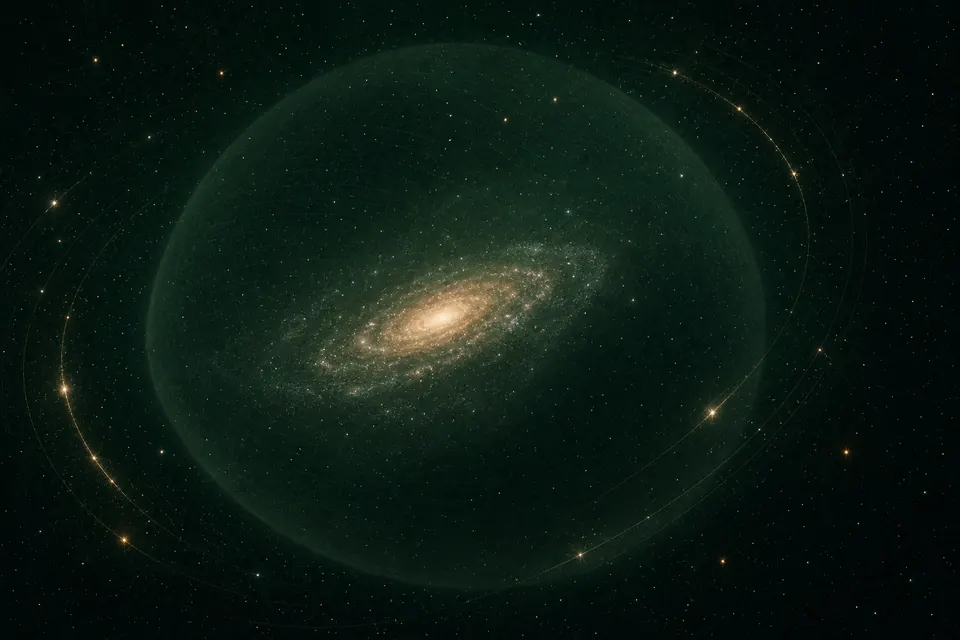
Dark matter is inferred because visible matter alone cannot account for many observed gravitational effects. Evidence includes galaxy rotation, gravitational lensing, cluster dynamics, the cosmic microwave background and the growth of cosmic structure.
Technical foundations
In the standard cosmological model, non-baryonic cold dark matter contributes most of the matter density and forms gravitational potential wells before ordinary gas cools into galaxies. Its abundance and clustering are constrained by acoustic features in the cosmic microwave background, baryon acoustic oscillations and growth of structure. On galactic scales, rotation curves and stellar dynamics probe enclosed mass; in clusters, gravitational lensing, galaxy velocities and hot-gas temperature provide independent estimators. A viable microscopic candidate must reproduce this combined evidence across many length scales.
How it works
In the standard cosmological picture, dark matter interacts strongly through gravity and only weakly, if at all, with light. Simulations begin with small density variations; dark matter collapses into halos that guide gas into the structures where galaxies form.
Measurement and research methods
Search strategies are complementary. Direct-detection experiments monitor low-background targets for nuclear or electronic recoils, calibrating thresholds, material response and neutrino backgrounds. Indirect searches look for photons, antiparticles or neutrinos from candidate annihilation or decay, requiring astrophysical models of density and conventional sources. Colliders test missing-momentum signatures under specified mediator models. Astronomical surveys use weak-lensing shear, strong-lensing substructure and stellar streams to constrain halo structure. Results are reported in parameter spaces whose assumptions must be stated explicitly rather than as model-independent exclusions.
Key ideas
- Dark matter is defined by converging gravitational evidence, not by optical darkness alone.
- Its microscopic identity is not established by the cosmological model.
- Alternative gravity models must explain the full set of observations, not only galaxy rotation curves.
Current research frontier
Candidates include weakly interacting massive particles, axions, sterile neutrinos, ultralight fields and compact objects over restricted mass ranges. Self-interacting dark matter may alter halo cores while retaining large-scale success, whereas warm species suppress formation below a free-streaming scale. Baryonic feedback can mimic some of these effects, creating degeneracies that require hydrodynamic simulations and multiple observations. Modified-gravity theories remain active alternatives but must fit lensing, cosmology and cluster collisions simultaneously. The key frontier is connecting a reproducible non-gravitational signal to the same component inferred astrophysically.
Why it matters
Mapping dark matter reveals how galaxies and clusters assemble and provides tests of cosmology and fundamental physics. Direct, indirect and collider searches explore candidate particles using complementary methods.
Limits and open questions
No proposed dark-matter particle has been conclusively detected. Small-scale galaxy observations, baryonic processes and measurement systematics complicate efforts to distinguish particle properties from astrophysical effects.
Explore through connected concepts
This article is indexed with 20 technical tags. Select a tag to explore the Wiki by concept.
You may also explore
Recommended from the technical tags shared with this article.
Gravitational Lensing
The deflection and magnification of light by curved spacetime around intervening mass distributions.
Read article →