Battery Electrochemistry
The coupled ion transport, electron transfer and materials transformations that store and release electrical energy in batteries.
- Revision
- 1
- Created by
- SCIENDIA Knowledge Desk
- Updated by
- SCIENDIA Knowledge Desk
- Last updated
- 18.08.2026 10:51
Built by the community
Members can improve this article. Every saved change remains visible in the revision ledger.
Overview
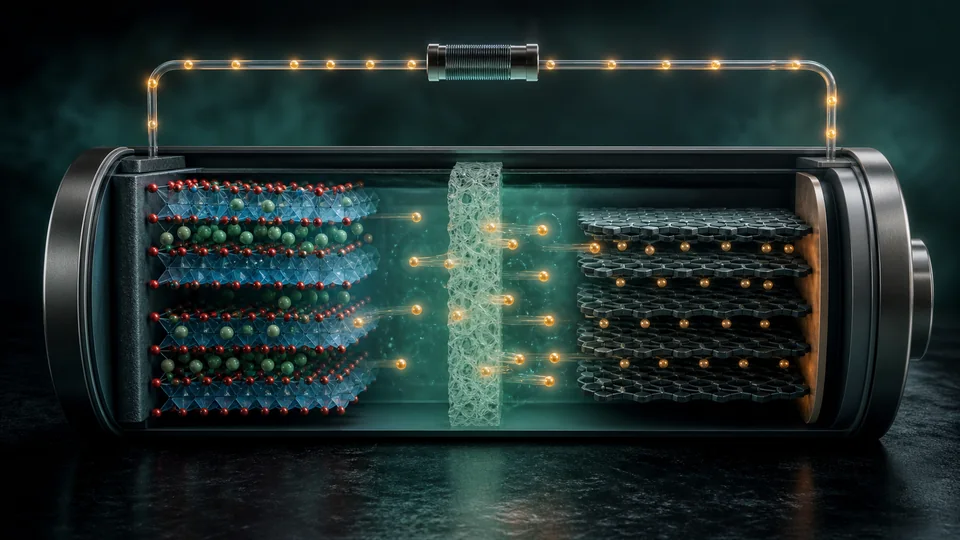
A rechargeable battery converts chemical free energy into electrical work through spatially separated redox reactions. During discharge, electrons travel through the external circuit while ions move through an electrolyte and separator to maintain charge balance. Charging applies an opposing voltage that drives the active materials toward a higher-energy state.
Technical foundations
Cell voltage reflects differences in electrochemical potential between electrodes. Intercalation materials store ions within host lattices, conversion materials form new phases and metal electrodes plate or strip. The Nernst equation describes equilibrium potential as a function of activity, while Butler-Volmer kinetics relates interfacial current to overpotential near equilibrium. Porous-electrode theory couples charge transfer with ionic transport, electronic conduction and solid diffusion across electrode thickness. Real particles develop concentration gradients and mechanical stress; phase transitions and anisotropic expansion can fracture material or disconnect it from conductive networks.
How it works
In a lithium-ion cell, lithium is inserted into or removed from host structures at the electrodes. Reaction kinetics at interfaces, solid-state diffusion, electrolyte conductivity and electronic transport jointly determine voltage and power. Protective interphases form from electrolyte decomposition and can stabilise operation while consuming inventory.
Measurement and research methods
Electrochemical characterisation includes galvanostatic cycling, cyclic voltammetry, pulse methods and impedance spectroscopy. Reference electrodes separate anode and cathode behaviour, while calorimetry measures heat generation. X-ray diffraction, spectroscopy, microscopy and neutron methods track structure and composition during operation, increasingly in operando. Capacity retention alone can hide rising resistance or lithium inventory loss, so degradation diagnosis combines voltage curves, coulombic efficiency, differential capacity and post-mortem analysis. Accelerated tests require validated models because high temperature or extreme rates may activate failure mechanisms absent in normal service.
Key ideas
- Cell capacity, energy, power, lifetime and safety are related but distinct performance dimensions.
- Measured voltage includes equilibrium thermodynamics plus kinetic, ohmic and transport losses.
- Electrode expansion, heat generation and side reactions couple electrochemistry to mechanics and thermal management.
Current research frontier
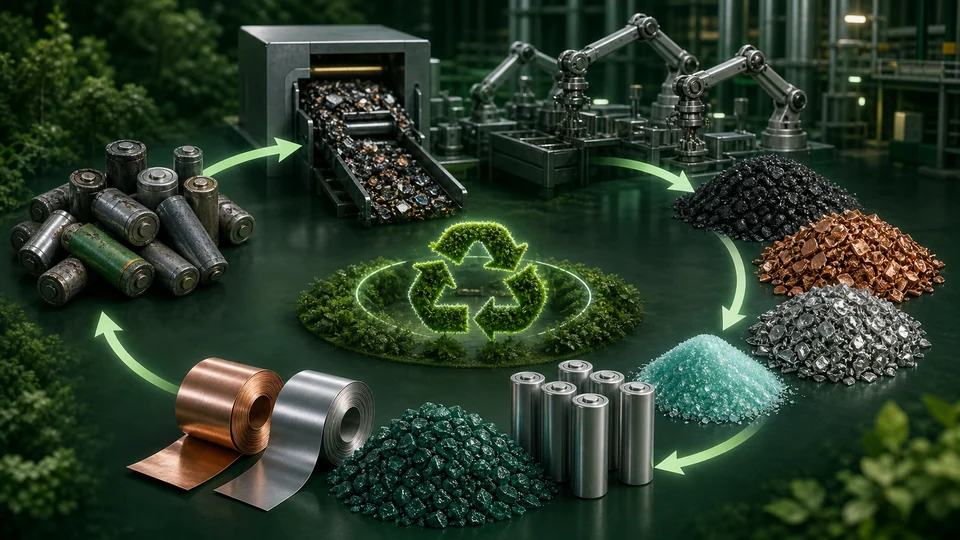
Research targets high-nickel and cobalt-reduced cathodes, silicon-rich anodes, lithium metal, solid electrolytes and sodium-ion alternatives. Fast charging requires coordinated electrode porosity, particle size, electrolyte, thermal control and charging protocol to avoid plating. Battery-management systems estimate state of charge, health and internal temperature from limited signals. Recycling strategies recover metals or preserve active-material value, and life-cycle assessment includes mining, manufacturing energy and service life. Remaining challenges include stable interfaces, dendrite prevention, thermal runaway propagation, manufacturable solid-solid contact and translating promising small cells into safe packs with reliable multi-year performance.
Why it matters
Better batteries enable electric transport, portable electronics and renewable-energy integration. Research connects atomic-scale materials chemistry with manufacturing, control systems, recycling and full life-cycle impacts.
Limits and open questions
Fast charging can accelerate lithium plating and heat generation, while high energy density may reduce abuse tolerance. Laboratory half-cell results do not directly predict commercial packs, where loading, balance, temperature variation and ageing histories differ.
Explore through connected concepts
This article is indexed with 20 technical tags. Select a tag to explore the Wiki by concept.
You may also explore
Recommended from the technical tags shared with this article.
Battery Recycling
Processes that recover materials and functional components from spent batteries for safe treatment and renewed production.
Read article →