Carbon Capture and Storage
The separation of carbon dioxide from concentrated sources or air followed by transport and long-term geological containment.
- Revision
- 1
- Created by
- SCIENDIA Knowledge Desk
- Updated by
- SCIENDIA Knowledge Desk
- Last updated
- 18.08.2026 12:20
Built by the community
Members can improve this article. Every saved change remains visible in the revision ledger.
Overview
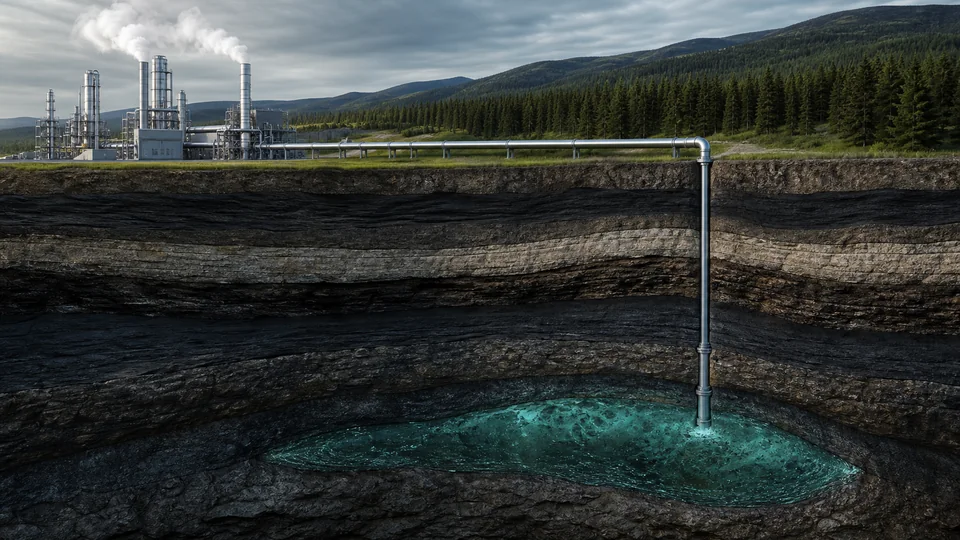
Carbon capture and storage aims to prevent selected emissions from reaching the atmosphere. Carbon dioxide is separated, compressed and injected into deep porous formations beneath sealing rock, where structural, residual, solubility and mineral trapping can retain it.
Technical foundations
Post-combustion capture commonly uses amine solvents that reversibly bind carbon dioxide, while pre-combustion systems separate carbon after gasification and oxy-fuel combustion produces a concentrated stream. Solid sorbents, membranes and calcium looping offer alternatives with different heat and impurity tolerance. Compression moves carbon dioxide into a dense supercritical-like state. In reservoirs, buoyancy drives upward migration until caprock, residual trapping and dissolution immobilise the plume; slower geochemical reactions can convert dissolved carbon into minerals.
How it works
Solvents, sorbents or membranes selectively remove carbon dioxide from gas streams. Pipelines or ships deliver a dense phase to injection wells. Reservoir pressure drives plume migration, while monitoring uses seismic, pressure, geochemical and atmospheric measurements to verify containment and update models.
Measurement and research methods
Site assessment combines seismic imaging, well logs, core measurements and pressure tests to estimate capacity and injectivity. Operators establish baseline groundwater and atmospheric conditions, then monitor plume and pressure with repeat seismic, downhole sensors, tracers and satellite deformation. Reservoir simulation predicts migration under parameter uncertainty and informs injection limits. Life-cycle analysis counts capture energy, upstream fuel, compression, transport and leakage risk to calculate net avoided emissions. Measurement, reporting and verification protocols define closure criteria and responsibility after injection ends.
Key ideas
- Capture rate and full-chain avoided emissions are different quantities.
- Storage capacity depends on injectivity, pressure and connected geology, not pore volume alone.
- Long-term stewardship requires monitoring, liability and corrective-action plans.
Current research frontier
Research lowers solvent regeneration energy, designs impurity-tolerant materials and optimises storage hubs shared by several emitters. Mineralisation in reactive rocks can accelerate permanent trapping but requires water and suitable formations. Direct-air capture paired with storage creates removal only when energy and supply-chain emissions are low. Open issues include pressure management across connected basins, long-term well integrity and equitable infrastructure siting. Deployment decisions should compare capture with process redesign, electrification and material substitution rather than assuming every facility should remain unchanged.
Why it matters
The technology may reduce emissions from cement, chemicals and other difficult industrial processes and can support durable carbon removal when paired with biomass or direct-air capture.
Limits and open questions
Capture consumes energy and increases cost, while transport networks and suitable storage are unevenly distributed. Leakage, induced seismicity, water use and community consent require site-specific governance, and the technology cannot substitute for all direct reductions.
Explore through connected concepts
This article is indexed with 20 technical tags. Select a tag to explore the Wiki by concept.
You may also explore
Recommended from the technical tags shared with this article.
Electrochemical Carbon Dioxide Reduction
The use of electricity, catalysts and electrochemical interfaces to convert carbon dioxide into chemical products.
Read article →