Electrochemical Carbon Dioxide Reduction
The use of electricity, catalysts and electrochemical interfaces to convert carbon dioxide into chemical products.
- Revision
- 1
- Created by
- SCIENDIA Knowledge Desk
- Updated by
- SCIENDIA Knowledge Desk
- Last updated
- 18.08.2026 14:57
Built by the community
Members can improve this article. Every saved change remains visible in the revision ledger.
Overview
Electrochemical carbon-dioxide reduction transfers electrons and protons to carbon dioxide at a cathode, producing carbon monoxide, formate, hydrocarbons or oxygenates depending on catalyst and conditions. When powered by low-carbon electricity, the process could connect captured carbon with chemical manufacturing, but climate benefit depends on efficiency, product lifetime and the source of every input.
Technical foundations
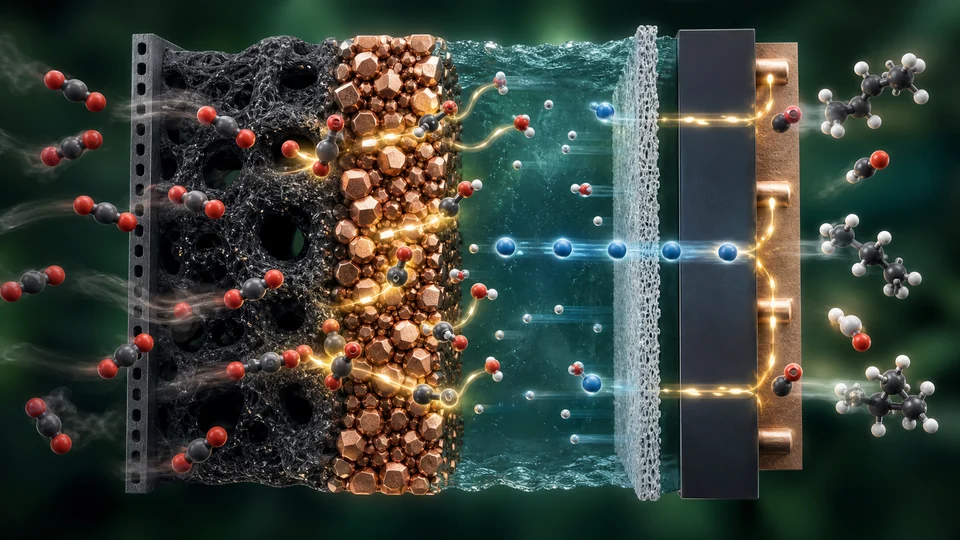
Carbon-dioxide reduction involves coupled electron and proton transfers through adsorbed intermediates. Metals bind these species differently: silver favours carbon monoxide, tin and bismuth often favour formate, and copper can form carbon-carbon bonds leading to ethylene or oxygenates. Applied potential changes driving force but also surface coverage and local pH. Gas-diffusion electrodes overcome low aqueous carbon-dioxide solubility by creating a three-phase boundary, yet flooding, salt precipitation and membrane dehydration can destabilise operation.
How it works
Carbon dioxide reaches catalytic sites through dissolved transport or a gas-diffusion layer. Intermediates adsorb, react and desorb while competing hydrogen evolution consumes charge. A membrane carries ions between cathode and anode, where oxidation balances electrons. Potential, local pH, catalyst morphology and mass transport determine selectivity. Product analysis and current measurement yield Faradaic efficiency, rate and energy efficiency.
Measurement and research methods
Gas chromatography, liquid chromatography, nuclear magnetic resonance and mass spectrometry quantify all products. Faradaic efficiencies should close near one hundred percent and be paired with partial current density, cell voltage, carbon balance and stability. Isotope-labelled carbon dioxide confirms product origin and detects contamination. Flow-cell studies track inlet and outlet carbon, including carbonate crossover and vented gas. Operando spectroscopy probes adsorbates and catalyst restructuring. Comparisons require geometric or electrochemically active area, temperature, pressure, electrolyte composition and uncompensated resistance.
Key ideas
- High selectivity at low current does not establish industrial productivity or low energy demand.
- Carbonate formation and crossover can move carbon through the cell without appearing in the desired product.
- Catalyst stability must be measured under realistic flow, impurity and duration conditions.
Current research frontier
Industrial research integrates tandem catalysts, membrane-electrode assemblies and downstream separation. Pulsed operation may control surface state, while alloying and nanostructure tune intermediate binding. The most credible targets have a clear market and can displace carbon-intensive chemistry with high conversion and product concentration. Open problems include anode durability, impurity tolerance and stable multicarbon production for thousands of hours. Systems analysis must compare direct electrolysis with alternative routes such as carbon monoxide production followed by thermochemical conversion and include renewable electricity availability, capture energy and fate of the product carbon.
Why it matters
The technology offers modular routes to carbon monoxide, formate and potentially multicarbon feedstocks while storing variable renewable electricity in chemical bonds. It also provides a controlled platform for studying catalytic reaction networks.
Limits and open questions
Durable multicarbon selectivity, single-pass carbon efficiency and product separation remain difficult. Full lifecycle value depends on capture, compression, electrolyte management and avoided conventional production. Short experiments and ideal feed gases can substantially overstate deployable performance.
Explore through connected concepts
This article is indexed with 20 technical tags. Select a tag to explore the Wiki by concept.
You may also explore
Recommended from the technical tags shared with this article.
Green Hydrogen Electrolysis
Production of hydrogen by splitting water with electricity whose life-cycle emissions are kept low through renewable energy and responsible system design.
Read article →