The Global Carbon Cycle
The movement of carbon among the atmosphere, oceans, living organisms, soils, rocks and Earth's interior.
- Revision
- 2
- Created by
- SCIENDIA Knowledge Desk
- Updated by
- SCIENDIA Knowledge Desk
- Last updated
- 17.08.2026 18:43
Built by the community
Members can improve this article. Every saved change remains visible in the revision ledger.
Overview
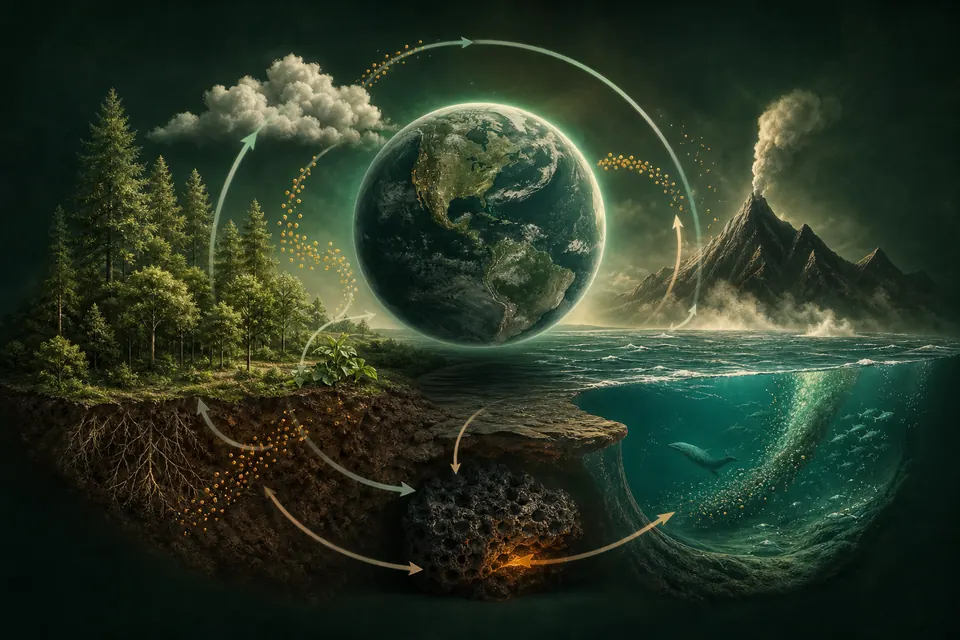
Carbon continually moves through reservoirs on timescales from hours to millions of years. Photosynthesis, respiration, decomposition, ocean exchange, weathering, sedimentation, volcanism and combustion all contribute to this connected system.
Technical foundations
The carbon cycle is quantified as reservoirs connected by gross and net fluxes. Atmospheric carbon dioxide exchanges rapidly with vegetation and the ocean surface, while soil organic matter, deep water, sediments and rocks store carbon over longer timescales. Ocean uptake combines gas exchange, carbonate chemistry, biological export and circulation. On land, gross primary production is offset by plant and microbial respiration. Silicate weathering and carbonate burial provide a slow climate-regulating feedback, whereas volcanism and metamorphism return geological carbon to the atmosphere-ocean system.
How it works
Fast exchanges link the atmosphere, upper ocean and biosphere. Slower geological processes store carbon in sediments and rocks. Human extraction and combustion of fossil carbon transfer material from long-term reservoirs into the active atmosphere-ocean system much faster than geological removal processes compensate.
Measurement and research methods
Researchers constrain fluxes using atmospheric concentration networks, carbon-isotope ratios, ocean surveys, eddy-covariance towers, forest inventories and satellite observations. Inverse models infer spatial sources and sinks from transport and concentration data, while Earth-system models couple biogeochemistry to climate. Carbon-13 helps separate terrestrial and fossil influences, and radiocarbon distinguishes recently exchanged carbon from old fossil sources. Budgets must reconcile independent estimates with uncertainty and avoid double counting. Local ecosystem uptake cannot be assumed permanent when fire, harvest, drought or land-use change can reverse it.
Key ideas
- A large gross exchange can coexist with a much smaller net flux.
- Land and ocean sinks absorb part, but not all, of human carbon emissions.
- Carbon storage durability differs greatly among forests, soils, oceans and rocks.
Current research frontier
Current research examines sink saturation, permafrost thaw, peatlands, ocean acidification and the durability of engineered removal. Warming changes respiration, stratification and nutrient supply, producing feedbacks whose magnitude varies by region and timescale. Carbon dioxide removal methods differ in additionality, leakage, monitoring and storage lifetime; a tonne temporarily stored in vegetation is not physically equivalent to mineralised carbon. Methane and other greenhouse gases interact with climate but require separate lifetimes and metrics. Reliable mitigation assessment therefore combines carbon accounting with energy, biodiversity, water and social constraints.
Why it matters
The carbon cycle regulates climate, ocean chemistry and biological productivity. Measuring sources and sinks supports climate attribution, budgeting and the evaluation of mitigation strategies.
Limits and open questions
Feedbacks can weaken or strengthen natural sinks as climate changes. Carbon accounting must distinguish temporary uptake from durable storage and avoid treating all carbon atoms or ecosystems as interchangeable.
Explore through connected concepts
This article is indexed with 20 technical tags. Select a tag to explore the Wiki by concept.
You may also explore
Recommended from the technical tags shared with this article.
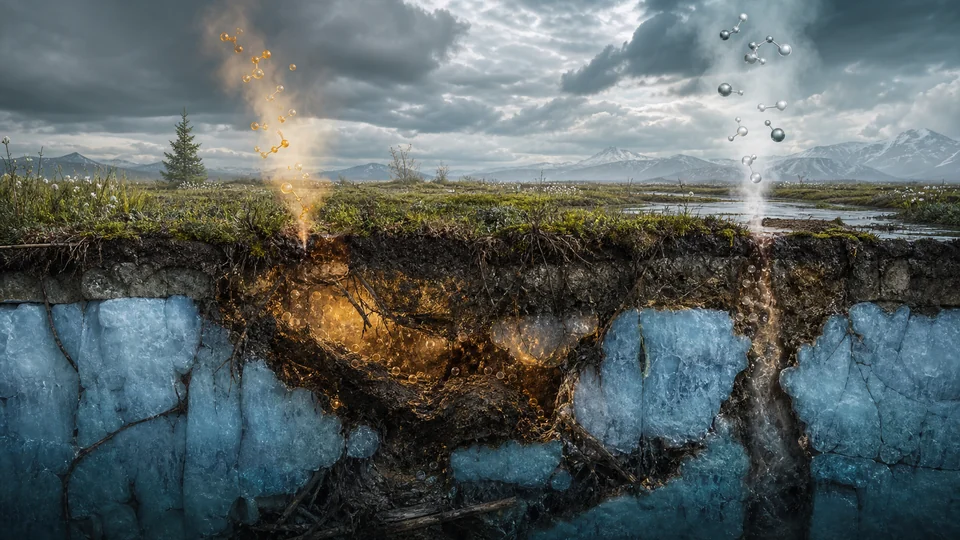
Permafrost Carbon Feedback
The climate interaction in which thaw exposes frozen organic matter to decomposition and releases additional greenhouse gases.
Read article →