Circadian Rhythms
Endogenous biological cycles near twenty-four hours that coordinate physiology and behaviour with environmental time.
- Revision
- 1
- Created by
- SCIENDIA Knowledge Desk
- Updated by
- SCIENDIA Knowledge Desk
- Last updated
- 18.08.2026 12:20
Built by the community
Members can improve this article. Every saved change remains visible in the revision ledger.
Overview
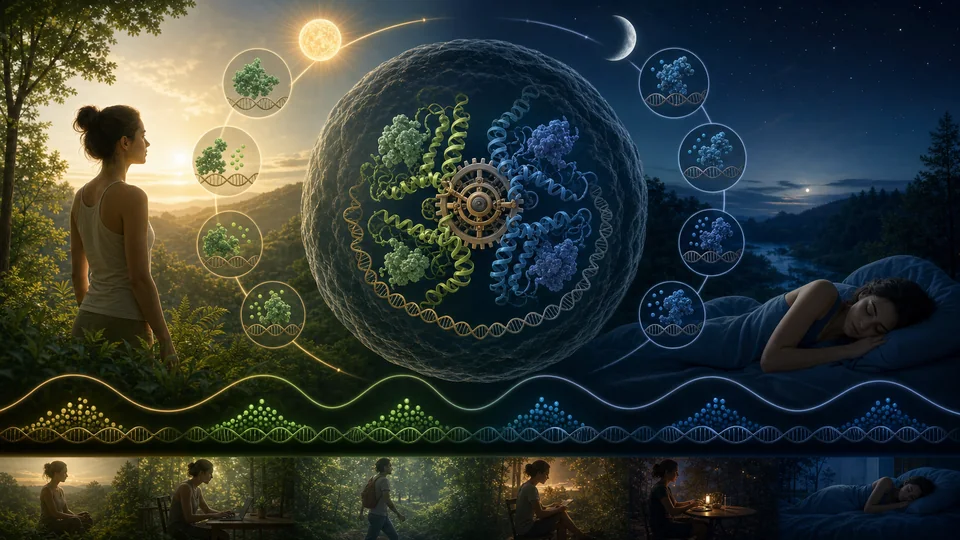
Circadian systems generate daily rhythms through molecular oscillators that continue without external cues but are reset by light, temperature, feeding and activity. Central and peripheral clocks coordinate sleep, metabolism, hormone release, immunity and tissue repair.
Technical foundations
Mammalian cellular clocks centre on transcription factors that activate Period and Cryptochrome genes; their protein products accumulate, enter the nucleus and repress the activating complex. Auxiliary loops regulate nuclear receptors and stabilise phase. Post-translational phosphorylation, ubiquitination and degradation set delay and period, while chromatin remodelling couples the oscillator to broad gene programmes. The suprachiasmatic nucleus coordinates systemic time through neural and hormonal signals, but liver, muscle and immune cells maintain locally entrainable clocks responsive to feeding and activity.
How it works
Transcriptional and translational feedback loops cause clock proteins to accumulate, inhibit their own production and later degrade. Photoreceptors and neural pathways adjust phase to local time. Coupling among cells improves stability, while tissue-specific signals align peripheral clocks with behaviour and nutrient availability.
Measurement and research methods
Circadian phase is measured with repeated melatonin, body-temperature or activity observations and with molecular reporters in cultured cells. Constant-routine and forced-desynchrony protocols separate endogenous rhythms from behavioural masking. Actigraphy estimates sleep-wake timing but is not a direct clock measurement. Transcriptomic time series require adequate sampling around the full cycle and models that distinguish oscillation from trends. Light interventions must report intensity, spectrum, duration and retinal timing, while clinical studies control prior sleep, caffeine, meals and individual chronotype.
Key ideas
- Circadian period is internally generated but environmental cues determine phase.
- Timing can alter biological response even when dose and composition are unchanged.
- Misalignment differs from simply sleeping fewer hours.
Current research frontier
Research investigates chronotherapy, metabolic timing and how ageing or inflammation alters clock coupling. Wearable sensors may enable personalised phase estimation, though behavioural proxies need biomarker validation. Shift-work interventions combine light, darkness, meal timing and schedule design rather than relying on one cue. Open questions include tissue-specific desynchrony, sex and genetic differences and causal pathways linking chronic misalignment to disease. Treatment claims require randomised outcomes because clock-correlated lifestyles and socioeconomic factors can confound observational associations.
Why it matters
Circadian biology informs shift-work policy, sleep medicine and the timing of drugs, meals and treatments. It provides a systems view connecting gene regulation with organism-level behaviour.
Limits and open questions
Laboratory schedules simplify irregular real-world light and social exposure. Individual chronotype, age and disease modify responses, and associations between timing and illness do not always establish whether circadian disruption is a cause or consequence.
Explore through connected concepts
This article is indexed with 20 technical tags. Select a tag to explore the Wiki by concept.
You may also explore
Recommended from the technical tags shared with this article.
Antibiotic Resistance
The inherited ability of microorganisms to survive or grow at drug concentrations that would normally inhibit them.
Read article →