Computational Protein Design
The algorithmic creation of amino-acid sequences expected to fold into structures with specified biochemical functions.
- Revision
- 1
- Created by
- SCIENDIA Knowledge Desk
- Updated by
- SCIENDIA Knowledge Desk
- Last updated
- 18.08.2026 11:13
Built by the community
Members can improve this article. Every saved change remains visible in the revision ledger.
Overview
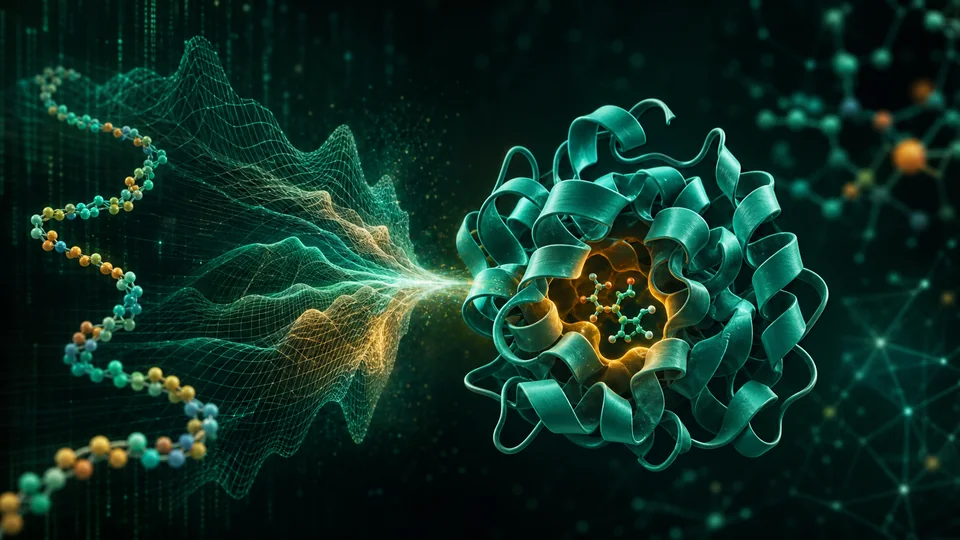
Computational protein design reverses the usual structure-prediction problem: instead of asking which structure a sequence adopts, it searches sequence and conformation space for molecules that satisfy geometric, energetic and functional constraints. Targets range from stable de novo folds to enzymes, binders, switches and therapeutic proteins.
Technical foundations
Protein design searches a combinatorial space in which each residue can adopt multiple amino-acid identities and side-chain conformations. Physics-inspired energy functions approximate van der Waals packing, solvation, electrostatics, hydrogen bonding and conformational entropy, while geometric constraints preserve catalytic or binding motifs. Rotamer libraries discretise side-chain states, and optimisation methods such as dead-end elimination, Monte Carlo search or integer programming identify low-energy sequences. Learned inverse-folding and diffusion models infer sequence-structure regularities from databases, but their probability scores are not identical to thermodynamic stability or biological function.
How it works
A design workflow defines a backbone or functional geometry, evaluates candidate sequences with physical energy functions or learned models and ranks structures by stability, specificity and manufacturability. Generative systems can propose backbones and sequences jointly, after which structure prediction, molecular simulation and experimental assays filter candidates through repeated design-build-test cycles.
Measurement and research methods
Evaluation proceeds through computational and experimental gates. Structure predictors test whether a designed sequence returns the intended fold with high confidence and without plausible alternative assemblies. Molecular dynamics probes local flexibility, interface hydration and kinetic stability, although accessible timescales remain limited. Genes are synthesised and expressed, then purified proteins are assessed with chromatography, mass spectrometry, circular dichroism, thermal denaturation and structural methods. Binding designs require kinetic and equilibrium measurements against intended and off-target partners; enzyme designs additionally need turnover, substrate scope and mechanistic controls rather than a single endpoint signal.
Key ideas
- A sequence must favour the intended fold over competing conformations and aggregates.
- Binding affinity is insufficient when specificity, kinetics and expression are not evaluated.
- Computational confidence does not replace biochemical validation under realistic conditions.
Current research frontier
The frontier joins generative backbone design, protein language models and laboratory automation in closed loops that learn from both successes and failures. Researchers build de novo cytokine mimics, membrane channels, molecular cages, biosensors and enzymes for reactions absent from natural metabolism. Multi-state design explicitly rewards a desired conformation while penalising off-target states, and active learning chooses experiments that reduce uncertainty efficiently. Open problems include predicting expression and aggregation, representing protonation and solvent networks, designing conformational switches and quantifying novelty-related risk. Responsible workflows screen sequences, document provenance and validate function before environmental or clinical use.
Why it matters
Designed proteins can create vaccines, diagnostics, catalysts, biomaterials and molecular tools that evolution has not supplied. They also provide controlled experiments for testing theories of folding, recognition and allostery.
Limits and open questions
Energy models approximate solvent, entropy and conformational dynamics, while training data overrepresent proteins that are easy to express and characterise. Many apparently plausible designs fail during synthesis, folding or functional testing, and safety must be assessed independently of novelty.
Explore through connected concepts
This article is indexed with 20 technical tags. Select a tag to explore the Wiki by concept.
You may also explore
Recommended from the technical tags shared with this article.
Protein Folding
The process by which an amino-acid chain acquires the three-dimensional structure needed for biological function.
Read article →