Gravitational Lensing
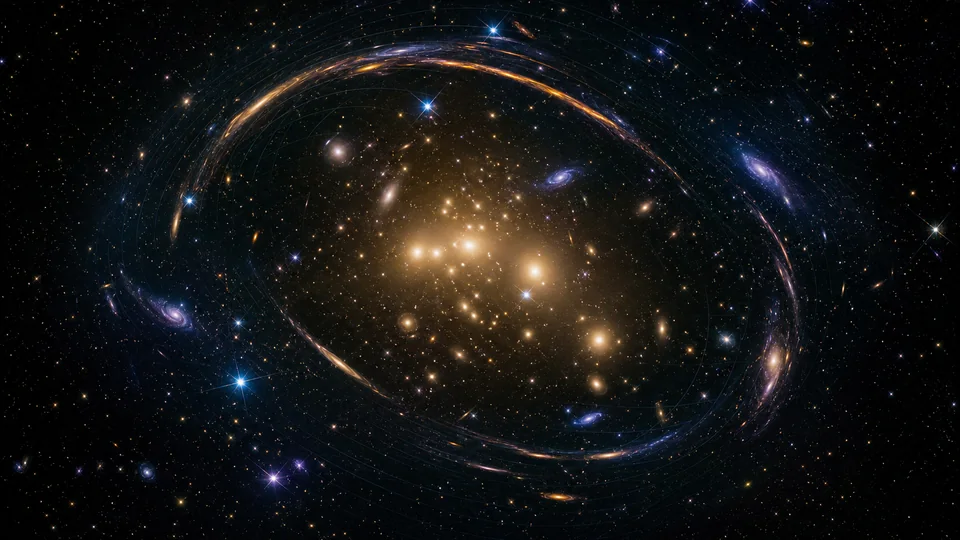
The deflection and magnification of light by curved spacetime around intervening mass distributions.
- Revision
- 1
- Created by
- SCIENDIA Knowledge Desk
- Updated by
- SCIENDIA Knowledge Desk
- Last updated
- 18.08.2026 11:13
Built by the community
Members can improve this article. Every saved change remains visible in the revision ledger.
Overview
Gravitational lensing occurs when matter between a source and observer bends light along multiple or distorted paths. Depending on alignment and mass, the effect produces separated images, arcs, Einstein rings, magnification or subtle coherent changes in the shapes of many background galaxies.
Technical foundations
In the thin-lens approximation, the lens equation relates image angle to source angle through a scaled deflection derived from the projected gravitational potential. The Jacobian of this mapping determines convergence, shear and magnification, while zeros of its determinant define critical curves whose source-plane counterparts are caustics. Axisymmetric alignment produces an Einstein radius that measures enclosed projected mass. Strong-lens systems form multiple images and arcs; weak lensing produces percent-level coherent ellipticity changes; microlensing is unresolved and identified through a characteristic magnification light curve as compact lenses move relative to background sources.
How it works
A lens model maps angular positions in the source plane to observed positions through a deflection field derived from projected mass. Strong lensing constrains mass with resolved multiple images, weak lensing extracts statistical shear from galaxy populations and microlensing follows time-variable magnification caused by compact objects crossing the line of sight.
Measurement and research methods
Strong-lens analysis fits image positions, surface-brightness structure and measured time delays with parametric or free-form mass models. Weak-lensing surveys estimate galaxy shapes after correcting the telescope point-spread function, detector effects and selection bias, then combine redshift distributions into tomographic shear correlations. Cluster studies integrate lensing with X-ray or dynamical data, while microlensing campaigns monitor dense stellar fields at high cadence. Synthetic image injection and blinded simulations calibrate pipelines. Bayesian inference propagates shape noise, photometric-redshift uncertainty and line-of-sight structure into mass or cosmological posteriors.
Key ideas
- Lensing responds to total projected mass whether or not that mass emits light.
- Image distortion is degenerate with intrinsic source shape and observational systematics.
- Time delays between images combine geometry, gravitational potential and cosmic expansion.
Current research frontier
Wide surveys are building mass maps over thousands of square degrees to test dark-energy models and the growth of structure. Time-delay cosmography uses variable quasars or supernovae to infer distance combinations sensitive to the Hubble constant, requiring detailed lens environments and stellar kinematics. Microlensing discovers cold exoplanets and constrains compact dark-matter populations, while natural magnification enables spectroscopy of very distant galaxies. Research targets mass-model degeneracies, baryonic feedback and intrinsic galaxy alignments. Cross-correlation with clustering, cosmic microwave background lensing and spectroscopy can break degeneracies and reveal residual systematic error.
Why it matters
Lensing maps dark matter, weighs galaxies and clusters, detects exoplanets and magnifies otherwise inaccessible distant sources. Cosmographic time delays and weak-lensing surveys provide independent constraints on the expansion and growth of cosmic structure.
Limits and open questions
Mass-sheet and source-position degeneracies can produce similar images from different mass models. Telescope point-spread functions, galaxy alignments, photometric-redshift errors and line-of-sight structure must be calibrated to prevent small biases from dominating precision cosmology.
Explore through connected concepts
This article is indexed with 20 technical tags. Select a tag to explore the Wiki by concept.
You may also explore
Recommended from the technical tags shared with this article.
Dark Matter
A name for the unseen gravitating component inferred from galaxies, clusters and the large-scale structure of the universe.
Read article →