Fusion Energy
The controlled release of nuclear binding energy by combining light nuclei under extreme temperature and confinement.
- Revision
- 1
- Created by
- SCIENDIA Knowledge Desk
- Updated by
- SCIENDIA Knowledge Desk
- Last updated
- 18.08.2026 10:51
Built by the community
Members can improve this article. Every saved change remains visible in the revision ledger.
Overview
Fusion energy research aims to reproduce selected reactions that power stars without relying on gravitational confinement. The most accessible terrestrial reaction combines deuterium and tritium, producing a helium nucleus, a neutron and 17.6 megaelectronvolts of kinetic energy. A power plant must create the plasma conditions for frequent fusion while recovering more useful energy than the complete facility consumes.
Technical foundations
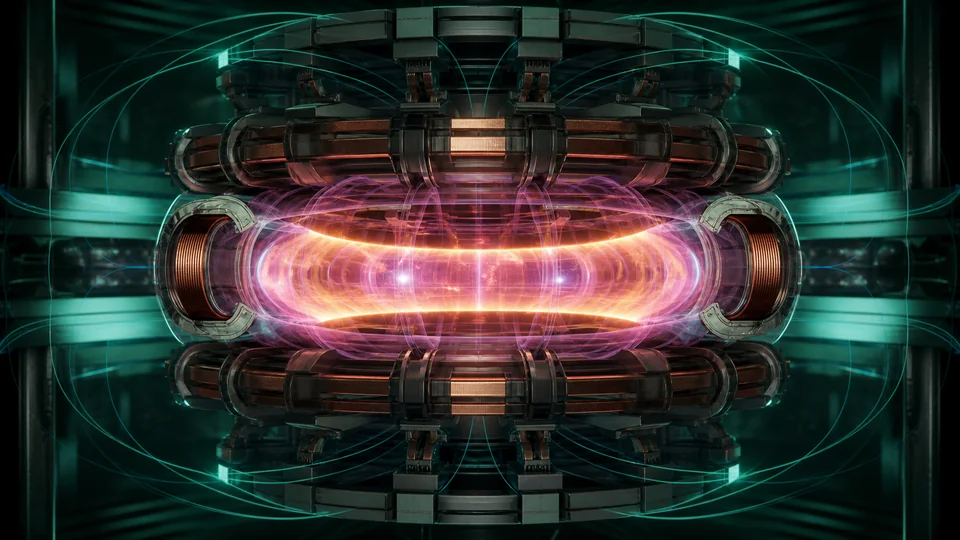
For a thermal deuterium-tritium plasma, reaction rate density is proportional to the product of the ion densities and the velocity-averaged fusion cross section. The Lawson criterion combines density, temperature and energy-confinement time into a threshold for self-heating. In a tokamak, nested magnetic flux surfaces are generated by external coils and plasma current; pressure gradients and current profiles must satisfy magnetohydrodynamic equilibrium while avoiding kink, tearing and edge-localised instabilities. Stellarators replace much of the plasma current with three-dimensional magnetic shaping, trading simpler steady-state operation for demanding coil and optimisation geometry.
How it works
In magnetic-confinement systems, strong toroidal and poloidal fields guide charged particles around a vacuum vessel while auxiliary heating raises the plasma above one hundred million kelvin. In inertial-confinement systems, lasers or particle beams compress a small fuel capsule rapidly enough that fusion occurs before the target disassembles. Both approaches must manage impurities, instabilities, heat exhaust and neutron damage.
Measurement and research methods
Diagnostics reconstruct conditions that cannot be sampled by ordinary probes. Interferometry estimates electron density, Thomson scattering measures electron temperature, neutron detectors constrain fusion power and magnetic sensors infer equilibrium. Spectroscopy reveals impurities and ion motion, while bolometry estimates radiated energy. Experiments report stored energy, confinement enhancement, plasma beta, disruption rates and heat flux as well as peak fusion yield. Integrated modelling couples turbulent transport, neutral-beam or radio-frequency heating, alpha-particle physics and plasma-wall interactions; uncertainty in calibration and profile reconstruction must accompany comparisons with predictive simulations.
Key ideas
- Fusion performance depends jointly on temperature, fuel density and energy-confinement time.
- Charged fusion products can heat the plasma, whereas energetic neutrons deposit energy in surrounding structures.
- Scientific gain at the target or plasma boundary is distinct from net electricity delivered by an entire plant.
Current research frontier
The engineering frontier is increasingly integrated. High-temperature superconductors may enable stronger, more compact magnets, but joints, neutron shielding and quench protection remain critical. Breeding blankets must convert neutron energy to heat while producing tritium from lithium and tolerating displacement damage and helium generation. Divertors require materials and geometries that exhaust heat and particles without contaminating the core. Research also addresses disruption mitigation, continuous current drive, tritium-accounting systems and remote replacement of activated components. A credible power-plant demonstration must close the fuel cycle and sustain high availability, not merely exceed plasma heating power during a transient experiment.
Why it matters
A practical fusion source could provide firm low-carbon electricity with abundant deuterium and no sustained fission chain reaction. The programme also advances superconducting magnets, plasma control, high-heat-flux materials, robotics and nuclear engineering.
Limits and open questions
No current fusion facility supplies commercial electricity. Tritium breeding, component lifetime, remote maintenance, conversion efficiency, capital cost and reliable operation must all be demonstrated together rather than inferred from a short high-performance plasma pulse.
Explore through connected concepts
This article is indexed with 20 technical tags. Select a tag to explore the Wiki by concept.
You may also explore
Recommended from the technical tags shared with this article.

Black Hole Accretion Disks
Rotating, heated flows of matter that release energy while spiralling toward a black hole.
Read article →