General Relativity
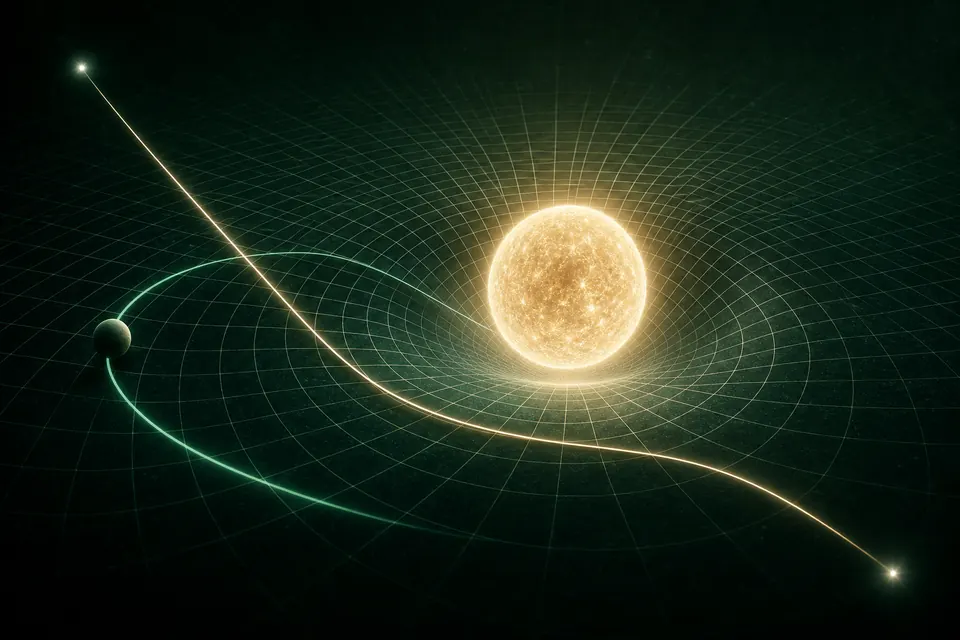
Einstein's geometric theory of gravity, in which matter and energy shape spacetime and free objects follow its geometry.
- Revision
- 2
- Created by
- SCIENDIA Knowledge Desk
- Updated by
- SCIENDIA Knowledge Desk
- Last updated
- 17.08.2026 18:43
Built by the community
Members can improve this article. Every saved change remains visible in the revision ledger.
Overview
General relativity replaces gravitational force in a fixed space with a dynamic spacetime geometry. Matter, radiation and pressure contribute to curvature, while that curvature determines how freely falling objects and light move.
Technical foundations
General relativity describes spacetime with a metric tensor that determines intervals, causal cones and geodesics. Curvature is encoded by the Riemann tensor and its contractions. Einstein's field equations equate the Einstein tensor, including an optional cosmological constant, to the stress-energy tensor multiplied by the gravitational coupling. Because geometry itself is dynamical, coordinate choices do not represent physical observables automatically. The equivalence principle appears locally as the ability to choose a freely falling frame in which nongravitational physics approaches special relativity.
How it works
The Einstein field equations connect spacetime geometry with energy and momentum. Solutions describe weak gravitational fields, expanding cosmologies, compact stars and black holes. In the weak-field limit, the theory reproduces Newtonian gravity to high accuracy.
Measurement and research methods
The theory is tested through planetary motion, gravitational redshift, light deflection, Shapiro delay, binary-pulsar timing, gravitational waves and horizon-scale imaging. Precision predictions integrate null or timelike geodesics in a model spacetime and compare invariant observables such as frequency ratios or arrival times. Numerical relativity reformulates the equations as an initial-value problem and evolves strong-field mergers on supercomputers. Parameterised tests search for consistent deviations while controlling ephemeris, plasma, detector and astrophysical uncertainties that could imitate gravitational effects.
Key ideas
- Free fall is inertial motion along a spacetime geodesic.
- Clock rates and light paths depend on gravitational environment.
- The theory is local and causal even though curved geometry can be globally complex.
Current research frontier
Modern work spans black-hole perturbations, cosmology and attempts at quantum gravity. The no-hair property of stationary black holes can be tested through orbital dynamics and ringdown spectra, while gravitational lensing maps both visible and dark mass. Singularities in classical solutions indicate geodesic incompleteness, not a directly observed point of infinite density with a settled microscopic description. Candidate quantum theories must recover general relativity at accessible scales and make testable predictions. Other open problems include the physical nature of dark energy, information in black-hole evaporation and nonlinear structure in modified-gravity models.
Why it matters
General relativity is required for precise satellite navigation and explains gravitational lensing, black holes, gravitational waves and the large-scale evolution of the universe.
Limits and open questions
The theory is extraordinarily successful but is not a quantum theory of gravity. Singularities signal regimes where the classical description is incomplete, motivating attempts to reconcile gravity with quantum physics.
Explore through connected concepts
This article is indexed with 20 technical tags. Select a tag to explore the Wiki by concept.
You may also explore
Recommended from the technical tags shared with this article.
Gravitational Waves
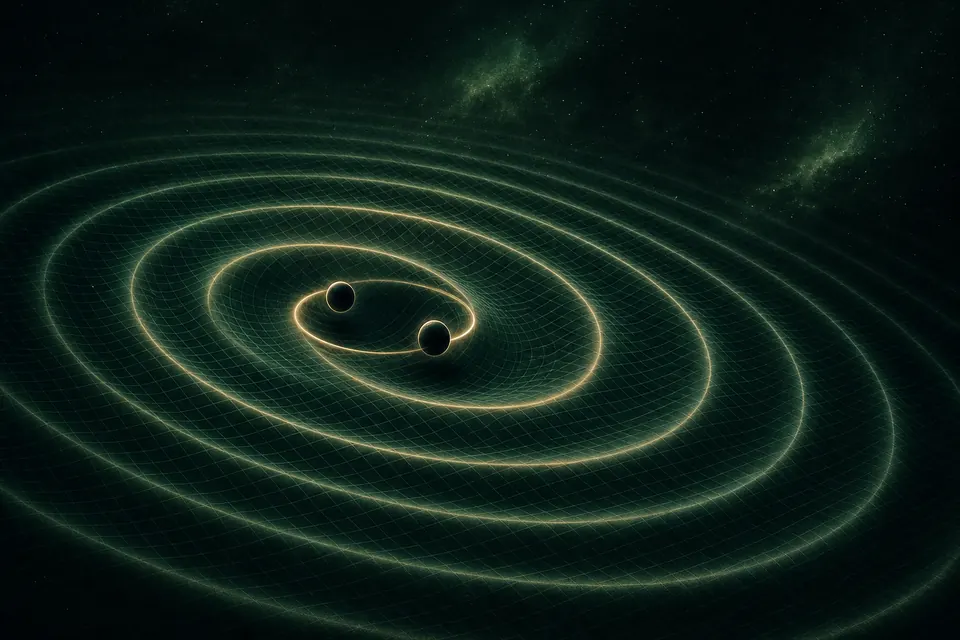
Ripples in spacetime produced by accelerating mass distributions and detected through their effect on distance.
Read article →