Gravitational Waves
Ripples in spacetime produced by accelerating mass distributions and detected through their effect on distance.
- Revision
- 2
- Created by
- SCIENDIA Knowledge Desk
- Updated by
- SCIENDIA Knowledge Desk
- Last updated
- 17.08.2026 18:43
Built by the community
Members can improve this article. Every saved change remains visible in the revision ledger.
Overview
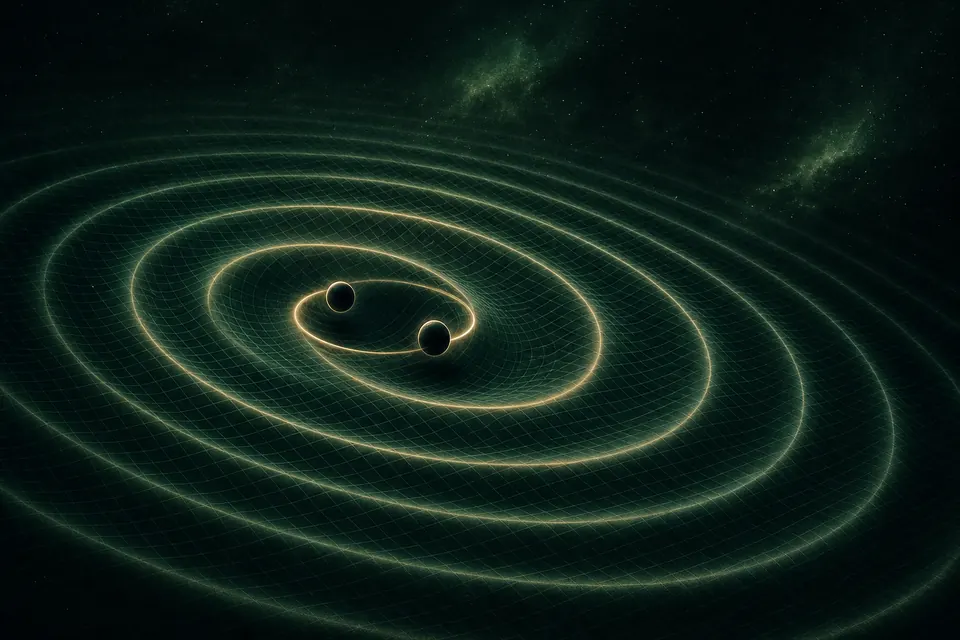
Gravitational waves are propagating distortions of spacetime predicted by general relativity. Strong, detectable waves are produced when compact objects such as black holes or neutron stars orbit and merge, changing the mass distribution rapidly and asymmetrically.
Technical foundations
In the weak-field limit of general relativity, gravitational radiation appears as a transverse perturbation of the spacetime metric with two tensor polarisations, conventionally labelled plus and cross. The observable strain h is the fractional change in separation between freely falling test masses. Compact binaries generate a chirp because radiation removes orbital energy and angular momentum, increasing orbital frequency until merger. Post-Newtonian expansions describe the inspiral, numerical relativity treats the strongly nonlinear merger, and black-hole perturbation theory models the damped ringdown modes of the remnant.
How it works
Laser interferometers compare the lengths of perpendicular arms. A passing wave stretches one direction while compressing the other by an extremely small fraction, changing the interference pattern of returning laser light. Networks of detectors compare arrival times and signal shapes to infer source direction and properties.
Measurement and research methods
Ground-based interferometers suspend highly reflective mirrors kilometres apart and use resonant optical cavities to measure differential arm-length changes smaller than a proton relative to the arm length. The data pipeline estimates noise spectra, removes known instrumental artefacts and searches either with matched-filter waveform banks or weakly modelled transient algorithms. Significance is assessed against time-shifted background data. Parameter inference uses Bayesian sampling to estimate masses, spins, distance, inclination and sky position, while calibration uncertainty and waveform modelling error are propagated into the posterior distributions.
Key ideas
- The wave carries energy and angular momentum away from its source.
- Its characteristic waveform records the dynamics of the emitting system.
- Multiple detectors are needed for robust localisation and polarisation information.
Current research frontier
A global detector network improves localisation, duty cycle and polarisation tests. Future ground facilities aim for lower seismic and thermal noise, while space interferometers will probe millihertz sources such as massive black-hole binaries. Pulsar-timing arrays target nanohertz variations through correlated pulse-arrival residuals. Research priorities include detecting a stochastic background, testing whether ringdown modes follow the Kerr metric, constraining the graviton's propagation properties and combining gravitational signals with photons, neutrinos or host-galaxy catalogues. Selection effects must be modelled carefully when inferring astrophysical merger rates and population distributions.
Why it matters
Gravitational-wave astronomy probes strong gravity, measures compact-object populations and tests relativity in regimes inaccessible to Solar-System experiments. Joint observations with light or particles can reveal the physics of explosive cosmic events.
Limits and open questions
Detectors are sensitive only within particular frequency bands and must suppress seismic, thermal and instrumental noise. Source distances and parameters can be correlated, making population analysis and independent observations important.
Explore through connected concepts
This article is indexed with 20 technical tags. Select a tag to explore the Wiki by concept.
You may also explore
Recommended from the technical tags shared with this article.
General Relativity
Einstein's geometric theory of gravity, in which matter and energy shape spacetime and free objects follow its geometry.
Read article →