Green Hydrogen Electrolysis
Production of hydrogen by splitting water with electricity whose life-cycle emissions are kept low through renewable energy and responsible system design.
- Revision
- 1
- Created by
- SCIENDIA Knowledge Desk
- Updated by
- SCIENDIA Knowledge Desk
- Last updated
- 19.08.2026 09:05
Built by the community
Members can improve this article. Every saved change remains visible in the revision ledger.
Overview
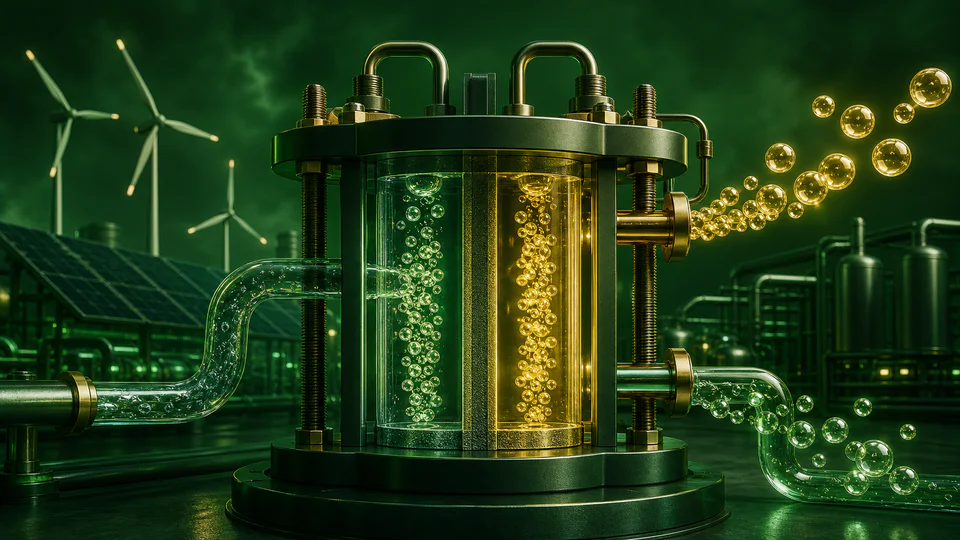
Water electrolysis converts electrical energy into hydrogen and oxygen. Hydrogen is described as green when the electricity and supporting supply chain meet a low-emissions definition. The resulting molecule can store energy or supply chemical feedstock, but conversion losses mean direct electrification is usually more efficient where it can provide the same service.
Technical foundations
Electrolysis requires at least the Gibbs free energy of water splitting, with additional voltage lost to electrode kinetics, ionic resistance and mass transport. The higher and lower heating values produce different efficiency conventions. Alkaline systems use porous diaphragms and non-precious catalysts, proton-exchange systems deliver compact dynamic operation but often use iridium at the oxygen electrode, and solid-oxide cells can use process heat to reduce electrical demand. Gas crossover constrains low-load operation and pressure differential.
How it works
Alkaline electrolysers use liquid electrolyte, proton-exchange-membrane systems use a solid acidic membrane and solid-oxide electrolysers operate at high temperature. At the cathode, water or protons are reduced to hydrogen; at the anode, oxygen evolves. Power electronics, purification, compression, water treatment, thermal management and gas separation determine plant performance beyond the electrochemical stack.
Measurement and research methods
Stack testing records voltage-current curves, gas purity, faradaic efficiency, temperature and degradation over steady and cycling schedules. Electrochemical impedance separates resistance contributions, while post-mortem microscopy and chemical analysis identify catalyst dissolution, membrane damage and contamination. Plant studies measure alternating-current consumption per delivered kilogram after drying and compression. Life-cycle assessment specifies electricity source, equipment manufacture and replacement. Certification may require hourly or similarly granular matching between renewable generation and electrolyser demand.
Key ideas
- Electricity carbon intensity and temporal matching determine whether electrolytic hydrogen is genuinely low emission.
- Stack efficiency, degradation, capacity factor and financing jointly determine production cost.
- Hydrogen leakage and nitrogen-oxide emissions from combustion must be included in environmental assessment.
Current research frontier
The frontier targets reduced precious-metal loading, anion-exchange membranes, pressurised operation and reversible solid-oxide systems. Co-location with steel, ammonia or synthetic-fuel plants can use oxygen and heat by-products. Flexible scheduling must balance low electricity prices against capital utilisation and degradation. Research also compares pipelines, ammonia, methanol and liquid carriers for transport. A credible project needs an offtaker, additional low-carbon electricity and methane-leakage-aware comparison with fossil hydrogen rather than relying only on electrolyser nameplate efficiency.
Why it matters
Low-emission hydrogen could decarbonise existing uses in ammonia and refining and may serve steelmaking, shipping fuels and long-duration storage where direct electricity is difficult. Flexible plants can use periods of abundant renewable generation while supporting industrial feedstock security.
Limits and open questions
Renewable electricity, transmission, water and storage infrastructure are substantial requirements. Electrolysers degrade under cycling and some technologies depend on scarce catalysts. Transporting low-density hydrogen is costly, and subsidies can shift electricity away from more effective decarbonisation. Certification must prevent fossil-derived or high-carbon power from being relabelled as green.
Explore through connected concepts
This article is indexed with 20 technical tags. Select a tag to explore the Wiki by concept.
You may also explore
Recommended from the technical tags shared with this article.
Electrochemical Carbon Dioxide Reduction
The use of electricity, catalysts and electrochemical interfaces to convert carbon dioxide into chemical products.
Read article →