Metamaterials
Engineered structures whose collective wave response is governed primarily by subwavelength geometry rather than bulk composition alone.
- Revision
- 1
- Created by
- SCIENDIA Knowledge Desk
- Updated by
- SCIENDIA Knowledge Desk
- Last updated
- 18.08.2026 12:20
Built by the community
Members can improve this article. Every saved change remains visible in the revision ledger.
Overview
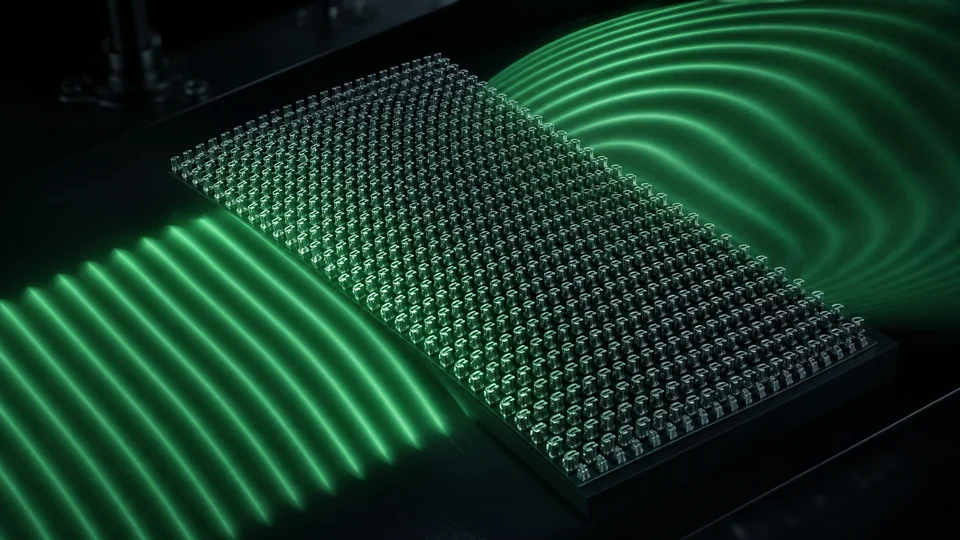
Metamaterials arrange resonant elements to control electromagnetic, acoustic or elastic waves. Their effective permittivity, permeability, density or stiffness can fall outside ranges common in natural materials, enabling unusual refraction, focusing and filtering.
Technical foundations
Electromagnetic metamaterials use resonant conductors, dielectric particles or patterned surfaces whose polarisation and magnetisation create engineered effective parameters. Negative refraction can occur when phase and energy flow differ, while metasurfaces impose spatially varying phase shifts across a thin interface. Acoustic and mechanical analogues manipulate pressure, displacement and elastic modes. Band structures reveal allowed and forbidden propagation, and symmetry or topology can protect selected edge states against some defects without eliminating material loss.
How it works
An incident wave drives currents, pressure fields or mechanical motion in repeating unit cells. Coupling among cells creates an effective response over wavelengths larger than the pattern. Geometry, material loss and symmetry determine resonances, bandwidth and whether homogenised descriptions remain valid.
Measurement and research methods
Characterisation measures complex transmission and reflection over frequency and angle, then retrieves effective parameters only when homogenisation is defensible. Near-field scanning maps local modes, and interferometry reconstructs phase. Fabrication uses lithography, printing or additive manufacturing across scales from optics to acoustics. Simulations solve Maxwell or elastic equations with measured material properties and tolerance sweeps. Claims of invisibility or perfect imaging should report bandwidth, aperture, polarisation, object size and loss; a restricted demonstration does not imply universal cloaking.
Key ideas
- The engineered unit cell is part of the material definition.
- Exotic response usually trades bandwidth, loss, tolerance or angular range.
- Subwavelength patterning does not remove causality or energy-conservation constraints.
Current research frontier
Research develops active metasurfaces with electronic, optical or mechanical tuning and integrates sensing with programmable wavefront control. Nonlinear and time-varying structures enable frequency conversion and nonreciprocal response. Manufacturing priorities include large-area repeatability and low-loss dielectrics. Open questions concern stable control of thousands of elements, thermal handling and trustworthy reduced models for strongly coupled cells. Applications will often succeed as narrow, engineered components rather than all-purpose replacements for conventional optics, antennas or structural materials.
Why it matters
Metamaterials enable compact antennas, vibration isolation, imaging, sensing and wavefront control. Tunable and reconfigurable designs connect materials engineering with signal processing.
Limits and open questions
Fabrication disorder, absorption and scaling from a small sample to a large aperture can erase predicted performance. Effective parameters become ambiguous near strong spatial dispersion, and demonstrations under one angle or frequency may not generalise.
Explore through connected concepts
This article is indexed with 20 technical tags. Select a tag to explore the Wiki by concept.
You may also explore
Recommended from the technical tags shared with this article.

Molecular Dynamics Simulation
Atomistic computation that propagates molecular motion through time using an interaction model and numerical integration.
Read article →