Molecular Dynamics Simulation
Atomistic computation that propagates molecular motion through time using an interaction model and numerical integration.
- Revision
- 1
- Created by
- SCIENDIA Knowledge Desk
- Updated by
- SCIENDIA Knowledge Desk
- Last updated
- 18.08.2026 14:57
Built by the community
Members can improve this article. Every saved change remains visible in the revision ledger.
Overview
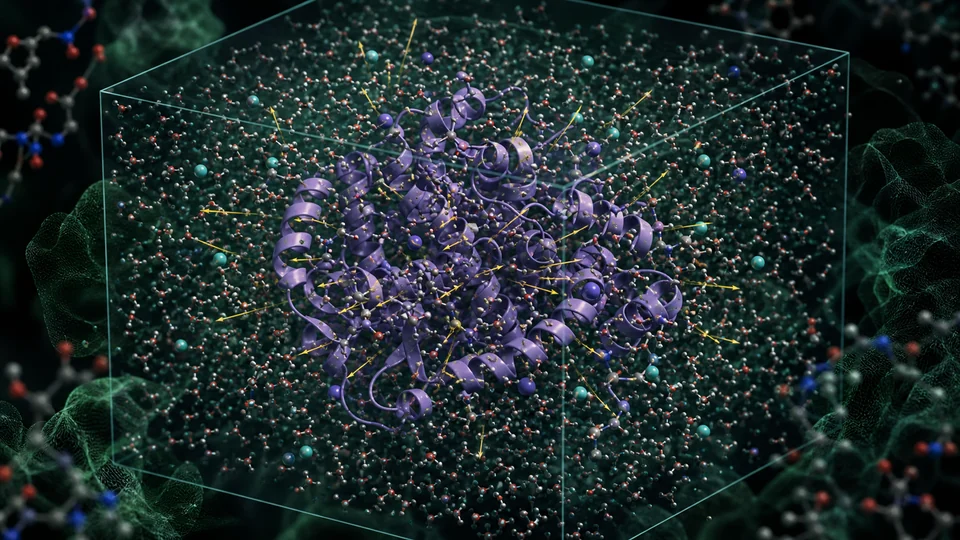
Molecular dynamics represents atoms or coarse-grained particles as coordinates, velocities and interaction parameters. By integrating equations of motion over many small time steps, it generates trajectories from which structure, fluctuations, transport and thermodynamic observables can be estimated. Applications range from protein conformations and membranes to electrolytes, polymers and nanoscale materials.
Technical foundations
Classical force fields approximate potential energy with bonded stretching, bending and torsion plus nonbonded Coulomb and Lennard-Jones terms. Parameters are fitted to quantum calculations and experiments within a chemical domain. Newtonian propagation uses algorithms such as velocity Verlet; constraints permit a longer step by fixing fast bond vibrations. Ewald-based methods treat periodic electrostatics, and cutoffs require consistent dispersion corrections. Coarse-grained models group atoms to access larger scales but smooth the energy landscape. Ab-initio dynamics instead calculates electronic structure during propagation at far higher cost.
How it works
A force field calculates bonded terms and nonbonded electrostatic and dispersion interactions. Integrators advance positions and velocities, while thermostats and barostats approximate selected statistical ensembles. Periodic boundaries mimic bulk material, neighbour lists accelerate short-range forces and specialised methods treat long-range electrostatics. Replicate simulations and enhanced-sampling algorithms explore states separated by large free-energy barriers.
Measurement and research methods
A defensible workflow equilibrates temperature, pressure and density before collecting independent production data. Convergence is assessed across replicas, starting conformations and trajectory blocks. Structural observables include distributions rather than one snapshot; diffusion, viscosity and free energy require estimators with finite-size and correlation corrections. Enhanced sampling uses umbrella potentials, replica exchange or metadynamics and then reweights biased data. Experimental comparison may involve scattering curves, chemical shifts or binding affinities computed with an explicit forward model and uncertainty from both simulation and measurement.
Key ideas
- A visually plausible trajectory is not evidence unless sampling, force-field error and uncertainty are assessed.
- Time step, boundary conditions and ensemble controls alter which physical process the computation represents.
- Simulation and experiment are most informative when compared through the same measurable observable.
Current research frontier
Machine-learned interatomic potentials seek quantum-level accuracy at classical-like scale, but need active learning and out-of-distribution detection. Constant-pH, reactive and polarizable models improve physical scope while adding parameters and cost. Exascale hardware enables larger ensembles, yet biologically relevant rare events still demand adaptive sampling. Open problems include transferable force fields, realistic membrane and crowding environments and reproducible uncertainty for binding free energies. Trajectories should be archived with topology, parameters and analysis code because coordinates without the exact interaction model and protocol are insufficient for replication.
Why it matters
Molecular dynamics provides mechanistic hypotheses at spatial and temporal resolution difficult to obtain experimentally. It supports drug discovery, materials design and interpretation of spectroscopy, microscopy and scattering measurements.
Limits and open questions
Accessible trajectories are still short relative to many biological and materials transitions, and empirical force fields omit electronic rearrangement. Initial structures, protonation and finite-size choices can dominate results; enhanced sampling improves exploration but introduces convergence and reweighting requirements.
Explore through connected concepts
This article is indexed with 20 technical tags. Select a tag to explore the Wiki by concept.
You may also explore
Recommended from the technical tags shared with this article.

Battery Electrochemistry
The coupled ion transport, electron transfer and materials transformations that store and release electrical energy in batteries.
Read article →