Microbial Synthetic Communities
Designed groups of microbial species used to study and engineer ecological interactions with controlled membership and function.
- Revision
- 1
- Created by
- SCIENDIA Knowledge Desk
- Updated by
- SCIENDIA Knowledge Desk
- Last updated
- 19.08.2026 09:05
Built by the community
Members can improve this article. Every saved change remains visible in the revision ledger.
Overview
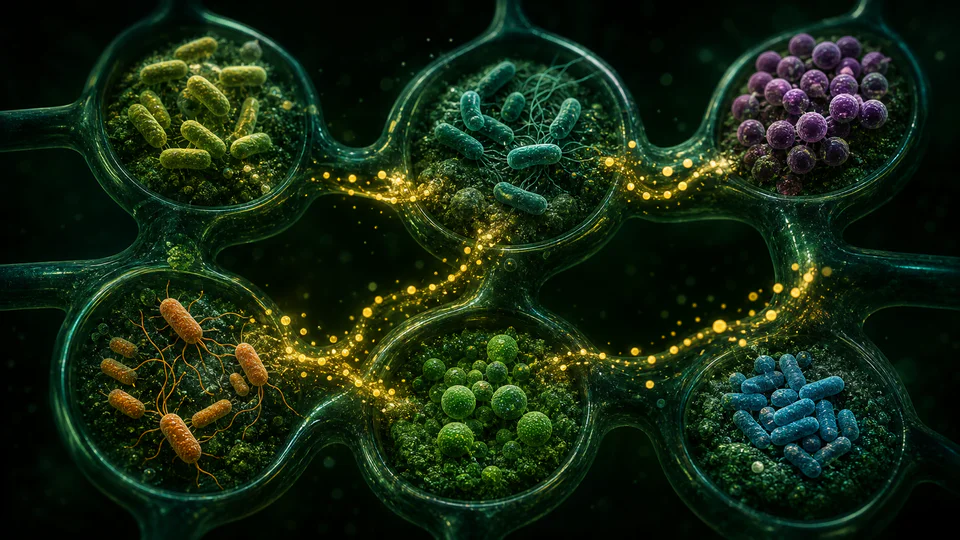
A synthetic microbial community, often called a SynCom, contains a defined set of cultured strains assembled to reproduce selected functions of a natural microbiome. Reducing community complexity makes interaction mechanisms experimentally tractable while retaining cooperation, competition, cross-feeding and environmental modification that cannot be studied in isolated monocultures.
Technical foundations
Community dynamics can be described by consumer-resource models, generalised Lotka-Volterra equations or explicit metabolic networks. Cross-feeding arises when one strain releases a metabolite another requires, while competition occurs through shared resource depletion, toxins or spatial occupation. Interaction signs can change with nutrient supply and density. Division of labour may improve pathway efficiency but creates dependence and opportunities for non-contributing mutants. Spatial gradients generate niches that allow strains to coexist even when a well-mixed culture predicts exclusion.
How it works
Researchers select strains based on genomes, metabolic capabilities or ecological origin, then combine them at controlled starting abundances. Species consume and release metabolites, alter pH and oxygen, exchange signals and sometimes inhibit neighbours. Serial passage, spatial structure and host association determine whether the consortium remains stable. Mathematical models describe resource competition, interaction networks and feedback between composition and environment.
Measurement and research methods
Assembly experiments start with authenticated isolates and genome-informed functional hypotheses. Barcode sequencing, quantitative PCR, plating and metagenomics track abundance; metabolomics and isotope tracing reveal exchanged compounds. Leave-one-out communities test strain contributions, and conditioned-medium experiments narrow mechanisms. Replicated time courses across environmental perturbations distinguish transient composition from stable attractors. In host-associated studies, gnotobiotic animals or sterile plant systems provide controlled colonisation while requiring ethical design and confirmation that inoculated strains remain identifiable.
Key ideas
- Community function can be redundant even when taxonomic composition changes substantially.
- Pairwise interactions do not always predict behaviour in a larger consortium because the environment is jointly modified.
- Stability requires resistance to invasion, resilience after disturbance and reproducible function, not merely coexistence.
Current research frontier
The frontier includes dynamically controlled consortia with engineered communication, kill switches and distributed biosynthesis. Machine learning and robotic culturing can search enormous mixture spaces, but successful prediction requires training across environments and starting conditions. Ecological theory is being linked to personalised microbiome interventions and resilient agricultural inoculants. Open problems include designing long-term evolutionary stability, preserving function after invasion by natural microbes and setting regulatory standards for a product whose composition and genetic state may change after deployment.
Why it matters
SynComs help reveal how plant, animal and environmental microbiomes influence nutrition, disease resistance and biogeochemical cycles. Engineered consortia may improve crop health, wastewater treatment, fermentation and biomanufacturing by dividing labour across specialised organisms.
Limits and open questions
Cultured strains represent only part of natural diversity, and laboratory media can reverse interactions observed in a host or soil. Evolution may erode engineered cooperation, while horizontal gene transfer changes capabilities. Environmental release demands containment, monitoring and ecological risk assessment, especially when a community can persist or exchange genes beyond its intended setting.
Explore through connected concepts
This article is indexed with 20 technical tags. Select a tag to explore the Wiki by concept.
You may also explore
Recommended from the technical tags shared with this article.
Synthetic Biology
The design and construction of biological systems using engineering principles, quantitative models and molecular tools.
Read article →