Microfluidics
The control of very small fluid volumes in engineered channels for analysis, synthesis and biological experimentation.
- Revision
- 1
- Created by
- SCIENDIA Knowledge Desk
- Updated by
- SCIENDIA Knowledge Desk
- Last updated
- 18.08.2026 14:57
Built by the community
Members can improve this article. Every saved change remains visible in the revision ledger.
Overview
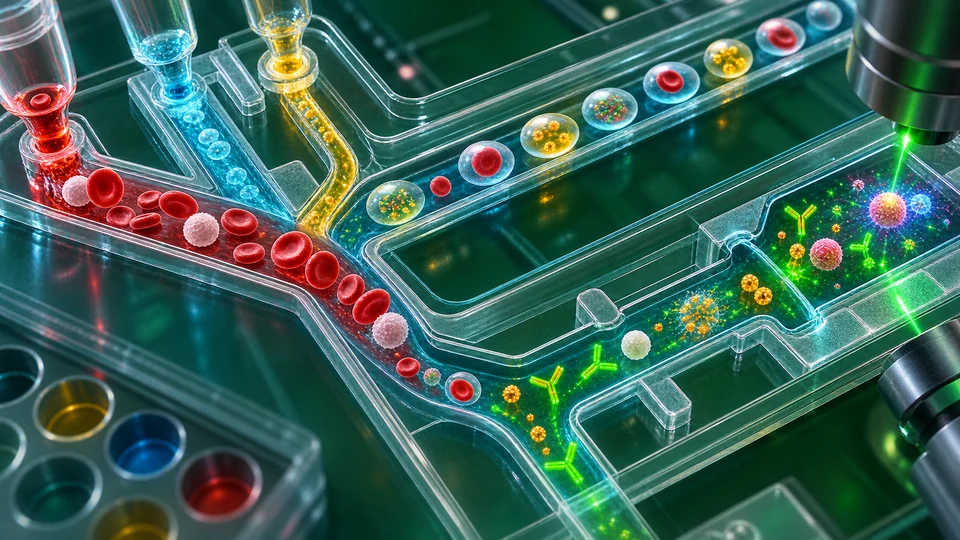
Microfluidic devices manipulate liquids in channels whose dimensions are commonly tens to hundreds of micrometres. At this scale viscous effects often dominate inertia, interfaces become comparatively important and diffusion can govern mixing. These properties enable compact assays, precise gradients, single-cell handling and highly parallel droplet reactions using little sample or reagent.
Technical foundations
At small channel dimensions the Reynolds number is often low, so momentum diffuses across the channel faster than inertial structures grow. Pressure-driven flow therefore approaches a predictable laminar profile, and hydraulic resistance scales strongly with cross-section. The capillary number compares viscous stress with surface tension and helps determine droplet breakup. Péclet number compares advection with molecular diffusion, explaining why two adjacent streams can travel far before mixing. Electrokinetic flow adds electrical double layers, zeta potential and Joule heating to the transport problem.
How it works
Pressure, electro-osmosis, capillarity or centrifugal force drives flow through patterned networks. Channel geometry sets hydraulic resistance and divides streams, while valves, membranes and surface treatments control timing and wetting. Droplet systems use immiscible phases to isolate reaction volumes. Optical, electrochemical or mechanical sensors then read molecular binding, cell behaviour or reaction products inside the chip.
Measurement and research methods
Devices are fabricated by soft lithography, injection moulding, laser machining, glass etching or additive methods. Fluorescent particle tracking and micro-particle image velocimetry measure flow; pressure sensors and flow standards calibrate resistance. Biological assays quantify cell recovery, viability, molecular capture and limit of detection with matrix-matched controls. Surface passivation reduces nonspecific adsorption, and bubble traps or degassing manage dissolved gas. Statistical validation must cover chip-to-chip and lot-to-lot variation because a single precisely imaged device does not establish a manufacturable process.
Key ideas
- Low Reynolds number makes most channel flow laminar, but laminar does not mean motionless or unmixed.
- Surface chemistry and fabrication tolerances can dominate performance as dimensions shrink.
- A laboratory demonstration becomes a product only after reliable sample preparation and fluidic interfacing are solved.
Current research frontier
The frontier integrates microfluidics with spatial omics, automated organ models and continuous bioprocess monitoring. Digital microfluidics moves droplets electrowettably on an electrode array, while acoustic and inertial systems sort cells without labels. Paper and capillary platforms trade control complexity for field robustness. Challenges include connecting macroscale samples to microscale channels, processing viscous or particulate clinical material and recovering analytes without bias. Standardised interfaces, recyclable materials and closed-loop control are important for deployment. Models must also include deformation, wetting hysteresis and cell-surface interactions when ideal rigid-channel assumptions no longer apply.
Why it matters
Microfluidics supports point-of-care diagnostics, organ-on-chip models, digital PCR, particle synthesis and rapid screening. Integration can reduce contamination and connect preparation, reaction and detection within a disposable cartridge.
Limits and open questions
Bubbles, adsorption, evaporation, clogging and variable biological samples can destabilise small-volume operation. Scaling from one chip to reproducible manufacturing requires metrology, packaging and quality control, while clinical use demands robust performance outside carefully controlled laboratories.
Explore through connected concepts
This article is indexed with 20 technical tags. Select a tag to explore the Wiki by concept.
You may also explore
Recommended from the technical tags shared with this article.
Bioprinting
Layer-by-layer fabrication of living tissue constructs using cells, biomaterials and spatially controlled deposition.
Read article →