mRNA Therapeutics
Medicines that deliver engineered messenger RNA so cells transiently produce a therapeutic protein or antigen.
- Revision
- 1
- Created by
- SCIENDIA Knowledge Desk
- Updated by
- SCIENDIA Knowledge Desk
- Last updated
- 18.08.2026 14:57
Built by the community
Members can improve this article. Every saved change remains visible in the revision ledger.
Overview
Messenger-RNA therapeutics use a designed nucleic-acid sequence as a temporary set of instructions. Rather than administering the final protein, the medicine delivers mRNA to selected cells, where ribosomes translate it and normal turnover pathways later remove the molecule. Applications include vaccination, protein replacement, immune modulation and in-situ expression of engineered antibodies or genome-editing components.
Technical foundations
Therapeutic mRNA contains a five-prime cap, untranslated regions, an open reading frame and a polyadenylate tail. Each element influences translation, innate sensing and degradation. Modified nucleosides can reduce recognition by pattern-recognition receptors, while sequence optimisation adjusts codon usage, secondary structure and unwanted open reading frames. Lipid nanoparticles commonly combine an ionisable lipid with helper phospholipid, cholesterol and a polyethylene-glycol lipid. The ionisable component is comparatively neutral in blood but becomes protonated during acidic formulation and endosomal trafficking, enabling RNA encapsulation and membrane disruption.
How it works
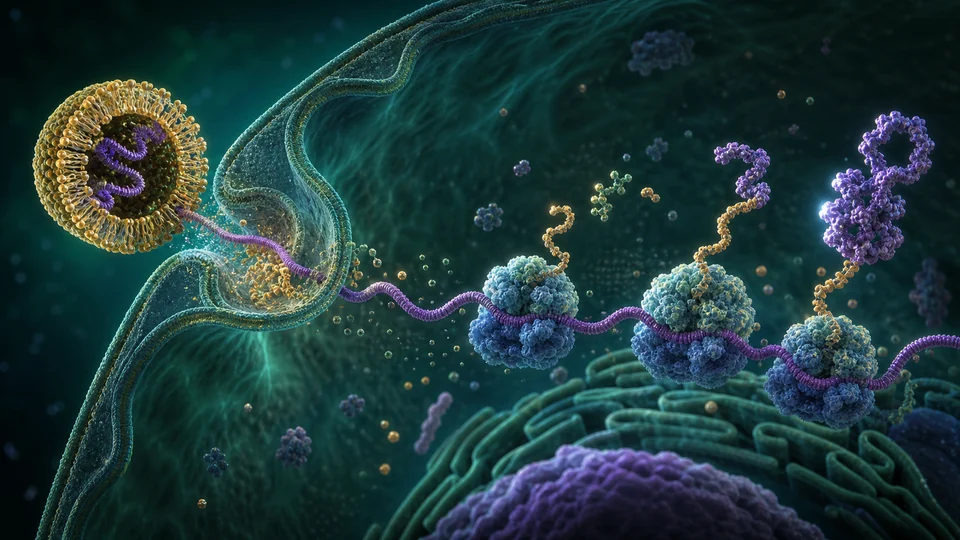
A therapeutic sequence is optimised for translation, stability and innate-immune compatibility, manufactured by in-vitro transcription and packaged in a delivery system such as a lipid nanoparticle. After cellular uptake, endosomal escape releases mRNA into the cytosol. Ribosomes produce the encoded protein, which may remain inside the cell, be secreted or be processed for antigen presentation. Dose and duration depend on delivery efficiency and RNA and protein half-lives.
Measurement and research methods
Development assays measure RNA identity, integrity, capping, polyadenylation, encapsulation, particle size, lipid impurities and in-vitro potency. In animals and humans, quantitative PCR, protein assays and pharmacodynamic markers describe exposure, while biodistribution methods distinguish intended expression from uptake by liver and immune cells. Controls compare naked RNA, empty particles and non-coding cargo. Formulation mixing rate, residual double-stranded RNA, freeze-thaw history and container interactions are critical quality attributes because small manufacturing changes can alter inflammation and expression.
Key ideas
- mRNA acts in the cytosol and does not need to enter the nucleus to be translated.
- Sequence design, chemical modification and delivery composition jointly determine biological activity.
- Transient expression can be advantageous, but it also makes exposure and repeat dosing central design variables.
Current research frontier
Research is expanding from prophylactic vaccination toward personalised cancer antigens, tolerising vaccines, regenerative factors and transient delivery of editing enzymes. Circular RNA and self-amplifying RNA seek longer expression at lower mass, but introduce different purity and innate-sensing questions. Tissue-selective particles use lipid chemistry, targeting ligands or local administration to move beyond liver-biased delivery. Major open problems are efficient endosomal escape, redosing after anti-carrier responses, scalable cold-chain alternatives and predictive translation from animal models. Safety evaluation must address both the encoded protein and the delivery vehicle, including dose-dependent inflammation and unintended expression sites.
Why it matters
The platform separates digital sequence design from a comparatively standard manufacturing workflow, enabling rapid prototyping and combination products. It can express proteins that are difficult to formulate directly and can stimulate both antibody and cellular immune responses.
Limits and open questions
Delivery remains tissue-biased, endosomal escape is inefficient and inflammatory responses can narrow the therapeutic window. Storage, repeat-dose immunity, batch consistency and rare adverse events require indication-specific evidence; success for one vaccine does not automatically validate every encoded product.
Explore through connected concepts
This article is indexed with 20 technical tags. Select a tag to explore the Wiki by concept.
You may also explore
Recommended from the technical tags shared with this article.

Messenger RNA Vaccines
Vaccines that deliver temporary genetic instructions so cells produce an antigen and train adaptive immunity.
Read article →