Ocean Acidification
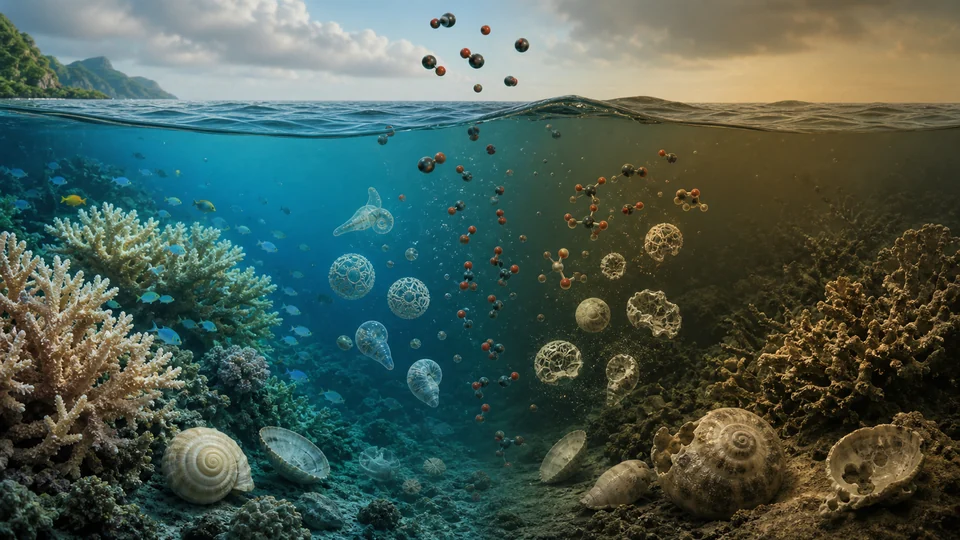
The long-term shift in seawater carbonate chemistry caused primarily by ocean uptake of anthropogenic carbon dioxide.
- Revision
- 1
- Created by
- SCIENDIA Knowledge Desk
- Updated by
- SCIENDIA Knowledge Desk
- Last updated
- 18.08.2026 14:57
Built by the community
Members can improve this article. Every saved change remains visible in the revision ledger.
Overview
When atmospheric carbon dioxide dissolves in seawater, it participates in equilibria among dissolved carbon dioxide, bicarbonate, carbonate and hydrogen ions. The resulting increase in hydrogen-ion activity lowers pH and generally reduces carbonate-ion availability. The process changes chemical conditions for calcifying organisms and interacts with temperature, oxygen, nutrients and local biological production.
Technical foundations
The marine carbonate system is governed by mass balance, acid dissociation equilibria and electroneutrality. Added carbon dioxide shifts dissolved inorganic carbon toward bicarbonate and increases hydrogen-ion activity, reducing carbonate ion and aragonite or calcite saturation state. Alkalinity changes little under pure gas exchange but changes through freshwater mixing, nutrient reactions and carbonate precipitation or dissolution. Buffer capacity, often expressed through a Revelle factor, varies with temperature and composition, so equal carbon additions do not create identical pH responses everywhere.
How it works
Air-sea gas exchange adds dissolved inorganic carbon to the mixed layer. Circulation transports it into the ocean interior, while buffering reactions redistribute carbon species. Researchers measure pH, total alkalinity, dissolved inorganic carbon and partial pressure; any suitable pair, with temperature and salinity, constrains the carbonate system. Experiments and models examine organism responses and ecosystem feedbacks across realistic variability.
Measurement and research methods
Reference-quality monitoring uses spectrophotometric pH, coulometric dissolved inorganic carbon and titrated alkalinity with certified standards. Autonomous floats and moorings increase coverage but require drift control and cross-calibration. Manipulation experiments should reproduce natural diel variability, food supply and co-stressors rather than change pH with an unreported acid addition that also alters alkalinity. Calcification, respiration, growth, reproduction and behaviour capture different response pathways. Regional models assimilate observations and separate anthropogenic trends from upwelling, river input and biological seasonality.
Key ideas
- Ocean acidification means a decrease in pH, even though average seawater remains alkaline rather than becoming acidic.
- Global carbon uptake sets a broad trend, but coastal chemistry can vary strongly through biology and runoff.
- Calcification response depends on species, life stage, adaptation and simultaneous environmental stressors.
Current research frontier
Research examines adaptation across generations, community reorganisation and feedback from changing plankton to carbon export. Coastal mitigation includes nutrient reduction, seagrass restoration and selective alkalinity enhancement, each with limited spatial reach and ecological trade-offs. Marine carbon-dioxide removal proposals require measurements of additional atmospheric uptake, permanence and downstream chemistry. Major uncertainties involve extreme events, multiple stressors and deep-sea ecosystems. Communication should distinguish well-established carbonate chemistry from variable organism responses while making clear that continued emissions commit the ocean to changes lasting far beyond individual management cycles.
Why it matters
Carbonate chemistry affects reefs, plankton, shellfish and biogeochemical cycling. Sustained observations inform fisheries, aquaculture and climate accounting, while emission reduction addresses the primary global driver.
Limits and open questions
Short laboratory exposures may not capture acclimation, evolution or food-web interactions, and natural variability can obscure trends at individual sites. Local management can reduce nutrient and oxygen stress but cannot fully offset continuing atmospheric carbon dioxide accumulation.
Explore through connected concepts
This article is indexed with 20 technical tags. Select a tag to explore the Wiki by concept.
You may also explore
Recommended from the technical tags shared with this article.
Permafrost Carbon Feedback
The climate interaction in which thaw exposes frozen organic matter to decomposition and releases additional greenhouse gases.
Read article →