Photosynthesis
The biological conversion of light energy into chemical energy, coupled to carbon fixation in plants, algae and some bacteria.
- Revision
- 2
- Created by
- SCIENDIA Knowledge Desk
- Updated by
- SCIENDIA Knowledge Desk
- Last updated
- 17.08.2026 18:43
Built by the community
Members can improve this article. Every saved change remains visible in the revision ledger.
Overview
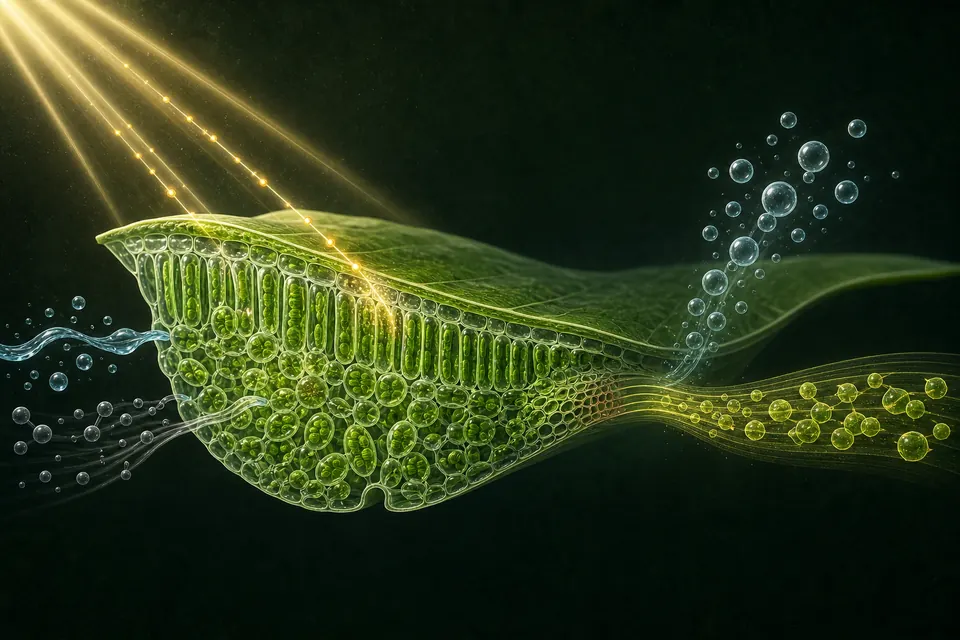
Photosynthesis stores energy from light in chemical bonds. Oxygenic photosynthesis uses water as an electron source, releases molecular oxygen and supplies energy and reducing power for the conversion of carbon dioxide into organic molecules.
Technical foundations
Oxygenic photosynthesis couples two photosystems through the thylakoid electron-transport chain. Photosystem II oxidises water at the manganese-calcium oxygen-evolving complex, releasing electrons, protons and molecular oxygen. Electrons move through plastoquinone and cytochrome b6f to photosystem I, where a second photochemical excitation supports reduction of ferredoxin and NADP+. Vectorial proton transfer establishes a proton-motive force used by chloroplast ATP synthase. The Calvin-Benson-Bassham cycle then fixes carbon through Rubisco and regenerates ribulose-1,5-bisphosphate at a substantial ATP and NADPH cost.
How it works
Pigments in light-harvesting complexes absorb photons and transfer excitation energy to reaction centres. Electron transport then builds a proton gradient across a membrane; ATP synthase uses that gradient to make ATP, while electron carriers provide reducing power. Carbon-fixation reactions use these products to incorporate inorganic carbon into organic compounds.
Measurement and research methods
Photosynthetic performance is measured across scales. Pulse-amplitude-modulated fluorescence estimates photochemical quantum yields and non-photochemical quenching, gas-exchange chambers quantify carbon assimilation and stomatal conductance, and isotope discrimination constrains carbon-fixation pathways. Action spectra, pigment chromatography and ultrafast spectroscopy resolve energy transfer, while eddy-covariance towers estimate ecosystem carbon exchange. Experiments must control irradiance, leaf temperature, carbon-dioxide concentration, humidity and developmental state because these variables alter electron transport, photorespiration and diffusion independently.
Key ideas
- Light reactions and carbon fixation are coupled but chemically distinct stages.
- Leaf structure, gas exchange, water supply and temperature influence whole-plant performance.
- Different organisms use variations that suit their environments and evolutionary histories.
Current research frontier
Research seeks to improve crop productivity without ignoring water and nutrient trade-offs. Strategies include engineering Rubisco kinetics, installing carbon-concentrating mechanisms, optimising canopy light distribution and accelerating recovery from photoprotection. C4 and crassulacean acid metabolism illustrate natural solutions to carbon limitation and water stress, but transferring such traits requires coordinated anatomy and regulation. Models increasingly couple chloroplast biochemistry with stomatal dynamics, source-sink allocation and field microclimate. Remaining challenges include predicting performance under fluctuating light, heat and drought, and separating short-term photosynthetic gains from whole-season yield and resilience.
Why it matters
Photosynthesis supports most food webs, helped shape Earth's oxygen-rich atmosphere and regulates a major part of the global carbon cycle. Improving its efficiency or resilience is a central goal in crop and climate research.
Limits and open questions
The familiar summary equation hides many pathways, losses and trade-offs. More light does not always mean more growth, and photosynthetic rate alone does not determine yield because respiration, nutrients and development also matter.
Explore through connected concepts
This article is indexed with 20 technical tags. Select a tag to explore the Wiki by concept.
You may also explore
Recommended from the technical tags shared with this article.
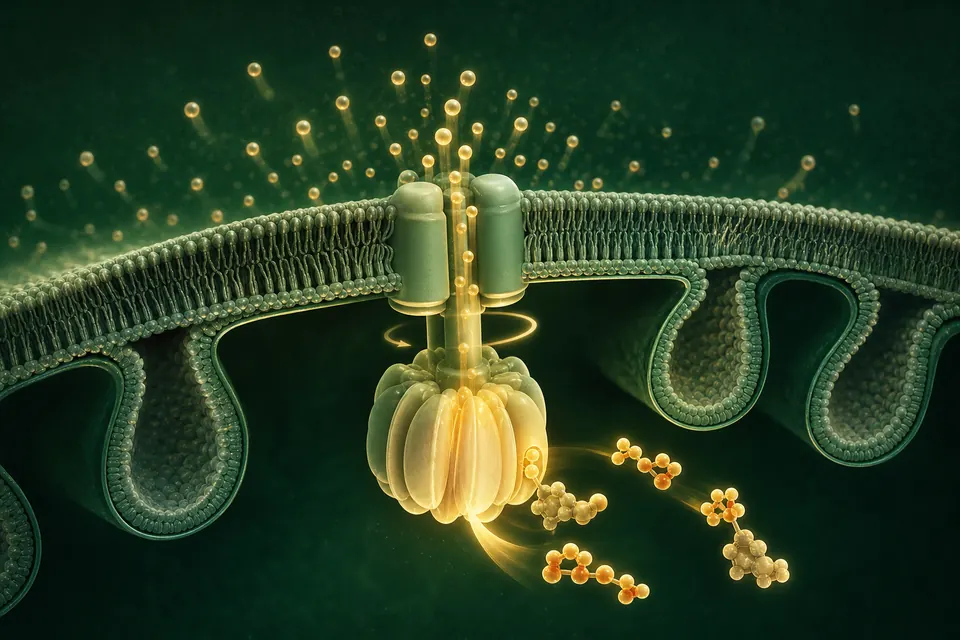
Mitochondrial ATP Synthesis
How electron transport and a proton gradient power ATP production across the inner mitochondrial membrane.
Read article →