Quantum Error Correction
Methods that encode fragile logical quantum information across many physical qubits and diagnose errors without reading the protected state directly.
- Revision
- 1
- Created by
- SCIENDIA Knowledge Desk
- Updated by
- SCIENDIA Knowledge Desk
- Last updated
- 18.08.2026 14:57
Built by the community
Members can improve this article. Every saved change remains visible in the revision ledger.
Overview
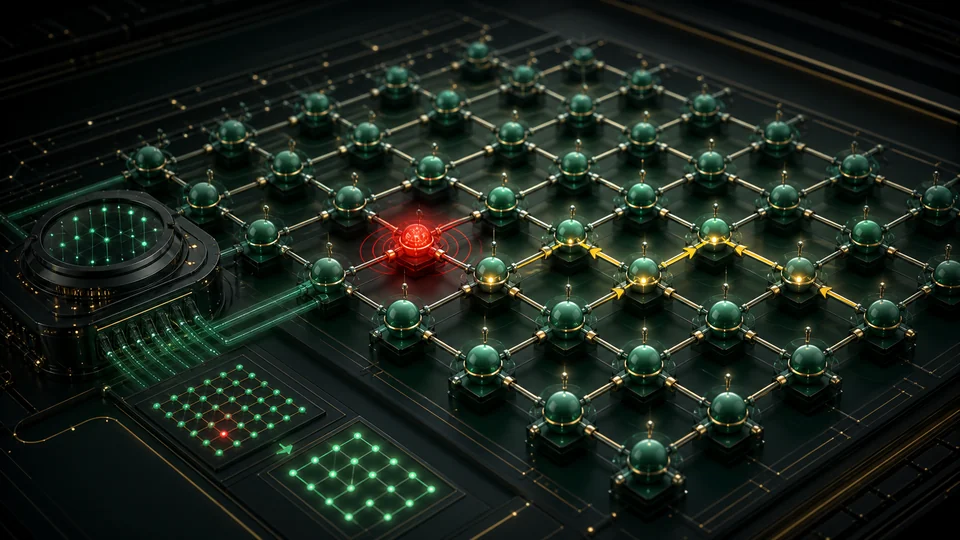
Quantum error correction protects computation from decoherence, imperfect gates and measurement faults. Because an unknown quantum state cannot be copied and direct inspection would disturb it, a logical qubit is represented nonlocally across a code space. Carefully chosen parity measurements reveal an error syndrome while preserving the logical amplitudes needed by the algorithm.
Technical foundations
A quantum code embeds a logical Hilbert space inside a larger physical space. Stabiliser codes define that subspace as the simultaneous positive eigenspace of commuting Pauli operators. Surface codes arrange local checks on a two-dimensional lattice; their distance is the minimum weight of a physical operator that changes logical information without producing a detectable syndrome. Bit and phase errors are treated symmetrically in the formalism, while erasure, leakage and coherent over-rotation require extended models. The no-cloning theorem prevents classical redundancy, but entanglement distributes logical information so local faults can be diagnosed indirectly.
How it works
Ancilla qubits interact with data qubits to measure stabilisers that define the valid code space. A decoder compares syndromes across repeated rounds and infers a likely chain of faults. Corrective operations may be applied physically or tracked in software. When physical error rates lie below a code-dependent threshold, increasing code distance suppresses logical failure, although the required qubit and control overhead can be substantial.
Measurement and research methods
Experiments repeat stabiliser measurements over time to create a three-dimensional syndrome history. Minimum-weight matching, belief propagation and machine-learned decoders infer likely corrections subject to strict latency. Benchmarks report logical error per cycle as code distance increases, using leakage removal and calibrated reset. Fault-tolerant state preparation, lattice surgery and magic-state distillation implement logical operations without exposing the code to uncontrolled error spread. Valid comparisons include qubit count, cycle duration, classical decoding resources and correlated error, not only a headline physical gate fidelity.
Key ideas
- A syndrome identifies consistency violations rather than revealing the encoded quantum value.
- Fault tolerance requires circuits whose single failures do not spread into uncorrectable correlated errors.
- Logical error rate, not isolated physical-qubit fidelity, is the decisive system-level metric.
Current research frontier
Current work develops low-density parity-check codes, bosonic encodings and hardware-tailored codes with lower overhead. Biased-noise qubits can favour codes designed around one dominant error channel. Modular processors add loss and entanglement-generation failure to local control noise, making networked error correction a separate engineering problem. The central milestone is repeated logical improvement with scale while executing nontrivial circuits. Open questions include practical decoding under nonstationary correlations, efficient logical memory at useful clock rates and architecture-level resource estimates that include factories for non-Clifford states, routing, cryogenic control and verification of the final computation.
Why it matters
Reliable error correction is the main route from short demonstrations to long quantum algorithms in chemistry, optimisation and cryptanalysis. It also provides a rigorous architecture for benchmarking control hardware, decoders and logical operations together.
Limits and open questions
Useful logical qubits may require thousands of physical components once leakage, correlated noise, routing and real-time decoding are included. Threshold statements depend on a noise model, and experimentally demonstrating progressively lower logical error across larger codes remains a demanding milestone.
Explore through connected concepts
This article is indexed with 20 technical tags. Select a tag to explore the Wiki by concept.
You may also explore
Recommended from the technical tags shared with this article.
Quantum Computing
Computation that controls quantum states to process information using interference, entanglement and measurement.
Read article →