Space Weather Forecasting
The observation and prediction of solar and geospace disturbances that can affect satellites, navigation, radio and power systems.
- Revision
- 1
- Created by
- SCIENDIA Knowledge Desk
- Updated by
- SCIENDIA Knowledge Desk
- Last updated
- 18.08.2026 14:57
Built by the community
Members can improve this article. Every saved change remains visible in the revision ledger.
Overview
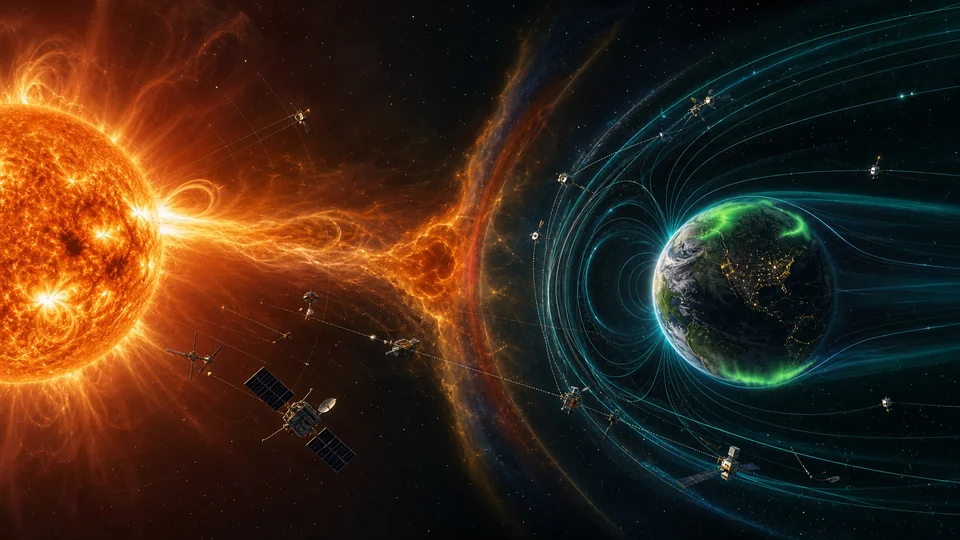
Space weather begins with variable solar radiation, energetic particles and magnetised plasma. Flares and coronal mass ejections can disturb Earth's magnetosphere and ionosphere, producing radiation hazards, aurora, radio absorption, navigation error and geomagnetically induced currents. Forecasting translates measurements and physical models into time-dependent risk for specific technologies.
Technical foundations
Solar active regions store magnetic free energy that can be released through reconnection, producing flares, energetic particles and coronal mass ejections. A CME expands through the solar wind, and its arrival time depends on initial speed and drag. Geomagnetic response is strongest when its magnetic field reconnects efficiently with Earth's dayside field. Magnetospheric convection and substorms energise particles, while changing ionospheric currents create ground magnetic variations that can drive currents through long conductors.
How it works
Solar telescopes observe magnetic fields and eruptions, coronagraphs track outward plasma and monitors near the Sun-Earth line sample the solar wind before arrival. Models propagate disturbances through the heliosphere and couple them to magnetosphere, ionosphere and thermosphere dynamics. Data assimilation updates initial states, while ensemble forecasts describe uncertainty in arrival time, orientation and impact.
Measurement and research methods
Operational systems combine solar magnetograms, extreme-ultraviolet images, coronagraphs, radio observations and in-situ plasma measurements. Heliospheric models initialise a background solar wind and propagate ensemble CME geometries. Near-Earth monitors provide tens of minutes of upstream warning, after which geospace models estimate indices, auroral boundaries, ionospheric density and geoelectric fields. Forecast verification uses event definitions fixed in advance, reliability diagrams and user-specific loss functions. Ground magnetometers, GNSS receivers and satellite dosimeters supply impact observations.
Key ideas
- Eruption speed alone does not determine geomagnetic severity; magnetic-field orientation at Earth is crucial.
- Different users need different observables, lead times and thresholds rather than one generic storm number.
- Forecast verification must distinguish missed events, false alarms, timing error and magnitude error.
Current research frontier
Research seeks earlier estimates of CME magnetic orientation using coronal field models, heliospheric imagers and observations away from the Sun-Earth line. Data assimilation and machine learning may improve flare probabilities and ionospheric specification but must remain robust across solar cycles. Extreme-event statistics are limited by the short space-age record, so historical magnetograms and cosmogenic isotopes provide context. Infrastructure risk depends on latitude, ground conductivity and system topology, making local models essential. Forecasts work best inside a resilience programme that includes radiation-tolerant design, backup timing and tested operational procedures.
Why it matters
Actionable forecasts help satellite operators protect hardware, aviation manage radiation and communication, and grid operators prepare for induced currents. They also support scientific understanding of plasma interactions across the solar system.
Limits and open questions
The magnetic structure of an Earth-directed ejection is difficult to infer before upstream sampling, limiting warning time. Sparse observations and nonlinear coupling produce large uncertainty. Resilient engineering and operational procedures remain necessary because forecasts cannot eliminate rare extreme-event risk.
Explore through connected concepts
This article is indexed with 20 technical tags. Select a tag to explore the Wiki by concept.
You may also explore
Recommended from the technical tags shared with this article.
Climate Feedback Loops
Processes that amplify or reduce an initial change in Earth's climate system.
Read article →