Stochastic Differential Equations
Differential equations that combine deterministic evolution with random forcing to represent systems influenced by continuous uncertainty.
- Revision
- 1
- Created by
- SCIENDIA Knowledge Desk
- Updated by
- SCIENDIA Knowledge Desk
- Last updated
- 19.08.2026 09:05
Built by the community
Members can improve this article. Every saved change remains visible in the revision ledger.
Overview
A stochastic differential equation describes how a state changes through a drift term and a noise term, commonly driven by Brownian motion or a more general stochastic process. It provides a mathematical language for diffusion, fluctuating physical systems, population dynamics, neural activity and financial variables where unresolved events accumulate over time.
Technical foundations
A typical Ito equation has differential form dX equal to a drift function times dt plus a diffusion matrix times dW. Its integral definition makes the noise increment independent of the present integrand in a precise filtration. Ito's formula adds a second-derivative correction absent from ordinary calculus. Stratonovich integration uses midpoint-like limits and transforms with the conventional chain rule, which can arise from smooth rapidly fluctuating physical forcing. Generators, martingales and Kolmogorov equations connect pathwise and distributional descriptions.
How it works
Because Brownian paths are nowhere classically differentiable, the noise term is defined through stochastic integration. Ito and Stratonovich interpretations use different limiting conventions and obey different calculus rules. Under suitable regularity conditions an SDE has a solution process whose probability distribution evolves according to a Fokker-Planck equation. Numerical solvers approximate sample paths using discrete random increments.
Measurement and research methods
Euler-Maruyama approximates increments with Gaussian draws and has different strong and weak convergence orders. Milstein methods include diffusion derivatives, while implicit schemes stabilise stiff problems. Researchers verify time-step convergence with shared random paths and compare moments or distributions against analytic cases. Parameter inference uses likelihood approximations, filtering, estimating functions or simulation-based methods. Observational sampling, hidden states and boundary conditions must be included, and pseudo-random seeds support reproducibility without substituting for independent runs.
Key ideas
- Ito and Stratonovich equations with identical symbols can represent different dynamics and must not be interchanged silently.
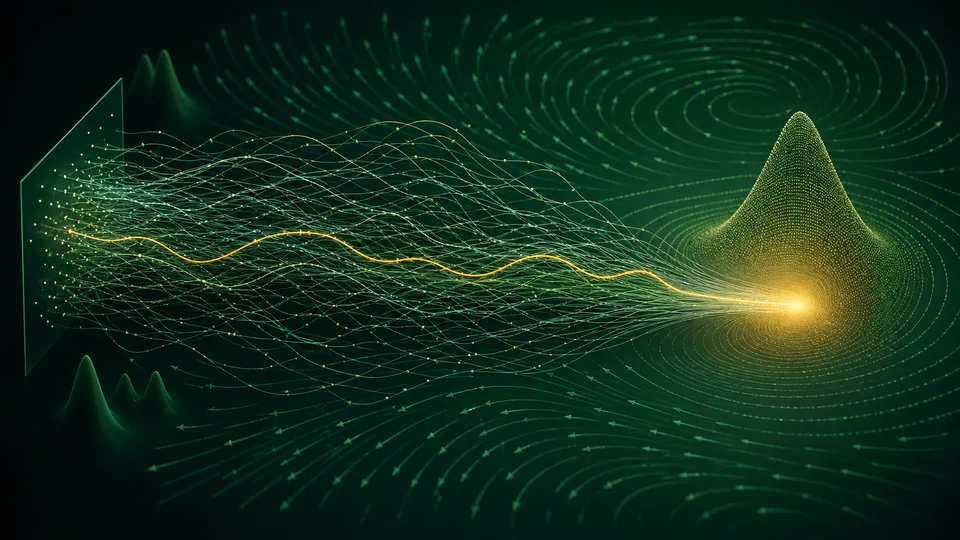
- One simulated trajectory illustrates variability but does not estimate a probability distribution reliably.
- Discretisation error and Monte Carlo error are distinct and require separate convergence checks.
Current research frontier
The frontier includes stochastic partial differential equations, rough paths, mean-field systems and controlled diffusions. Multilevel Monte Carlo reduces computational cost by combining coarse and fine paths. Rare-event algorithms estimate transition probabilities that direct simulation almost never observes. Score-based diffusion generative systems reverse a noise process using a learned score, creating links between probability, SDEs and machine learning. Open questions involve reliable inference for non-stationary systems, model misspecification and scalable uncertainty estimates in high-dimensional interacting processes.
Why it matters
SDEs connect microscopic randomness to macroscopic distributions and enable uncertainty-aware prediction, filtering and control. They underpin option pricing, molecular diffusion, climate variability, epidemiological models and modern score-based generative methods.
Limits and open questions
Noise structure is often inferred from limited and discretely sampled data, creating identifiability problems between drift, diffusion and measurement error. Rare transitions require specialised sampling. Classical assumptions can fail for jumps, memory or heavy tails, and numerical schemes may violate positivity, conservation or stability if chosen without regard to the equation.
Explore through connected concepts
This article is indexed with 20 technical tags. Select a tag to explore the Wiki by concept.
You may also explore
Recommended from the technical tags shared with this article.

Optimal Transport
A mathematical framework for transforming one distribution into another while minimising a defined movement cost.
Read article →