Topological Insulators
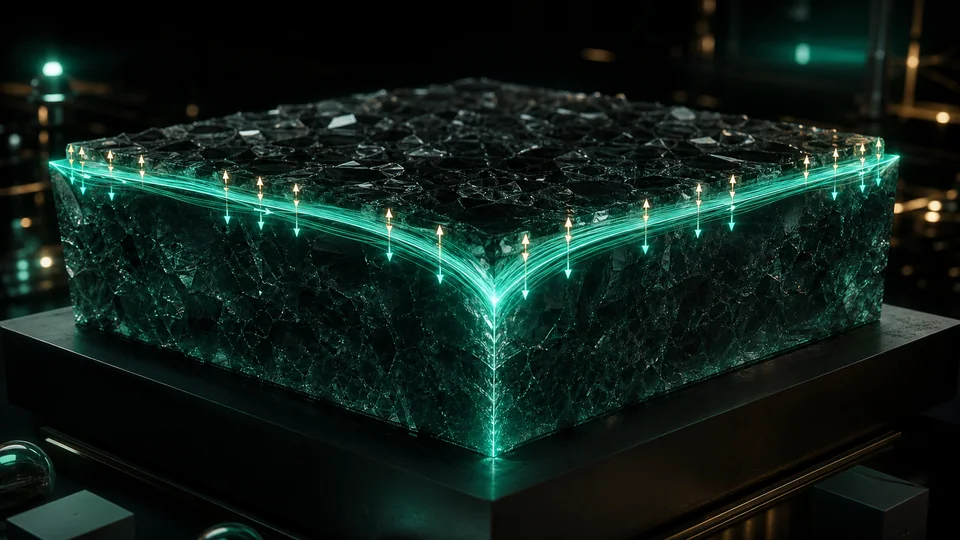
Quantum materials with an insulating bulk and robust conducting states at their surfaces or edges.
- Revision
- 1
- Created by
- SCIENDIA Knowledge Desk
- Updated by
- SCIENDIA Knowledge Desk
- Last updated
- 18.08.2026 10:51
Built by the community
Members can improve this article. Every saved change remains visible in the revision ledger.
Overview
A topological insulator is a material whose occupied electronic bands possess a global structure that cannot be continuously transformed into an ordinary insulator without closing the energy gap or breaking a protecting symmetry. Its interior can remain electrically insulating while boundaries host metallic states constrained by topology and, in many cases, time-reversal symmetry.
Technical foundations
Electronic topology is formulated from Bloch wave functions over the Brillouin zone. Berry connection and Berry curvature describe geometric phase structure, and integrals or symmetry indicators define invariants such as Chern numbers or time-reversal Z2 indices. In a two-dimensional quantum spin Hall insulator, counterpropagating edge channels form Kramers partners. In three dimensions, an odd number of surface-state crossings connects valence and conduction bands. Bulk-boundary correspondence links the invariant of the occupied bulk bands to the existence of boundary modes, provided the relevant energy gap and protecting symmetry remain meaningful.
How it works
Strong spin-orbit coupling can invert the ordering of electronic bands. At an interface with a topologically trivial material or vacuum, the invariant must change, forcing gap-crossing boundary states to appear. In a three-dimensional time-reversal-invariant topological insulator these states often form a Dirac-like surface cone with electron spin correlated to momentum.
Measurement and research methods
Angle-resolved photoemission spectroscopy maps surface dispersion and can identify a Dirac cone, spin-resolved measurements test spin texture, and scanning tunnelling spectroscopy probes local density of states and quasiparticle interference. Magnetotransport experiments examine weak antilocalisation, quantum oscillations and Hall responses, but parallel conduction through defects can imitate or obscure surface signals. First-principles calculations predict band inversion and symmetry eigenvalues, while composition, thickness and gating tune the Fermi level. Convincing identification combines spectroscopy, transport, dimensional scaling and control samples rather than relying on one characteristic curve.
Key ideas
- Topology classifies global properties of wave functions rather than the shape of a physical sample.
- Boundary conduction remains sensitive to disorder, contacts, magnetic perturbations and unintended bulk carriers.
- Different symmetries and dimensions support distinct topological phases and measurable responses.
Current research frontier
Current work extends topology to crystalline symmetry, higher-order boundary states, magnetic topological insulators, Weyl and Dirac semimetals, moire systems and non-Hermitian bands. Introducing superconductivity may create topological quasiparticles useful for protected quantum operations, although unambiguous Majorana evidence requires stringent alternatives to be excluded. Materials challenges include disorder, trivial surface accumulation layers and chemical instability. Researchers are developing thin films, heterostructures and electrostatic devices in which exchange, pairing and topology can be tuned reproducibly. The broader goal is to connect mathematical classification with a quantised, device-relevant response under realistic temperature and fabrication conditions.
Why it matters
Topological materials provide a laboratory for Berry phases, protected transport and unusual quasiparticles. They are investigated for low-dissipation electronics, spin conversion, precision metrology and platforms that may support fault-tolerant quantum information.
Limits and open questions
Protection is not absolute: interactions, symmetry breaking and coupling between opposite surfaces can open gaps or localise states. Producing low-defect crystals, placing the chemical potential in the bulk gap and distinguishing surface from bulk transport remain practical challenges.
Explore through connected concepts
This article is indexed with 20 technical tags. Select a tag to explore the Wiki by concept.
You may also explore
Recommended from the technical tags shared with this article.
Superconductivity
A collective quantum state in which electrical resistance vanishes and magnetic response changes below critical conditions.
Read article →