Black Hole Accretion Disks
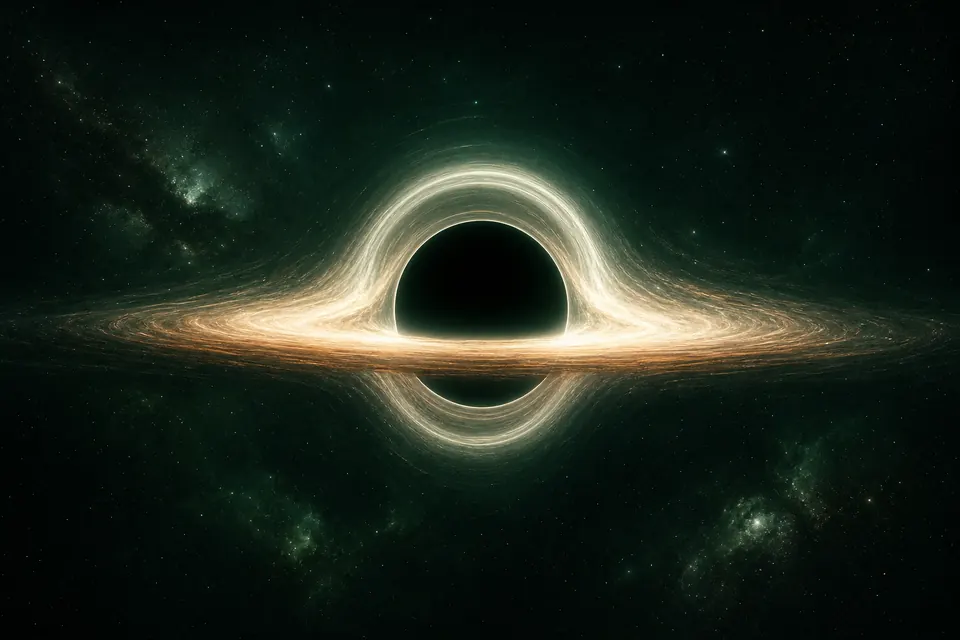
Rotating, heated flows of matter that release energy while spiralling toward a black hole.
- Revision
- 2
- Created by
- SCIENDIA Knowledge Desk
- Updated by
- SCIENDIA Knowledge Desk
- Last updated
- 17.08.2026 18:43
Built by the community
Members can improve this article. Every saved change remains visible in the revision ledger.
Overview
An accretion disk forms when gas falling toward a compact object has enough angular momentum to orbit rather than plunge directly inward. Friction-like stresses redistribute angular momentum, allowing some matter to move inward while energy is released as heat and radiation.
Technical foundations
A thin accretion disk is often modelled as a nearly Keplerian flow in which stresses transport angular momentum outward and allow mass to drift inward. In magnetised plasma, the magnetorotational instability drives turbulence that supplies this effective stress. Relativistic disk models place the inner edge near the innermost stable circular orbit, whose radius depends on black-hole spin. At high accretion rates radiation can be trapped and advected, whereas low-density flows may be optically thin, geometrically thick and dominated by ion-electron disequilibrium.
How it works
The disk's structure depends on accretion rate, magnetic fields, opacity and the black hole's mass and spin. Near the event horizon, relativistic motion, gravitational redshift and light bending shape the observed spectrum and image. Magnetic processes can also help launch powerful jets.
Measurement and research methods
Observers infer disk structure from broadband spectra, rapid variability, polarisation and relativistically broadened emission lines. Continuum fitting estimates an inner radius under assumptions about mass, inclination and spectral hardening. X-ray reflection spectroscopy models fluorescent iron lines, Compton scattering and gravitational energy shifts. Very-long-baseline interferometry resolves horizon-scale synchrotron emission, while reverberation lags measure light-travel delays between a compact corona and reflecting disk. Interpretation requires radiative-transfer calculations and careful treatment of absorption, calibration, variability and parameter degeneracy.
Key ideas
- The bright disk lies outside the event horizon; the black hole itself emits no light.
- Observed radiation comes from hot matter and its surrounding plasma.
- Gravitational lensing can make the far side of a disk appear above and below the shadow.
Current research frontier
General-relativistic magnetohydrodynamic simulations now evolve turbulent plasma around spinning black holes and generate synthetic spectra and images through ray tracing. Magnetically arrested disks can accumulate strong vertical magnetic flux and efficiently power relativistic jets through rotational energy extraction. Key uncertainties involve electron heating, non-thermal particle acceleration, magnetic-field topology and the geometry of the X-ray corona. Multiwavelength campaigns seek to connect horizon-scale dynamics to jets and galactic environments. Apparent shadows and rings are therefore model-dependent radiation structures shaped by both spacetime geometry and emitting plasma.
Why it matters
Accretion converts gravitational energy into radiation with high efficiency, making growing black holes visible across vast distances. Disk observations test strong gravity and reveal how black holes influence galaxies.
Limits and open questions
Real disks can be turbulent, variable and geometrically complex, so a single idealised ring is not a complete physical model. Connecting plasma-scale processes to large observations remains computationally challenging.
Explore through connected concepts
This article is indexed with 20 technical tags. Select a tag to explore the Wiki by concept.
You may also explore
Recommended from the technical tags shared with this article.
Gravitational Waves
Ripples in spacetime produced by accelerating mass distributions and detected through their effect on distance.
Read article →