Coral Reef Resilience
The capacity of reef ecosystems to resist disturbance, recover structure and retain ecological function under environmental change.
- Revision
- 1
- Created by
- SCIENDIA Knowledge Desk
- Updated by
- SCIENDIA Knowledge Desk
- Last updated
- 18.08.2026 11:45
Built by the community
Members can improve this article. Every saved change remains visible in the revision ledger.
Overview
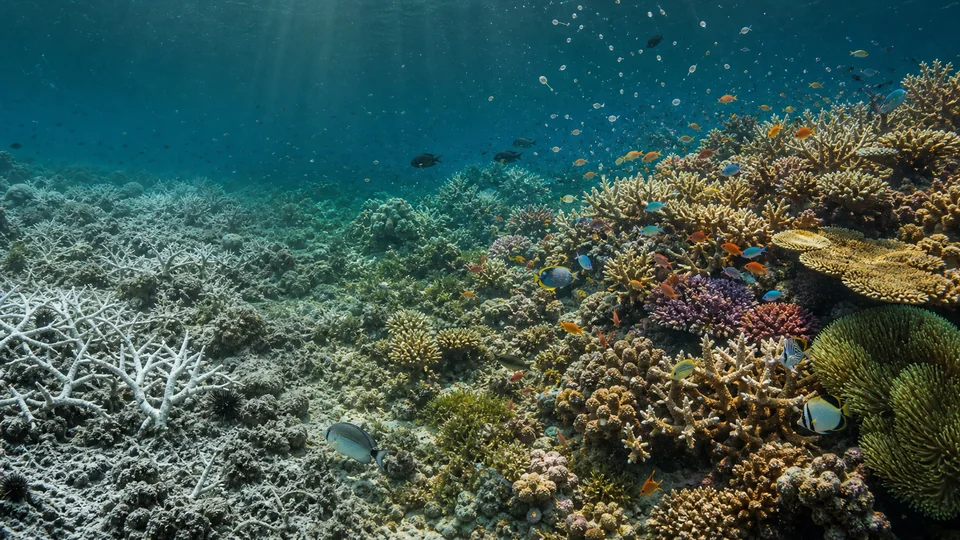
Coral reef resilience depends on interactions among coral physiology, symbiotic algae, herbivores, recruitment, disease, water quality and connectivity among reefs. A reef can survive a disturbance without major change or recover through growth and larval settlement, but repeated heat stress can shift it toward persistent algal dominance.
Technical foundations
Reef state emerges from coral growth and mortality, symbiont physiology, carbonate production and erosion, herbivory, competition and recruitment. Heat stress destabilises the partnership between coral hosts and photosynthetic dinoflagellates, leading to pigment loss and energy deficit. Degree-heating weeks summarise accumulated thermal exposure but do not capture every local modifier. Structural complexity creates habitat and wave resistance, while parrotfish, surgeonfish and urchins can suppress macroalgae. Connectivity supplies larvae across reefs, yet dispersal can also spread disease or poorly adapted genotypes.
How it works
Thermal anomalies can disrupt coral-algal symbiosis and cause bleaching. Survival varies with exposure history, genotype, symbiont community and local conditions. Recovery requires surviving colonies, reproductive supply, available substrate and grazing that prevents macroalgae from excluding recruits, all operating within regional ocean circulation and climate trends.
Measurement and research methods
Monitoring combines benthic transects, photogrammetry, autonomous acoustics, environmental DNA and satellite temperature products. Repeated permanent plots separate colony survival, growth and recruitment. Physiological assays measure photosynthetic efficiency, energy reserves and symbiont communities, while genomic studies test host adaptation. A resilience assessment should report coral composition, size structure, rugosity, herbivore biomass, disease and water quality rather than one cover percentage. Before-after-control-impact designs help evaluate protected areas or restoration, although marine heatwaves can affect controls and treatments simultaneously.
Key ideas
- Resilience includes both resistance during disturbance and recovery after it.
- Local management can improve recovery conditions but cannot eliminate global heat exposure.
- Coral cover alone does not capture diversity, structural complexity or ecosystem function.
Current research frontier
Research tests selective breeding, assisted gene flow, probiotics, cryopreserved gametes and settlement substrates, but field-scale benefit and ecological side effects remain uncertain. Restoration portfolios increasingly preserve genetic diversity and environmental representation instead of cloning a few fast-growing colonies. Forecast systems combine seasonal heat outlooks with local exposure and vulnerability. The largest constraint is the pace of ocean warming and acidification, which reduces the time available for recovery. Effective strategy joins emissions reduction with fisheries management, watershed control, disease surveillance and transparent triage rather than presenting restoration as a substitute for climate action.
Why it matters
Reefs support biodiversity, fisheries, tourism and coastal protection. Understanding resilience helps direct monitoring, protected areas and restoration toward sites and processes most likely to persist under future climates.
Limits and open questions
Recovery can take decades while marine heatwaves recur more frequently. Transplant and assisted-evolution approaches face scale, genetic diversity and ecological risk constraints, and historical baselines are often incomplete or already degraded.
Explore through connected concepts
This article is indexed with 20 technical tags. Select a tag to explore the Wiki by concept.
You may also explore
Recommended from the technical tags shared with this article.
Ocean Acidification
The long-term shift in seawater carbonate chemistry caused primarily by ocean uptake of anthropogenic carbon dioxide.
Read article →