Digital Twins
Continuously updated computational representations of physical assets or processes used to estimate state, test scenarios and guide decisions.
- Revision
- 1
- Created by
- SCIENDIA Knowledge Desk
- Updated by
- SCIENDIA Knowledge Desk
- Last updated
- 19.08.2026 09:05
Built by the community
Members can improve this article. Every saved change remains visible in the revision ledger.
Overview
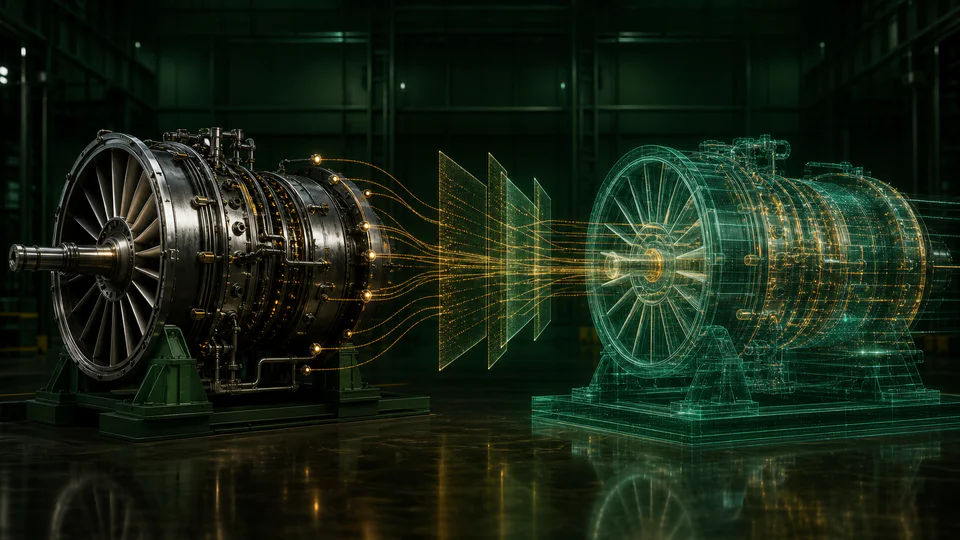
A digital twin links a physical system with a computational representation through observations over time. Unlike a static simulation, it updates state or parameters as new sensor, maintenance and operating data arrive. Twins can represent a component, factory, energy network, building or physiological process, with scope and fidelity chosen for a defined operational decision.
Technical foundations
A twin is a state-estimation and prediction system. Physical equations may be discretised with finite-element, network or reduced-order methods, while surrogate models approximate expensive components. Bayesian updating, Kalman filtering or particle methods assimilate observations and estimate latent variables. The twin also requires an asset information model connecting sensor channels to components, units and configuration versions. Control use introduces an additional requirement: recommendations must remain safe when the twin is uncertain or outside its validated operating envelope.
How it works
The twin combines geometry, physics-based equations, control logic and data-driven components. Data pipelines align measurements, assess quality and estimate hidden states. Calibration and data assimilation reconcile the model with the asset, while uncertainty propagation describes confidence in predictions. Operators use the twin for anomaly detection, remaining-life estimation, optimisation and safe testing of proposed control actions.
Measurement and research methods
Verification checks numerical implementation, while validation compares predictions with held-out physical observations. Commissioning establishes sensor calibration, time synchronisation and baseline parameters. Residual analysis detects drift and distinguishes sensor failure from asset change. Scenario tests vary loads and faults and report prediction intervals. For maintenance decisions, evaluation uses lead time, false-alarm cost and avoided downtime rather than generic accuracy. Governance records model versions, data provenance and human approval when outputs influence safety-critical control.
Key ideas
- A useful twin is defined by a decision and validation target, not by visual resemblance alone.
- Synchronization requires timestamps, configuration history and traceable links between physical and digital identities.
- Prediction uncertainty must include sensor error, parameter uncertainty and structural mismatch.
Current research frontier
Research creates fleet-level twins that transfer knowledge while preserving asset-specific differences, and hybrid twins that combine conservation laws with learned corrections. Edge computing supports low-latency updates, while interoperable semantic standards may reduce integration cost. Digital twins of patients are being explored but face especially difficult identifiability and clinical-validation questions. Open problems include structural uncertainty, real-time updating after system reconfiguration and preventing optimisation against a simulation artifact rather than improved physical performance.
Why it matters
Digital twins can reduce downtime, improve energy efficiency and support design feedback from deployed systems. They provide a shared technical object for engineers, operators and maintenance teams and can test rare or hazardous scenarios without risking the physical asset.
Limits and open questions
High-fidelity models can be too slow for operations, while simplified models may fail outside calibration conditions. Sensor drift, software changes and undocumented repairs break synchronization. Cybersecurity is critical because compromised data or control links can corrupt decisions. Economic value must be demonstrated against simpler monitoring and modelling alternatives.
Explore through connected concepts
This article is indexed with 20 technical tags. Select a tag to explore the Wiki by concept.
You may also explore
Recommended from the technical tags shared with this article.
Artificial Neural Networks
Layered computational models that learn distributed representations by adjusting weighted connections from data.
Read article →