Ecosystem Biodiversity
Variation within species, among species and across ecosystems, together with the interactions that sustain ecological function.
- Revision
- 2
- Created by
- SCIENDIA Knowledge Desk
- Updated by
- SCIENDIA Knowledge Desk
- Last updated
- 17.08.2026 18:43
Built by the community
Members can improve this article. Every saved change remains visible in the revision ledger.
Overview
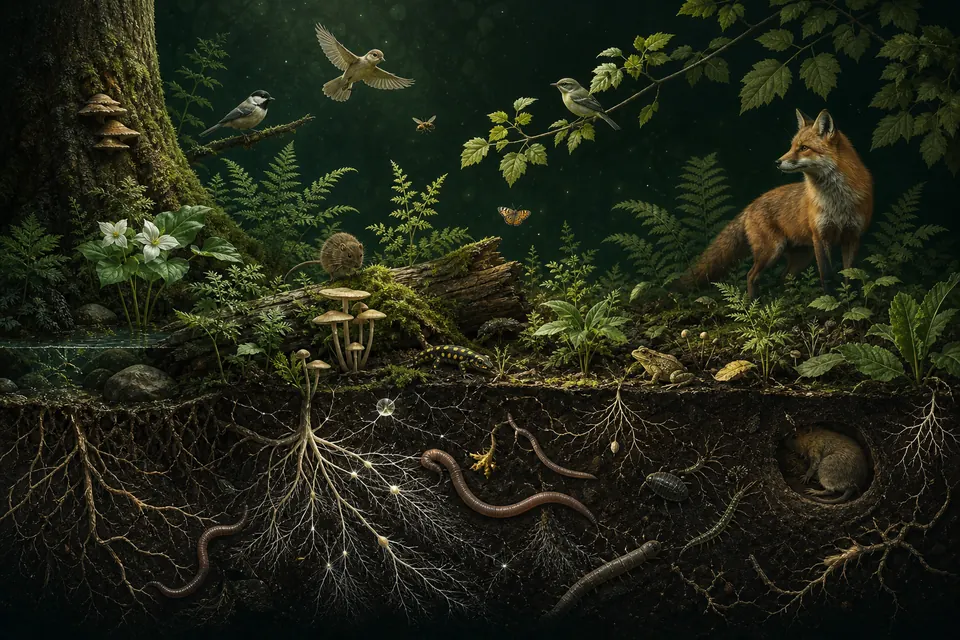
Biodiversity includes genetic diversity, species diversity and the diversity of habitats and ecological processes. It is not only a count of species; abundance, evolutionary history, spatial pattern and interaction networks also shape an ecosystem.
Technical foundations
Biodiversity is partitioned into alpha diversity within a site, beta diversity among sites and gamma diversity across a region. Richness counts taxa, whereas Shannon and Simpson indices also incorporate relative abundance. Phylogenetic and functional diversity measure evolutionary history and trait space, which may better predict ecosystem processes than species number alone. Interaction networks add trophic, mutualistic and competitive structure. Ecosystem function emerges from complementarity, selection effects, redundancy and response diversity, so two communities with identical richness can differ markedly in productivity, stability and resilience.
How it works
Energy flows through food webs while organisms cycle nutrients, modify habitats and respond to disturbance. Functional redundancy can buffer some changes, while the loss of a unique ecological role can produce effects disproportionate to one species' abundance.
Measurement and research methods
Field assessment combines standardised plots, transects, acoustic sensors, camera traps, remote sensing and environmental DNA. Occupancy models separate true absence from imperfect detection, while mark-recapture methods estimate population size and survival. Long-term experiments manipulate diversity or disturbance, and trait databases support cross-system synthesis. Spatial sampling must represent habitat heterogeneity and seasonality; taxonomic misidentification and uneven effort can distort trends. Satellite observations can map habitat structure and productivity but usually require ground validation before they are interpreted as species-level biodiversity.
Key ideas
- Diversity can be measured at local, regional and landscape scales.
- Community composition matters alongside total species richness.
- Soil organisms, microbes and fungi are major components of ecosystem function.
Current research frontier
Research focuses on causal links between biodiversity loss, ecosystem services and recovery under climate and land-use change. Metacommunity theory tracks dispersal among habitat patches, while genomic monitoring estimates adaptive potential and inbreeding. Conservation planning uses complementarity algorithms to protect sets of areas rather than isolated hotspots, and restoration evaluates whether interactions and functions return, not merely vegetation cover. Uncertainties include cryptic species, poorly sampled microbes and delayed extinction debt. Effective policy must therefore combine protected areas with connectivity, sustainable use, invasive-species control and continuous outcome monitoring.
Why it matters
Biodiversity supports food production, water regulation, soil formation, cultural value and resilience to environmental change. Monitoring it helps identify where conservation actions are most urgent and effective.
Limits and open questions
Relationships between diversity and stability depend on scale and context. Protecting a few charismatic species is not equivalent to conserving ecological networks, habitat quality and evolutionary potential.
Explore through connected concepts
This article is indexed with 20 technical tags. Select a tag to explore the Wiki by concept.
You may also explore
Recommended from the technical tags shared with this article.
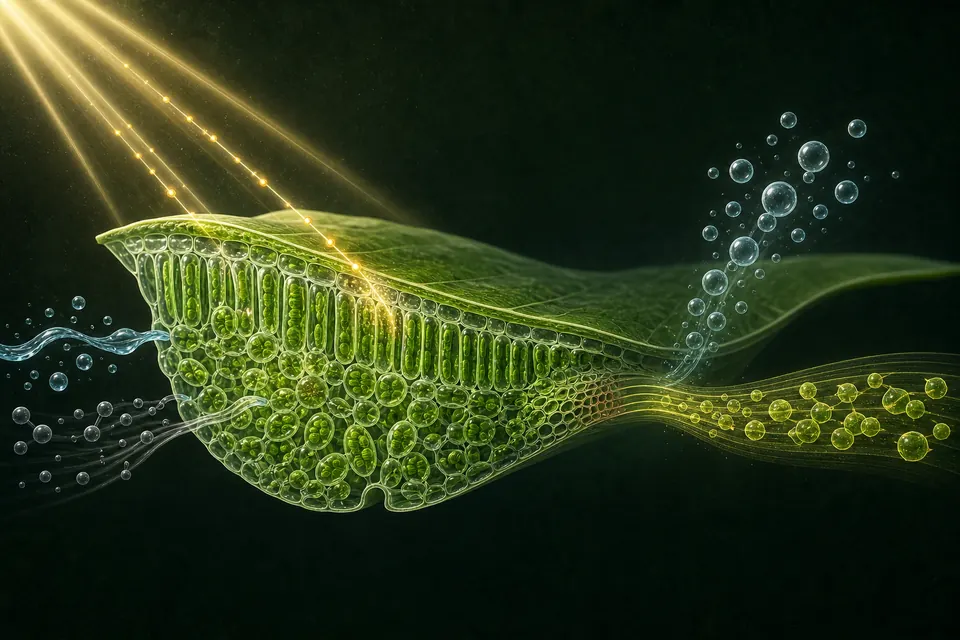
Photosynthesis
The biological conversion of light energy into chemical energy, coupled to carbon fixation in plants, algae and some bacteria.
Read article →