Epigenetic Regulation
Heritable or persistent control of gene activity mediated by chromatin state without changing DNA sequence.
- Revision
- 1
- Created by
- SCIENDIA Knowledge Desk
- Updated by
- SCIENDIA Knowledge Desk
- Last updated
- 18.08.2026 10:51
Built by the community
Members can improve this article. Every saved change remains visible in the revision ledger.
Overview
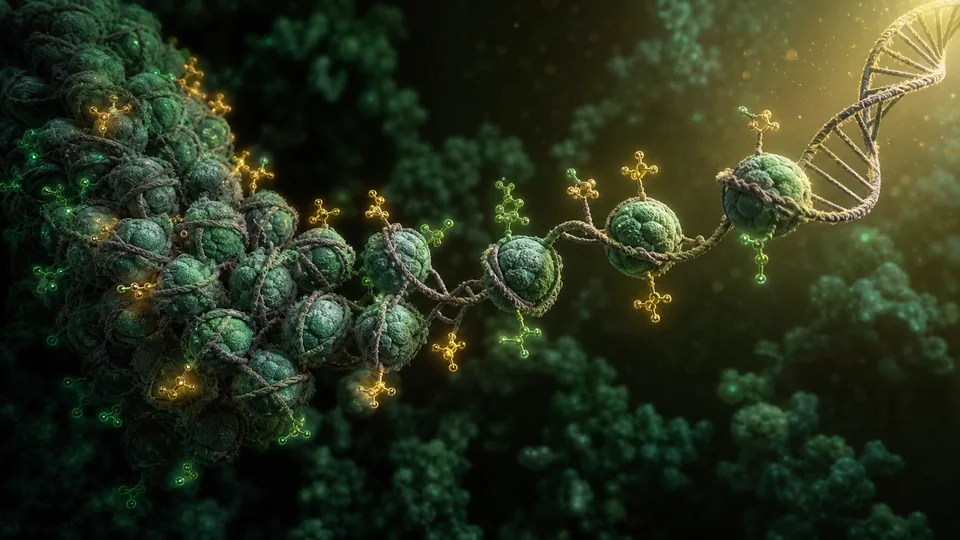
Epigenetic regulation describes molecular processes that influence access to genomic information and can persist through cell division. DNA methylation, histone modification, nucleosome positioning, chromatin remodelling and regulatory RNA help establish cell-specific transcriptional programmes even though most cells in an organism contain nearly the same DNA sequence.
Technical foundations
Cytosine methylation is deposited and maintained by DNA methyltransferases, while TET enzymes support oxidation and demethylation pathways. Histone tails carry acetylation, methylation and other modifications whose effects depend on residue, degree and protein context. Polycomb and Trithorax complexes participate in repressive and active memory, respectively, while ATP-dependent remodelers slide, evict or exchange nucleosomes. Enhancers, promoters, insulators and loop-extruding cohesin organise regulatory contacts within chromosomes. These layers interact with transcription factors and RNA polymerase rather than forming a separate code with one-to-one meanings.
How it works
Writer enzymes deposit chemical modifications, erasers remove them and reader proteins recruit complexes that alter chromatin or transcription. ATP-dependent remodelers reposition nucleosomes, while three-dimensional contacts connect promoters with distant regulatory elements. During replication and development, feedback among these components can restore a characteristic chromatin state.
Measurement and research methods
Bisulfite and enzymatic sequencing measure cytosine modification, chromatin immunoprecipitation profiles associated proteins or histone marks, and accessibility assays identify regions open to transposase or nuclease. Chromosome-conformation methods estimate physical contacts, while single-cell and spatial versions reveal heterogeneity. Antibody specificity, crosslinking, sequencing depth and cell composition create assay-specific biases. Causal experiments use targeted recruitment, degron-mediated protein removal or CRISPR-based epigenome editing, with time-resolved transcription and chromatin measurements to distinguish a mark required for regulation from one deposited after gene activity changes.
Key ideas
- Epigenetic marks are biochemical components of regulatory systems, not independent instructions with fixed meanings.
- Cell composition and developmental history strongly affect measurements from a tissue sample.
- Stable maintenance, reversible adaptation and transgenerational inheritance are separate evidential claims.
Current research frontier
Research investigates how chromatin states are copied through replication, reset during germline and embryonic development and altered with ageing. Disease studies map regulatory mutations and abnormal methylation, while epigenetic drugs target enzymes in selected cancers. Reprogramming experiments seek partial restoration of youthful states without loss of cell identity or tumour suppression. Major questions concern the stability and direction of environmental effects, the molecular carriers of memory and the extent of transgenerational inheritance. Multi-omic models increasingly link sequence, transcription-factor occupancy, chromatin, three-dimensional structure and expression, but predictions still require perturbational validation in the relevant cell type.
Why it matters
Epigenetic mechanisms explain how cell identities are maintained, how environments influence gene regulation and why genetically identical cells can behave differently. They are central to development, ageing, cancer biology and regenerative medicine.
Limits and open questions
Correlation between a chromatin mark and expression does not establish causation. Many marks are consequences as well as regulators of transcription, and evidence for environmentally induced inheritance across multiple human generations remains difficult to separate from genetic and social factors.
Explore through connected concepts
This article is indexed with 20 technical tags. Select a tag to explore the Wiki by concept.
You may also explore
Recommended from the technical tags shared with this article.
Chromatin Architecture
The three-dimensional organisation of DNA, histones and regulatory complexes that helps control genome activity inside the nucleus.
Read article →