Chromatin Architecture
The three-dimensional organisation of DNA, histones and regulatory complexes that helps control genome activity inside the nucleus.
- Revision
- 1
- Created by
- SCIENDIA Knowledge Desk
- Updated by
- SCIENDIA Knowledge Desk
- Last updated
- 19.08.2026 09:05
Built by the community
Members can improve this article. Every saved change remains visible in the revision ledger.
Overview
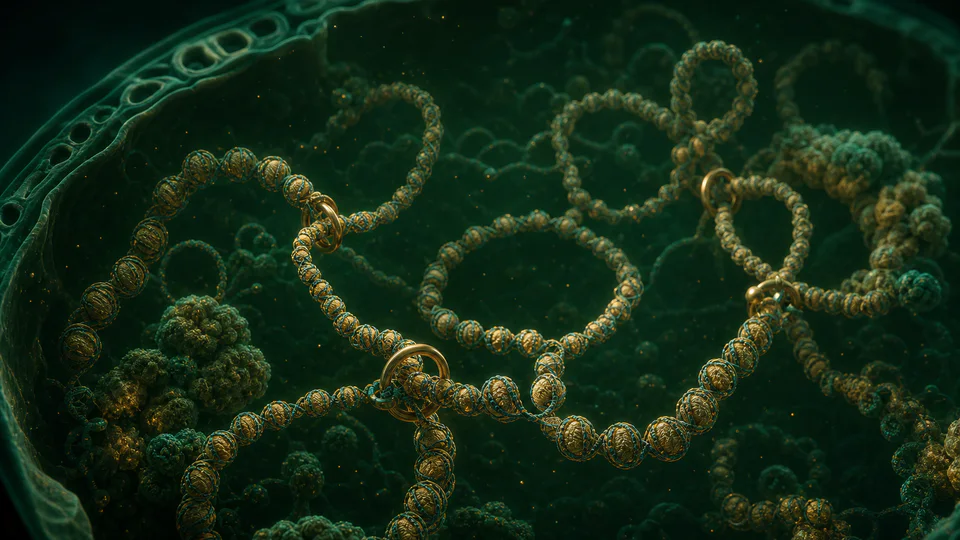
Chromatin architecture describes how long DNA molecules are folded from nucleosomes into loops, domains, compartments and chromosome territories. This organisation is dynamic rather than a fixed scaffold. It influences which enhancers contact promoters, how replication proceeds, where DNA damage is repaired and which genomic regions remain active or repressed in a particular cell state.
Technical foundations
Chromatin is a polymer whose monomers are nucleosomes, but its folding is constrained by sequence-specific proteins, transcriptional activity and the nuclear environment. Loop extrusion models treat cohesin as a motor-like complex that enlarges a chromatin loop until release or a convergent CTCF boundary. At larger scales, preferential interactions among active or inactive regions produce A and B compartments. Polymer ensembles reconcile frequent local contacts with substantial cell-to-cell variability. Topological stress, condensates and tethering to the lamina or nucleolus create additional organisational layers.
How it works
Cohesin complexes can extrude loops until they encounter oriented boundary proteins such as CTCF, helping form contact domains. Active and inactive chromatin segregate into broad compartments through polymer interactions and associated proteins. Transcription, supercoiling, nuclear lamina attachment and phase-separated condensates further shape local contacts. During mitosis, interphase organisation is replaced by compact chromosomes and then rebuilt after division.
Measurement and research methods
Chromosome-conformation-capture methods ligate DNA segments that were crosslinked near one another, producing contact matrices after sequencing and bias correction. Imaging methods such as multiplexed fluorescence in-situ hybridisation trace loci directly in single cells, while live-cell tagging measures movement. Protein-centric assays map cohesin, CTCF, histone marks and transcription factors. Perturbations use degrons, boundary deletion or targeted recruitment, followed by transcription and contact measurements. Resolution, cell number, genomic distance and batch effects must be reported because they strongly influence apparent domains and loops.
Key ideas
- A contact-frequency map reports population probabilities, not one literal structure shared by every cell.
- Enhancer proximity can support regulation without proving that a detected contact is causal.
- Genome sequence, epigenetic state, transcription and nuclear mechanics jointly determine folding.
Current research frontier
Current research integrates single-cell conformation, imaging, accessibility, transcription and lineage data to connect folding with cell fate. Mechanistic studies ask when a contact drives gene regulation and when both arise from a third process. Disease work examines enhancer hijacking, repeat expansion and altered compartmentalisation. Synthetic looping systems may test causal rules or control therapeutic genes. Remaining problems include reconstructing dynamic four-dimensional trajectories from sparse snapshots and explaining how local molecular events scale into reproducible chromosome territories without assuming one consensus structure.
Why it matters
Three-dimensional genome analysis explains how distant regulatory variants can affect genes and why structural rearrangements sometimes activate oncogenes. It informs developmental biology, rare-disease diagnosis, cancer research and strategies for engineering gene regulation without changing protein-coding sequence.
Limits and open questions
Chromatin structures vary across cells and time, while most assays average millions of conformations or trade coverage for single-cell resolution. Crosslinking and reconstruction can introduce bias. Perturbing an architectural protein often changes transcription and cell physiology simultaneously, making it difficult to separate direct folding mechanisms from secondary effects.
Explore through connected concepts
This article is indexed with 20 technical tags. Select a tag to explore the Wiki by concept.
You may also explore
Recommended from the technical tags shared with this article.
Epigenetic Regulation
Heritable or persistent control of gene activity mediated by chromatin state without changing DNA sequence.
Read article →