Exoplanet Detection
Methods for identifying and characterising planets orbiting stars beyond the Solar System.
- Revision
- 2
- Created by
- SCIENDIA Knowledge Desk
- Updated by
- SCIENDIA Knowledge Desk
- Last updated
- 17.08.2026 18:43
Built by the community
Members can improve this article. Every saved change remains visible in the revision ledger.
Overview
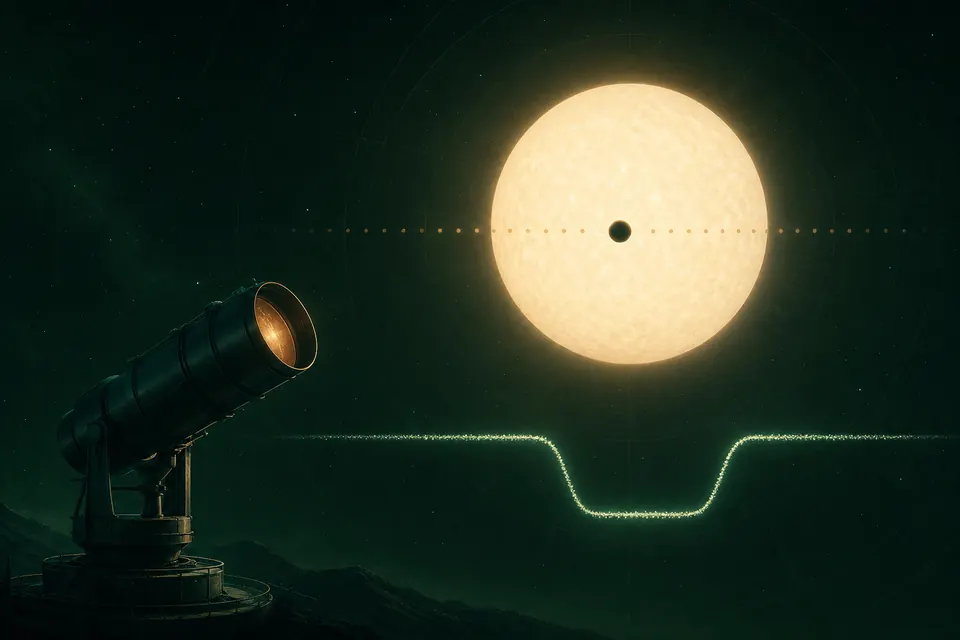
Most exoplanets are detected indirectly because their host stars are much brighter. A transit produces a periodic dip in starlight when a planet crosses the stellar disk, while radial-velocity measurements detect the star's line-of-sight motion caused by an orbiting companion.
Technical foundations
Transit photometry measures the fractional stellar-flux loss, approximately the squared planet-to-star radius ratio for a small opaque planet, but limb darkening, starspots and orbital geometry modify the light curve. Radial velocity measures Doppler shifts and yields a mass multiplied by the sine of unknown inclination. Astrometry measures sky-plane stellar motion, microlensing uses transient gravitational magnification, and direct imaging suppresses starlight to resolve young or widely separated planets. Each method therefore samples a different region of planet mass, radius, period and host-star properties.
How it works
Repeated signals reveal orbital period and help reject noise or stellar variability. Transit depth estimates the planet-to-star area ratio; radial velocity constrains a minimum mass. Combining methods can yield density, while spectroscopy during a transit can probe atmospheric absorption.
Measurement and research methods
Candidate validation combines repeated observations, instrumental systematics models and tests for eclipsing binaries or contaminating background stars. Transit timing variations can reveal additional planets, while joint transit and radial-velocity fits provide bulk density. Atmospheric transmission and emission spectroscopy compare wavelength-dependent transit depth or planet-star contrast with radiative-transfer models. Retrievals infer molecular abundance, clouds and temperature probabilistically, but results depend on opacity data, stellar spectra and model assumptions. Injection-recovery experiments quantify survey completeness and are essential for estimating occurrence rates from detected samples.
Key ideas
- Each method has selection effects that favour particular planet sizes and orbits.
- A periodic dimming event is a candidate signal until alternative explanations are tested.
- Planet properties depend on accurate knowledge of the host star.
Current research frontier
The frontier targets temperate terrestrial planets, atmospheric chemistry and planetary-system architecture. High-contrast instruments use coronagraphs, adaptive optics and wavefront control, while future space telescopes aim to suppress a host star by many orders of magnitude. Stellar activity can mimic Doppler signals and contaminate transmission spectra, motivating simultaneous photometric and spectroscopic monitoring. A potential biosignature must be evaluated in chemical and geological context, with false-positive pathways and multiple gases considered. Detecting a planet, locating it in a nominal habitable zone and demonstrating inhabited conditions are three distinct evidential steps.
Why it matters
Exoplanet surveys reveal the diversity of planetary systems and test theories of planet formation and evolution. Atmospheric studies are beginning to compare the chemistry and climate of worlds unlike those in our Solar System.
Limits and open questions
Detection does not by itself demonstrate habitability or life. Stellar activity, instrumental systematics and geometric biases complicate interpretation, especially for small planets around active stars.
Explore through connected concepts
This article is indexed with 20 technical tags. Select a tag to explore the Wiki by concept.
You may also explore
Recommended from the technical tags shared with this article.
Planetary Habitability
The capacity of a planetary environment to sustain conditions compatible with life over relevant places and times.
Read article →