Geothermal Reservoir Engineering
The characterisation and management of subsurface heat, fluids and fractures for durable geothermal energy production.
- Revision
- 1
- Created by
- SCIENDIA Knowledge Desk
- Updated by
- SCIENDIA Knowledge Desk
- Last updated
- 18.08.2026 14:57
Built by the community
Members can improve this article. Every saved change remains visible in the revision ledger.
Overview
Geothermal reservoir engineering connects geological structure, heat transport and well performance. A productive system must deliver hot fluid at a useful rate while maintaining pressure, limiting unwanted chemical reactions and avoiding rapid thermal breakthrough. Reservoirs may be naturally permeable hydrothermal systems or engineered volumes where stimulation improves flow through hot rock.
Technical foundations
Reservoir performance follows conservation of mass and energy in porous or fractured rock. Darcy-type relations connect pressure gradient, permeability and fluid viscosity, while relative permeability and capillary pressure describe multiphase flow. Enthalpy determines extractable thermal power, and conductive plus advective heat transport controls recharge. Fractures can dominate permeability but occupy little volume, creating a tension between rapid production and early cooling. Thermoelastic contraction and pressure change alter effective stress, aperture and seismic slip potential during injection.
How it works
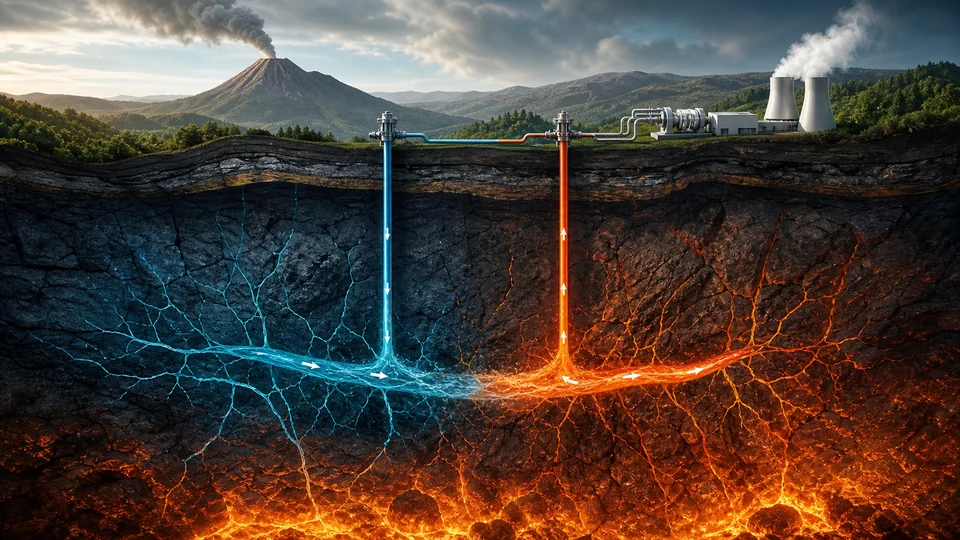
Production wells remove hot brine or steam, surface equipment converts part of its energy and injection wells return cooled fluid. Pressure-transient tests, tracers and geophysical monitoring constrain connected fractures and storage. Numerical models couple multiphase flow, heat transfer, stress and geochemistry to forecast decline and design well spacing, injection rate and make-up drilling.
Measurement and research methods
Engineers combine well logs, cores, pressure build-up, interference tests and chemical tracers to estimate transmissivity and connected volume. Microseismic arrays map stimulated fracture responses, although event clouds are not direct permeability images. Production history is matched with numerical models that represent wells, faults and uncertain boundary conditions. Forecasts use ensembles rather than one deterministic realisation. Fluid sampling tracks scaling minerals, non-condensable gases and corrosion. Surface and downhole temperature, pressure and flow meters close the mass and energy balance and reveal changes requiring operational adjustment.
Key ideas
- Stored heat is not equivalent to economically recoverable heat at an acceptable flow rate.
- Injection sustains mass balance but can shorten thermal lifetime if flow paths connect too directly.
- Reservoir management must integrate chemistry, geomechanics and surface conversion rather than optimise wells in isolation.
Current research frontier
Enhanced and closed-loop concepts seek heat where natural permeability or fluid is insufficient. Multi-lateral wells increase contact area, supercritical conditions may raise enthalpy and repurposed oilfield data can reduce exploration uncertainty. Research focuses on stimulation protocols that improve injectivity without unacceptable seismic response, high-temperature tools and coupled fracture evolution. Economic optimisation must include drilling failure, parasitic pumping and declining temperature. Long-term sustainability is demonstrated through monitored reinjection and adaptive rates, not by the size of an in-place heat estimate. Community governance needs transparent traffic-light protocols, baseline seismicity and clear responsibility for induced events.
Why it matters
Geothermal plants can provide firm low-carbon heat and electricity with a small surface footprint. Better subsurface imaging and drilling may extend development beyond conventional volcanic regions and supply industrial heat directly.
Limits and open questions
Exploration and drilling carry high upfront risk, corrosion and scaling damage equipment, and stimulation can induce felt seismicity. Sustainable output is site-specific; long-term monitoring, adaptive operation and transparent seismic-risk governance are required to avoid overestimating resource life.
Explore through connected concepts
This article is indexed with 20 technical tags. Select a tag to explore the Wiki by concept.
You may also explore
Recommended from the technical tags shared with this article.

Plate Tectonics
The framework that explains the motion of Earth's lithospheric plates and the concentration of geological activity at their boundaries.
Read article →