Heterogeneous Catalysis
Chemical acceleration at an interface where reactants and catalyst occupy different physical phases.
- Revision
- 1
- Created by
- SCIENDIA Knowledge Desk
- Updated by
- SCIENDIA Knowledge Desk
- Last updated
- 18.08.2026 11:45
Built by the community
Members can improve this article. Every saved change remains visible in the revision ledger.
Overview
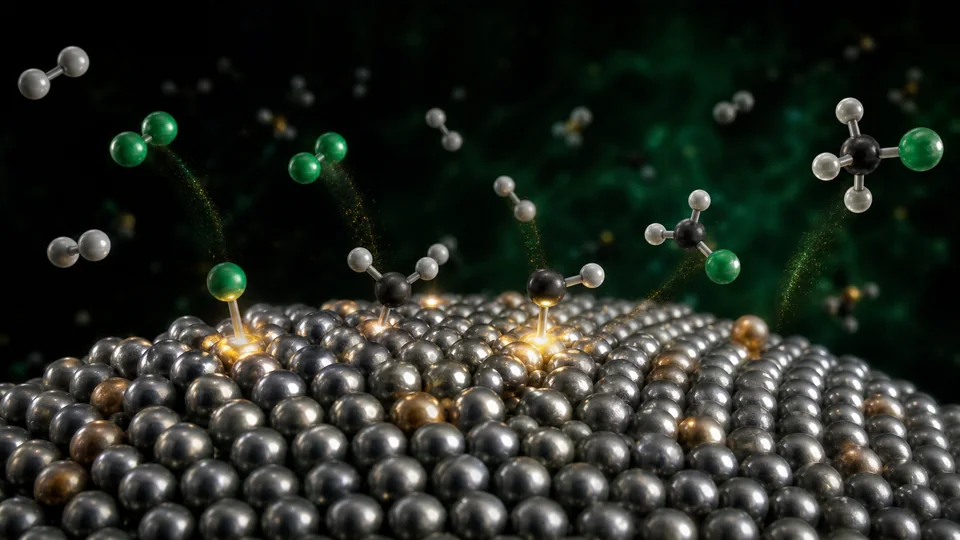
Heterogeneous catalysts are usually solids that provide surface sites where gas- or liquid-phase reactants adsorb, rearrange and form products through a lower-energy pathway. Activity depends on surface composition, atomic geometry, defects and the surrounding reaction environment rather than bulk formula alone.
Technical foundations
Surface reactions are described as elementary adsorption, diffusion, reaction and desorption steps. Langmuir-Hinshelwood mechanisms involve two adsorbed reactants, whereas Eley-Rideal pathways combine an adsorbate with a gas-phase species. Microkinetic models solve coverage-dependent rate equations using activation and adsorption energies, with detailed balance preserving thermodynamic consistency. Sabatier's principle predicts an optimum between binding too weakly to activate reactants and too strongly to release products. Real catalysts expose terraces, steps, vacancies, supports and interfaces, creating site ensembles whose abundance changes with particle size and environment.
How it works
Reactants diffuse to a surface, bind at active sites and undergo elementary bond-breaking or bond-forming steps. Products desorb and leave sites available for another cycle. The slowest kinetically influential steps and surface coverages determine observed rate, while heat and mass transport can obscure intrinsic chemistry in practical reactors.
Measurement and research methods
Temperature-programmed methods, chemisorption and isotopic transients measure adsorption and turnover, while infrared, Raman, X-ray and electron spectroscopies identify intermediates and oxidation states. Operando cells attempt measurement at working pressure and temperature, reducing the gap between ultrahigh-vacuum surface science and reactors. Density-functional theory proposes pathways but requires uncertainty in exchange-correlation approximations and coverage. Intrinsic kinetics must be separated from external mass transfer, pore diffusion and heat gradients using particle-size tests and dimensionless criteria. Turnover frequencies need defensible active-site counts and stable conversion conditions.
Key ideas
- Catalysts change reaction rates and pathways without changing equilibrium thermodynamics.
- The most active surface under operating conditions may differ from the prepared material.
- Selectivity is as important as conversion when competing products carry different costs.
Current research frontier
Research pursues single-atom catalysts, dynamic active sites, electrified interfaces and data-driven catalyst discovery. Machine learning accelerates energy prediction, but training sets must cover relevant compositions and transition states. Earth-abundant replacements for platinum-group metals are important for hydrogen, ammonia and carbon-dioxide conversion. Catalyst design increasingly includes reactor integration, separations and life-cycle impacts because a selective pathway may still be uneconomic at system scale. Remaining challenges include predicting reconstruction, controlling support effects, preventing deactivation and transferring atomic-scale insight into durable shaped catalysts manufactured by the tonne.
Why it matters
Heterogeneous catalysis underpins fuels, fertilisers, polymers, pollution control and many commodity chemicals. Improved selectivity and lower-temperature operation can reduce energy demand, waste and dependence on scarce elements.
Limits and open questions
Active sites restructure, poison, sinter or coke during use, and laboratory powders do not reproduce industrial pellets and flow fields. Mechanistic assignments can be non-unique because transient intermediates are difficult to observe under realistic pressure and temperature.
Explore through connected concepts
This article is indexed with 20 technical tags. Select a tag to explore the Wiki by concept.
You may also explore
Recommended from the technical tags shared with this article.
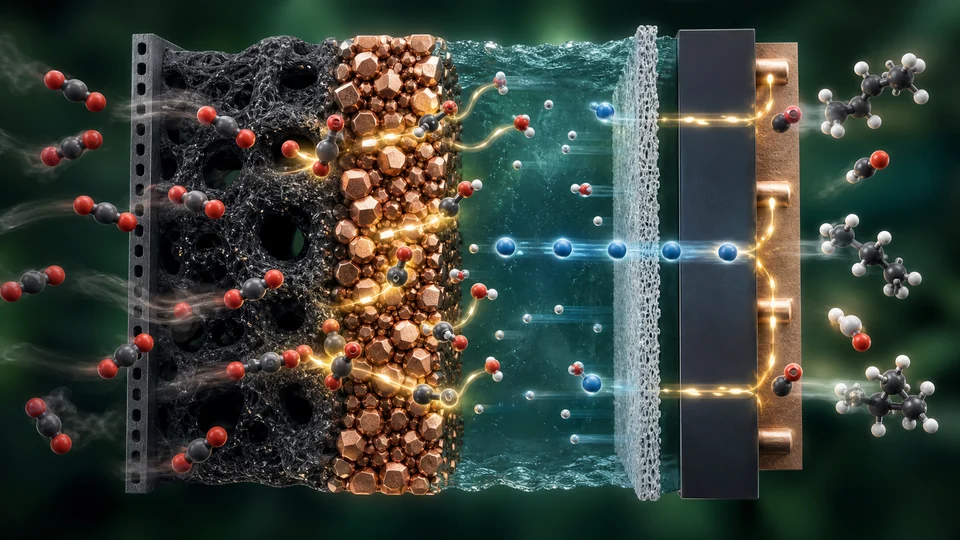
Electrochemical Carbon Dioxide Reduction
The use of electricity, catalysts and electrochemical interfaces to convert carbon dioxide into chemical products.
Read article →