Neutrino Oscillations
The quantum-mechanical transformation of neutrinos among electron, muon and tau flavours during propagation.
- Revision
- 1
- Created by
- SCIENDIA Knowledge Desk
- Updated by
- SCIENDIA Knowledge Desk
- Last updated
- 18.08.2026 11:45
Built by the community
Members can improve this article. Every saved change remains visible in the revision ledger.
Overview
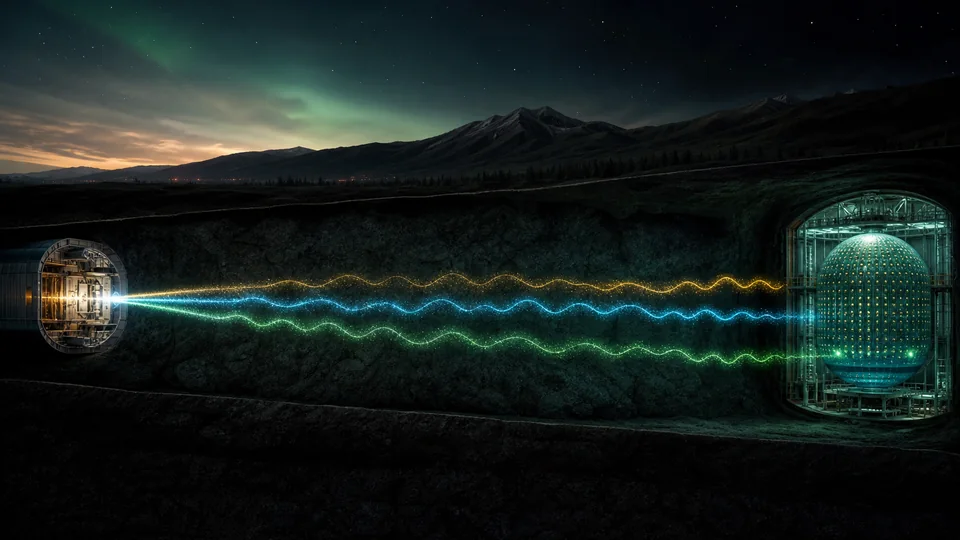
Neutrino oscillation occurs because flavour states created in weak interactions are coherent combinations of propagation states with different masses. Their phases evolve at slightly different rates, so the probability of detecting a particular flavour changes with travel distance and energy. This observation established that neutrinos have non-zero mass beyond the simplest Standard Model.
Technical foundations
Flavour and mass states are related by the Pontecorvo-Maki-Nakagawa-Sakata mixing matrix. During propagation, each mass eigenstate accumulates a phase proportional to its squared mass divided by energy, producing interference when a weak interaction projects the state back onto flavour. Three-flavour oscillations depend on two independent mass-squared splittings, three mixing angles and a complex phase that can violate charge-parity symmetry. Coherence requires wave packets to overlap; averaging over poorly resolved energy or extremely long baselines suppresses visible oscillatory structure without converting the process into classical flavour switching.
How it works
A source produces neutrinos with a known flavour composition. After a controlled or natural baseline, detectors infer flavour from charged particles and secondary radiation. Comparing energy spectra and event rates across baselines constrains mass-squared differences, mixing angles and a possible charge-parity-violating phase while accounting for interactions with matter.
Measurement and research methods
Solar, atmospheric, reactor and accelerator experiments provide different baselines and energies. Water Cherenkov, liquid scintillator, liquid-argon and tracking calorimeter detectors identify flavour through interaction products, but event reconstruction depends on nuclear cross sections and detector response. Near detectors constrain the initial beam and interaction model, while far detectors measure disappearance or appearance spectra. Fits jointly vary flux, energy calibration, backgrounds and oscillation parameters. Matter effects arise from coherent forward scattering on electrons and can enhance selected transitions, supplying sensitivity to mass ordering and distinguishing neutrino from antineutrino propagation.
Key ideas
- Oscillation measures differences between squared masses rather than the absolute neutrino mass scale.
- Coherent phase evolution links the observable probability to both baseline and neutrino energy.
- Matter changes effective mixing differently for neutrinos and antineutrinos.
Current research frontier
Long-baseline programmes seek the mass ordering and the phase associated with leptonic charge-parity violation, while complementary reactors refine mixing parameters. Sterile-neutrino searches test whether additional states explain anomalous spectra, though inconsistent datasets and nuclear modelling demand caution. Astrophysical neutrinos traverse densities and distances unavailable on Earth, probing flavour composition and exotic interactions. Major open questions include the absolute mass scale, Dirac versus Majorana character and connections to early-universe matter generation. Progress requires combined analyses with controlled correlations rather than selecting one experiment or anomaly in isolation.
Why it matters
Neutrino oscillations probe physics inaccessible to charged particles and may help explain why the observable universe contains more matter than antimatter. They connect particle physics, nuclear processes, astrophysical explosions and cosmology.
Limits and open questions
Unknown mass ordering, cross-section uncertainties and detector systematics complicate precision measurements. Oscillation alone cannot determine whether neutrinos are their own antiparticles or establish their absolute masses, and new interactions can mimic standard parameter changes.
Explore through connected concepts
This article is indexed with 20 technical tags. Select a tag to explore the Wiki by concept.
You may also explore
Recommended from the technical tags shared with this article.
Axion Dark Matter Searches
Experiments that test whether extremely light, weakly interacting axions or axion-like particles constitute the unseen matter in galaxies.
Read article →