Organoids
Three-dimensional, self-organising cell cultures that reproduce selected structural and functional features of organs.
- Revision
- 1
- Created by
- SCIENDIA Knowledge Desk
- Updated by
- SCIENDIA Knowledge Desk
- Last updated
- 18.08.2026 11:13
Built by the community
Members can improve this article. Every saved change remains visible in the revision ledger.
Overview
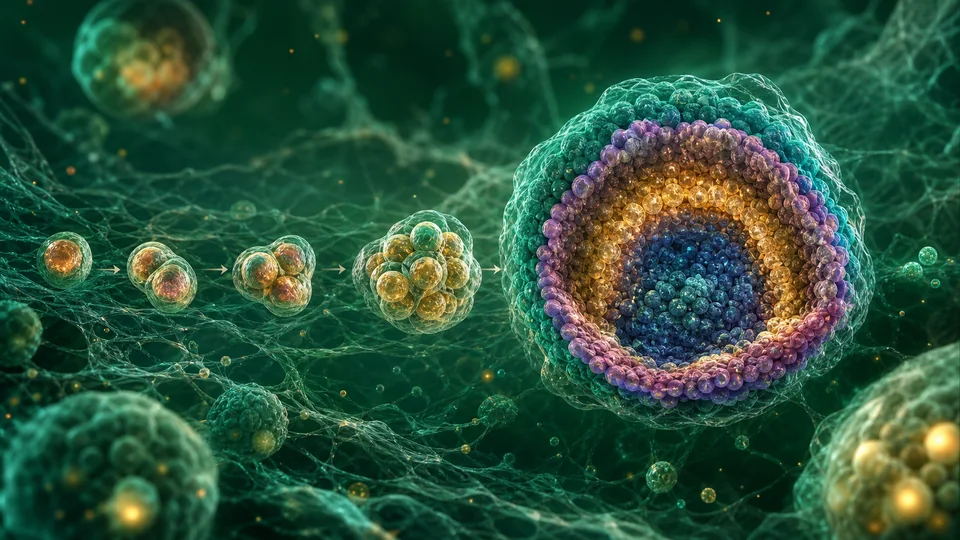
Organoids are grown from pluripotent or tissue-resident stem cells under conditions that guide differentiation and self-organisation. They do not recreate an entire organ, but can model epithelial architecture, cell diversity and developmental programmes more realistically than many two-dimensional cultures.
Technical foundations
Organoid formation relies on stem-cell competence, morphogen gradients and cell-cell or cell-matrix feedback that allow populations to break symmetry and form organised domains. Adult stem-cell organoids often maintain tissue-specific epithelial lineages, whereas pluripotent stem cells can traverse developmental trajectories toward brain, kidney, liver or retinal identities. WNT, BMP, FGF, TGF-beta and Notch signals are activated or inhibited in timed combinations. The extracellular matrix supplies biochemical ligands and mechanical resistance, but commonly used animal-derived matrices vary between batches and complicate quantitative control and clinical translation.
How it works
Cells are embedded in an extracellular matrix or scaffold and exposed to timed growth-factor signals that mimic developmental pathways. Local interactions generate spatial patterning and specialised cell types. Researchers analyse morphology, function, imaging and single-cell molecular profiles, then compare the culture with primary tissue and known developmental references.
Measurement and research methods
Validation compares organoids with reference tissue using histology, electrophysiology, barrier assays, imaging and single-cell or spatial omics. Lineage tracing tests developmental relationships, and perturbations can use CRISPR, pathogens or candidate drugs. Replicate cultures should span independent differentiations, donors and matrix batches because many cells from one organoid are not independent biological replicates. Microfluidic perfusion, air-liquid interfaces and organ-on-chip systems improve nutrient delivery and mechanical cues. Drug studies must measure penetration, metabolism and toxicity and avoid assuming that an in-vitro concentration reproduces systemic exposure.
Key ideas
- An organoid is a model with defined fidelity, not a miniature complete organ.
- Matrix composition and protocol variation can change cell identity and architecture.
- Vascular, immune, neural and mechanical components often require deliberate co-culture or engineering.
Current research frontier
The frontier includes vascularised and immune-competent cultures, assembloids that connect regional models and bioprinted scaffolds with controlled geometry. Patient-derived tumour organoids support functional drug testing, while gene-corrected organoids explore regenerative transplantation. Long-term maturation and reproducible scale-up remain difficult because diffusion limits create hypoxia and necrotic cores. Researchers are replacing undefined matrices with synthetic hydrogels and shared quality standards. Ethical governance must evolve for complex neural organoids, embryo-like models and biobanks, addressing donor consent, genomic privacy, commercial use, chimeric transplantation and evidence-based thresholds for additional oversight.
Why it matters
Organoids enable studies of human development, infection, inherited disease, cancer and patient-specific drug response while reducing reliance on some animal experiments. Biobanks can preserve diverse genotypes for reproducible comparative research.
Limits and open questions
Many organoids remain immature, poorly vascularised and variable between batches. Culture matrices may be chemically undefined, drug exposure differs from living tissue and increasingly complex neural or reproductive models raise ethical questions about consent, oversight and permissible endpoints.
Explore through connected concepts
This article is indexed with 20 technical tags. Select a tag to explore the Wiki by concept.
You may also explore
Recommended from the technical tags shared with this article.
Bioprinting
Layer-by-layer fabrication of living tissue constructs using cells, biomaterials and spatially controlled deposition.
Read article →