Perovskite Solar Cells
Thin-film photovoltaic devices built around halide-perovskite absorbers with tunable optoelectronic properties.
- Revision
- 1
- Created by
- SCIENDIA Knowledge Desk
- Updated by
- SCIENDIA Knowledge Desk
- Last updated
- 18.08.2026 11:13
Built by the community
Members can improve this article. Every saved change remains visible in the revision ledger.
Overview
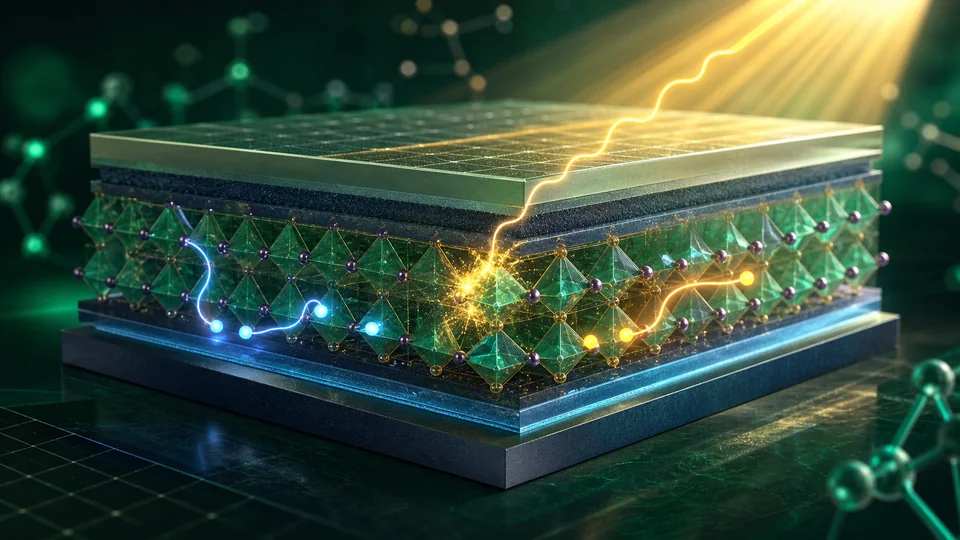
Perovskite solar cells use semiconductors with the ABX3 structural motif, commonly containing an organic or inorganic A-site cation, a metal at the B site and halide anions. Their strong absorption, adjustable band gap and long carrier diffusion lengths permit efficient devices fabricated from relatively low-temperature solution or vapour processes.
Technical foundations
Halide perovskites adopt corner-sharing metal-halide octahedra whose composition controls lattice symmetry, band gap and defect energetics. Absorbed photons create electron-hole populations that thermalise and diffuse toward selective contacts. Device voltage is limited by radiative and non-radiative recombination, whereas current depends on absorption, collection and parasitic optical loss. Many point defects are relatively shallow, but surfaces, grain boundaries and poorly aligned transport layers introduce deep traps. Mobile ionic species redistribute under illumination and bias, coupling electronic response to slower structural and chemical processes.
How it works
Light creates mobile electrons and holes in the perovskite layer. Selective transport layers extract opposite charge carriers toward electrodes while suppressing recombination. Composition, crystal growth, defect passivation and interface energetics determine voltage and current. In tandem devices, a wide-band-gap perovskite cell harvests higher-energy photons above a silicon or lower-gap subcell.
Measurement and research methods
Research cells are characterised with current-voltage scans in both directions, stabilised maximum-power tracking and external quantum-efficiency spectra. Reporting aperture area, scan rate, preconditioning, temperature and spectral mismatch is necessary because hysteresis can inflate an isolated scan. Time-resolved photoluminescence, impedance spectroscopy and transient measurements probe recombination and transport, while diffraction, electron microscopy and surface spectroscopy reveal phases and interfaces. Accelerated ageing protocols combine heat, humidity, light and electrical bias, but lifetime extrapolation requires failure models validated against outdoor modules rather than a single short stress test.
Key ideas
- High laboratory efficiency must be evaluated together with operational stability and scalable area.
- Interfaces and mobile ions can dominate hysteresis, degradation and long-term performance.
- Encapsulation and recycling are integral to managing moisture, oxygen and lead-containing materials.
Current research frontier
Current development emphasises perovskite-silicon tandems, scalable coating and compositions that resist phase segregation. Molecular passivators reduce interfacial recombination, two-dimensional capping layers slow moisture ingress and diffusion barriers limit metal migration. Lead-management strategies include robust encapsulation, capture layers and closed-loop recycling; replacing lead without sacrificing electronic quality remains difficult. Manufacturing research controls solvent evaporation and crystallisation over large areas while reducing toxic processing chemicals. Key open questions concern decades-long stability, reproducible module yield, bankable field data and life-cycle impacts that include material sourcing, energy payback, repair and end-of-life recovery.
Why it matters
Perovskites could lower photovoltaic manufacturing energy and enable lightweight, flexible or high-efficiency tandem modules. Their tunable chemistry also supports photodetectors, light-emitting devices and radiation sensing.
Limits and open questions
Heat, illumination, electrical bias and humidity can drive phase segregation or chemical decomposition. Lead toxicity, solvent handling, electrode reactions and the gap between small-area records and durable commercial modules remain central engineering and governance challenges.
Explore through connected concepts
This article is indexed with 20 technical tags. Select a tag to explore the Wiki by concept.
You may also explore
Recommended from the technical tags shared with this article.
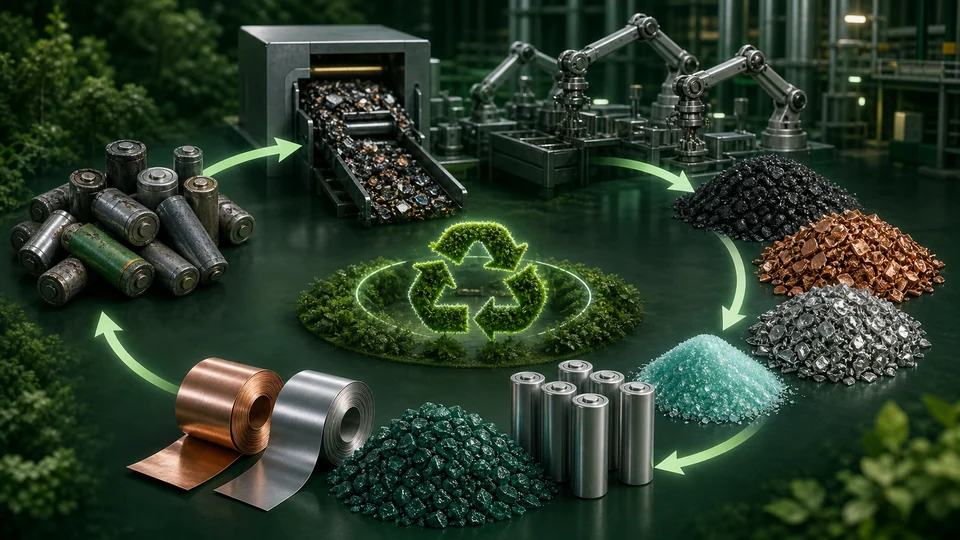
Battery Recycling
Processes that recover materials and functional components from spent batteries for safe treatment and renewed production.
Read article →