Quantum Computing
Computation that controls quantum states to process information using interference, entanglement and measurement.
- Revision
- 2
- Created by
- SCIENDIA Knowledge Desk
- Updated by
- SCIENDIA Knowledge Desk
- Last updated
- 17.08.2026 18:43
Built by the community
Members can improve this article. Every saved change remains visible in the revision ledger.
Overview
A quantum computer represents information in qubits, whose state can contain coherent combinations of basis values. Quantum gates transform joint states so that probability amplitudes interfere before measurement produces classical outcomes.
Technical foundations
Quantum computation represents an n-qubit register in a complex vector space of dimension two to the power n, but algorithms access that state only through allowed operations and measurement. Unitary gates create interference patterns, and entangling gates generate correlations unavailable to independent qubits. Circuit complexity counts gate number, depth and connectivity, while practical resource estimates also include state preparation and readout. Quantum speed-ups arise from problem structure, as in phase estimation, amplitude amplification and period finding, rather than from evaluating every classical answer and reading them all at once.
How it works
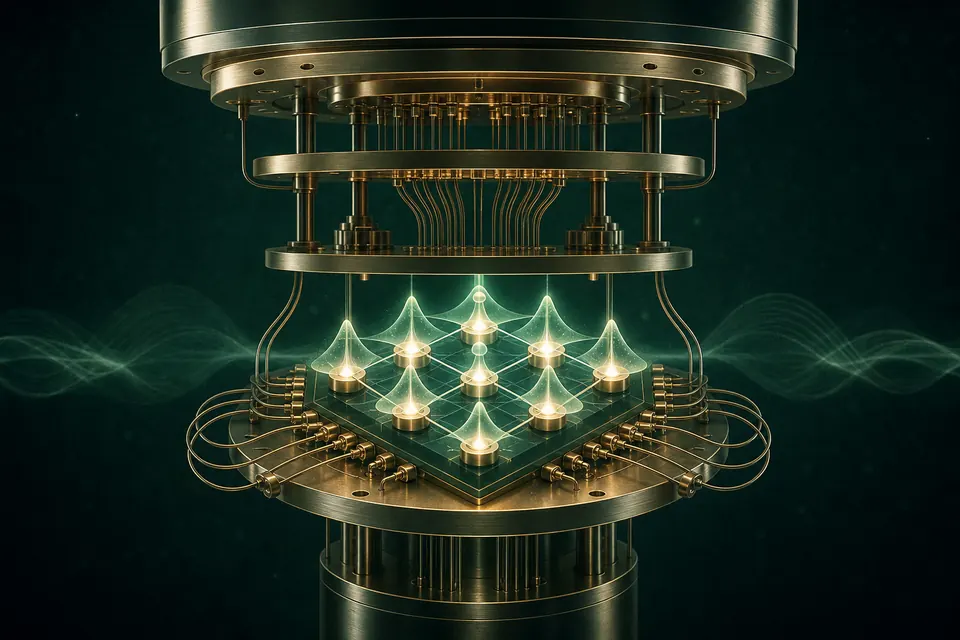
Algorithms are designed to amplify useful outcomes or estimate properties that are difficult to access classically. Physical implementations include superconducting circuits, trapped ions, neutral atoms, photons and spins. Error correction encodes logical information across many imperfect physical qubits.
Measurement and research methods
Hardware is characterised through relaxation and dephasing times, gate and measurement fidelity, crosstalk and leakage outside the computational subspace. Randomised benchmarking estimates average error, while tomography and cycle benchmarking provide richer but more expensive diagnostics. Useful comparisons include total runtime, success probability and classical preprocessing, not qubit count alone. Error mitigation extrapolates or cancels noise without full fault tolerance, whereas quantum error correction repeatedly measures syndromes to detect faults while preserving logical information. Surface-code thresholds still require large physical-qubit overhead and fast classical decoding.
Key ideas
- A qubit does not reveal all amplitudes when measured; measurement returns limited classical data.
- Quantum advantage is problem-specific rather than a universal speed-up.
- Useful fault-tolerant machines require error rates below demanding thresholds and substantial overhead.
Current research frontier
Near-term research tests whether analogue simulators or specialised circuits produce scientifically useful results beyond classical methods. Fault-tolerant roadmaps optimise magic-state production, logical gate synthesis and architecture-specific connectivity. Quantum networking introduces distributed entanglement and modular processors, while blind and verifiable computation address trust. Claims of advantage require transparent benchmarks against strong classical algorithms running on comparable tasks. Open challenges include correlated noise, scalable cryogenic or optical control, manufacturability, and resource estimates for chemistry, optimisation and cryptanalysis that include precision, data loading and error-correction costs.
Why it matters
Promising applications include quantum-system simulation, selected optimisation and algebraic tasks, and new cryptographic capabilities. The field also drives advances in control, cryogenics and precision measurement.
Limits and open questions
Current processors are noisy and limited in scale. Whether a proposed application outperforms the best classical method must be established through careful resource estimates and fair benchmarks.
Explore through connected concepts
This article is indexed with 20 technical tags. Select a tag to explore the Wiki by concept.
You may also explore
Recommended from the technical tags shared with this article.
Quantum Error Correction
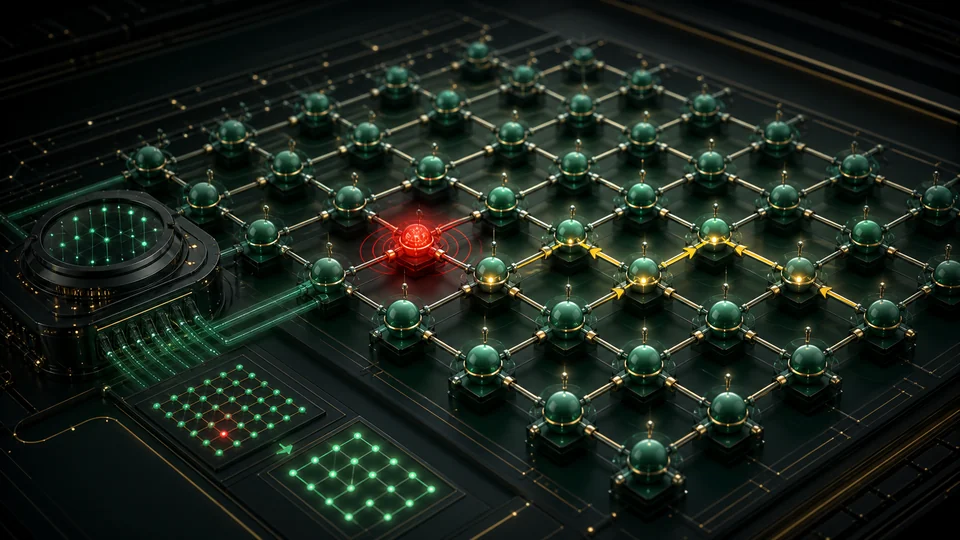
Methods that encode fragile logical quantum information across many physical qubits and diagnose errors without reading the protected state directly.
Read article →