Viral Evolution
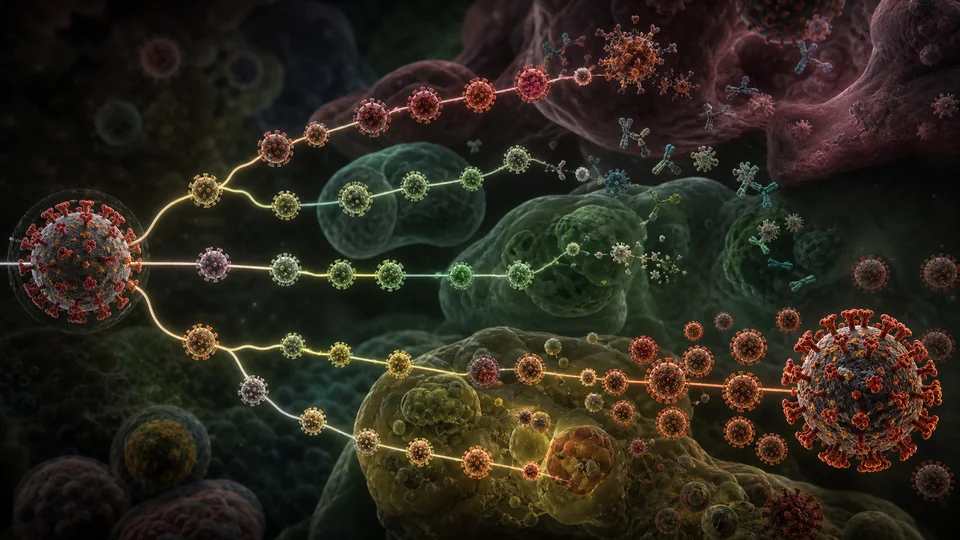
The change of viral populations through mutation, selection, recombination, migration and genetic drift across hosts and time.
- Revision
- 1
- Created by
- SCIENDIA Knowledge Desk
- Updated by
- SCIENDIA Knowledge Desk
- Last updated
- 18.08.2026 12:20
Built by the community
Members can improve this article. Every saved change remains visible in the revision ledger.
Overview
Viruses evolve rapidly because large populations generate variation and transmission repeatedly samples that variation. Fitness depends on replication, immune escape, host range and transmission, but improvements in one context can impose costs in another.
Technical foundations
Viral evolutionary rates reflect polymerase fidelity, generation time, genome architecture and selection. RNA viruses often mutate rapidly, while DNA viruses can evolve more slowly but recombine extensively. Fitness landscapes are shaped by epistasis: the effect of one mutation depends on other substitutions. Purifying selection removes many harmful variants, whereas positive selection can favour receptor binding, immune escape or drug resistance. Transmission bottlenecks reduce diversity between hosts, and reassortment in segmented viruses can exchange whole genome segments during coinfection.
How it works
Polymerase errors, recombination or genome reassortment create variants. Selection changes their frequencies within hosts and between hosts, while population bottlenecks and founder effects add chance. Phylogenetic trees and time-resolved sequences reconstruct ancestry, spread and adaptation under explicitly modelled sampling.
Measurement and research methods
Genomic surveillance sequences representative samples with dates and locations, performs quality control and builds phylogenetic or phylodynamic models. Molecular-clock estimates require tested rate assumptions and account for uneven sampling. Deep sequencing measures within-host variants but must separate true low-frequency alleles from amplification errors. Neutralisation assays, receptor-binding studies and competition experiments test phenotypic consequences. Epidemiological growth advantage is estimated with lineage frequencies and covariates; it should not be inferred from a cluster size without accounting for founder events and public-health interventions.
Key ideas
- Mutation produces variation; selection and drift determine which variants persist.
- Within-host advantage need not increase transmission between hosts.
- Sequence similarity alone cannot prove a direct transmission event.
Current research frontier
Research links genotype to antigenic phenotype, forecasts lineage turnover and studies cross-species emergence. Experimental evolution reveals repeatable pathways but laboratory hosts and transmission differ from nature. Wastewater and metagenomic surveillance broaden detection while raising mixture-deconvolution challenges. Open problems include predicting epistatic combinations, integrating animal reservoirs and quantifying how immunity reshapes selection. Responsible interpretation avoids naming every new mutation a threat and uses convergent epidemiological, laboratory and clinical evidence before revising vaccines or countermeasures.
Why it matters
Understanding viral evolution guides vaccines, antiviral stewardship, genomic surveillance and risk assessment for emerging diseases. It also reveals general principles of adaptation in rapidly changing populations.
Limits and open questions
Sampling is uneven across locations and hosts, recombination can violate tree assumptions and apparent growth can reflect surveillance bias. Forecasting specific future mutations remains difficult because epistasis and ecological opportunity reshape the fitness landscape.
Explore through connected concepts
This article is indexed with 20 technical tags. Select a tag to explore the Wiki by concept.
You may also explore
Recommended from the technical tags shared with this article.
Antibiotic Resistance
The inherited ability of microorganisms to survive or grow at drug concentrations that would normally inhibit them.
Read article →