Volcanic Eruption Dynamics
The coupled flow, degassing and fragmentation processes that govern how magma reaches the surface and erupts.
- Revision
- 1
- Created by
- SCIENDIA Knowledge Desk
- Updated by
- SCIENDIA Knowledge Desk
- Last updated
- 18.08.2026 10:51
Built by the community
Members can improve this article. Every saved change remains visible in the revision ledger.
Overview
Volcanic behaviour emerges from magma composition, temperature, dissolved volatiles, crystal content, conduit geometry and surrounding stress. As magma rises and pressure falls, water, carbon dioxide and other gases exsolve into bubbles. Their growth changes magma density and viscosity and can drive acceleration, fragmentation and explosive release.
Technical foundations
Silicate-melt viscosity varies by orders of magnitude with temperature, composition, crystal fraction and dissolved water. As pressure decreases, volatile solubility falls and bubbles nucleate, grow by diffusion and expand. The relative timescales of ascent, bubble growth, crystallisation and gas escape control whether pressure is relieved or retained. Fragmentation can occur when gas volume fraction and stress exceed the strength or relaxation capacity of the magma. Above the vent, turbulent entrainment of air may produce a buoyant plume, whereas insufficient entrainment can generate a collapsing fountain and pyroclastic density current.
How it works
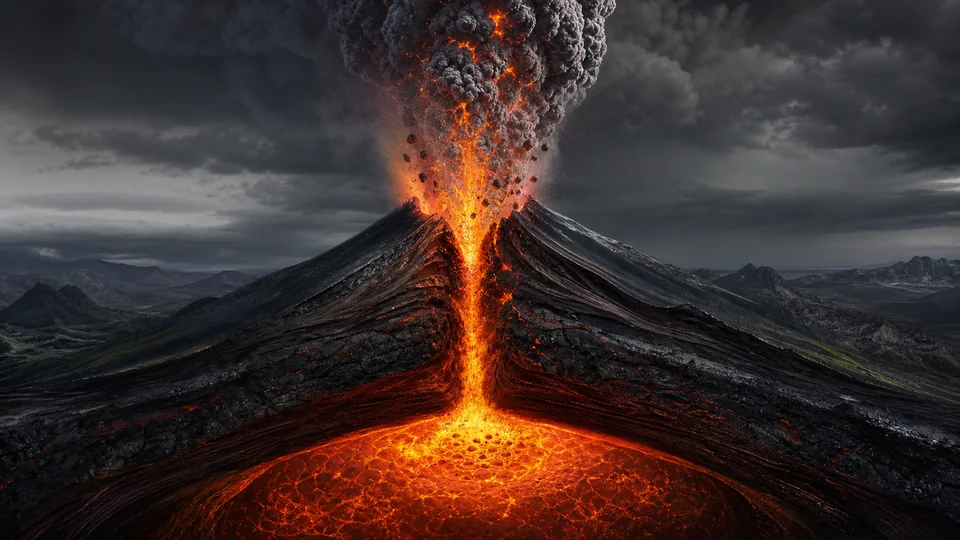
Magma stored in a crustal reservoir may propagate through a dike and enter a conduit. Gas can remain coupled to melt, escape through permeable pathways or accumulate beneath a plug. If bubbles expand faster than pressure can relax, the mixture can fragment into ash and gas that feeds an eruption column or dense pyroclastic current.
Measurement and research methods
Monitoring networks combine earthquake location and waveform, ground deformation from GNSS and radar, gas flux and composition, infrasound, thermal imaging and satellite ash detection. Petrological analysis of crystals and melt inclusions constrains storage pressure, temperature and pre-eruptive volatile content. Deposit grain size, componentry and stratigraphy reveal parts of the eruption sequence. Inversion models connect observations to source processes, but non-unique solutions are common. Operational forecasts therefore update scenarios as evidence changes and explicitly communicate uncertainty, detection limits and the possibility of unobserved pathways.
Key ideas
- Eruption style can change during one event as supply, permeability and conduit conditions evolve.
- Identical bulk compositions may erupt differently because ascent rate and volatile history differ.
- Monitoring signals indicate changing subsurface processes but do not map uniquely to one outcome.
Current research frontier
Current models couple multiphase conduit flow, porous gas escape, fracture, plume dynamics and atmospheric transport. Experiments and numerical simulations investigate how plugs fail, how magma transitions between open- and closed-system degassing and how caldera collapse interacts with reservoir withdrawal. Machine-learning classifiers can recognise signal patterns but must be evaluated across volcanoes and changing instrumentation. High-priority work seeks reliable precursors of escalation, rapid estimates of ash injection height and probabilistic maps for compound hazards. Social vulnerability, communication and evacuation logistics are essential to risk reduction even when the geophysical forecast is technically strong.
Why it matters
Understanding eruption dynamics supports hazard maps, aviation warnings and decisions about evacuation. The field also illuminates crustal magmatism, volatile cycling and the climatic influence of major eruptions.
Limits and open questions
Conduits are rarely observable directly, and deposits incompletely preserve transient processes. Forecasts must therefore combine uncertain models with seismic, deformation, gas and thermal data; they express conditional probabilities rather than deterministic eruption times or sizes.
Explore through connected concepts
This article is indexed with 20 technical tags. Select a tag to explore the Wiki by concept.
You may also explore
Recommended from the technical tags shared with this article.

Plate Tectonics
The framework that explains the motion of Earth's lithospheric plates and the concentration of geological activity at their boundaries.
Read article →