Gene Regulatory Networks
Interacting genes, regulatory DNA and molecular factors that control when and where biological programmes are expressed.
- Revision
- 1
- Created by
- SCIENDIA Knowledge Desk
- Updated by
- SCIENDIA Knowledge Desk
- Last updated
- 18.08.2026 11:45
Built by the community
Members can improve this article. Every saved change remains visible in the revision ledger.
Overview
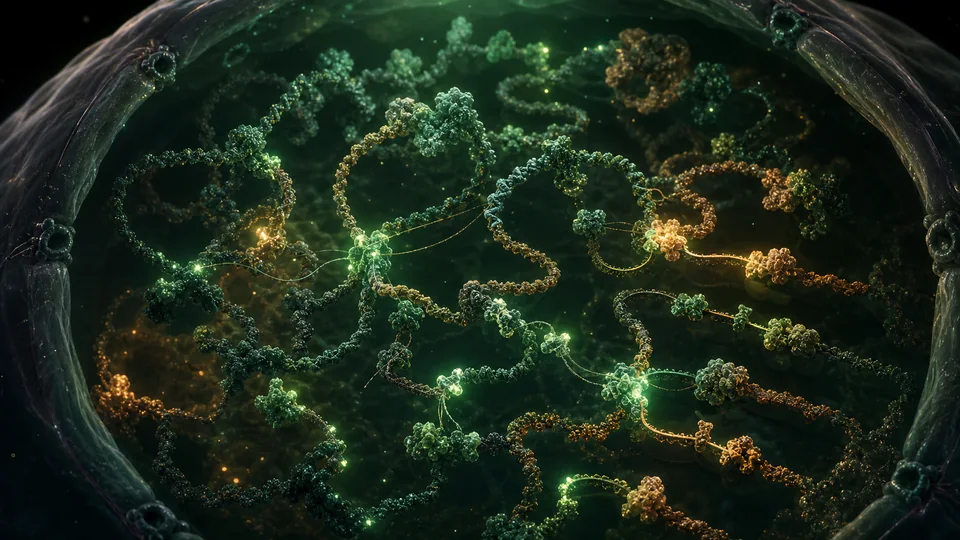
Gene regulatory networks describe how transcription factors, chromatin state, enhancers, promoters and non-coding RNAs jointly influence gene expression. Feedback and feed-forward motifs can stabilise cell identity, generate oscillations, filter noise or switch between developmental states.
Technical foundations
Regulatory networks can be represented as directed signed graphs, but functional behaviour depends on binding affinities, cooperative occupancy, chromatin accessibility and degradation rates. Ordinary differential equations model continuous concentrations, stochastic processes capture bursty transcription and Boolean networks approximate qualitative state transitions. Enhancers contact promoters through three-dimensional chromatin organisation, while pioneer factors open previously inaccessible regions. Positive feedback can create bistability and memory; negative feedback stabilises expression; incoherent feed-forward loops generate pulses or adaptation. The same topology can therefore produce different dynamics when parameters or molecular context change.
How it works
Signals modify regulators that bind DNA or alter chromatin accessibility. Their combined action changes transcription initiation and RNA abundance, which in turn changes protein concentrations and downstream regulation. Network behaviour emerges from binding kinetics, degradation, spatial organisation and interactions with signalling and metabolic systems.
Measurement and research methods
Chromatin-accessibility assays, transcription-factor binding profiles, nascent-RNA measurements and single-cell transcriptomics supply complementary evidence. Perturb-seq combines genetic perturbation with single-cell readout to test candidate edges at scale, while reporter assays isolate regulatory sequences from some genomic context. Time-course and lineage-tracing data help orient dependencies that static correlation cannot. Inference methods use regression, mutual information, Bayesian networks or dynamical models, but should be benchmarked on held-out perturbations. Batch correction must preserve biological transitions rather than erasing them, and indirect effects should not be labelled as direct binding.
Key ideas
- A regulatory edge is conditional on cell type, developmental state and environment.
- Correlation between genes does not establish a direct regulatory interaction.
- Network motifs acquire meaning through quantitative parameters and biological context.
Current research frontier
Current work builds cell-state atlases, predicts enhancer logic from sequence and designs synthetic circuits that remain stable under changing burden. Spatial multi-omics links regulation to tissue neighbourhood, while allele-specific measurements expose cis-regulatory variation. Foundation models can propose regulatory elements but require functional validation and uncertainty estimates. Open problems include long-range enhancer assignment, context-dependent transcription-factor grammar and integration of signalling, metabolism and mechanics. Therapeutic network control also demands safe delivery and avoidance of compensatory pathways, because changing a highly connected regulator can cause widespread unintended effects.
Why it matters
Regulatory networks explain differentiation, adaptation and disease progression and guide cell engineering, crop improvement and therapeutic target discovery. They link genomic sequence to dynamic phenotype more directly than gene lists alone.
Limits and open questions
Networks inferred from sparse expression data are often non-identifiable and omit protein activity, spatial structure or hidden regulators. Perturbations can trigger compensatory paths, while population averages obscure rare states and temporal ordering.
Explore through connected concepts
This article is indexed with 20 technical tags. Select a tag to explore the Wiki by concept.
You may also explore
Recommended from the technical tags shared with this article.
Epigenetic Regulation
Heritable or persistent control of gene activity mediated by chromatin state without changing DNA sequence.
Read article →