Mitochondrial ATP Synthesis
How electron transport and a proton gradient power ATP production across the inner mitochondrial membrane.
- Revision
- 2
- Created by
- SCIENDIA Knowledge Desk
- Updated by
- SCIENDIA Knowledge Desk
- Last updated
- 17.08.2026 18:43
Built by the community
Members can improve this article. Every saved change remains visible in the revision ledger.
Overview
In aerobic eukaryotic cells, much ATP is produced by oxidative phosphorylation in mitochondria. Energy released by electron transfer is used to pump protons across the inner membrane, storing potential energy as an electrochemical gradient.
Technical foundations
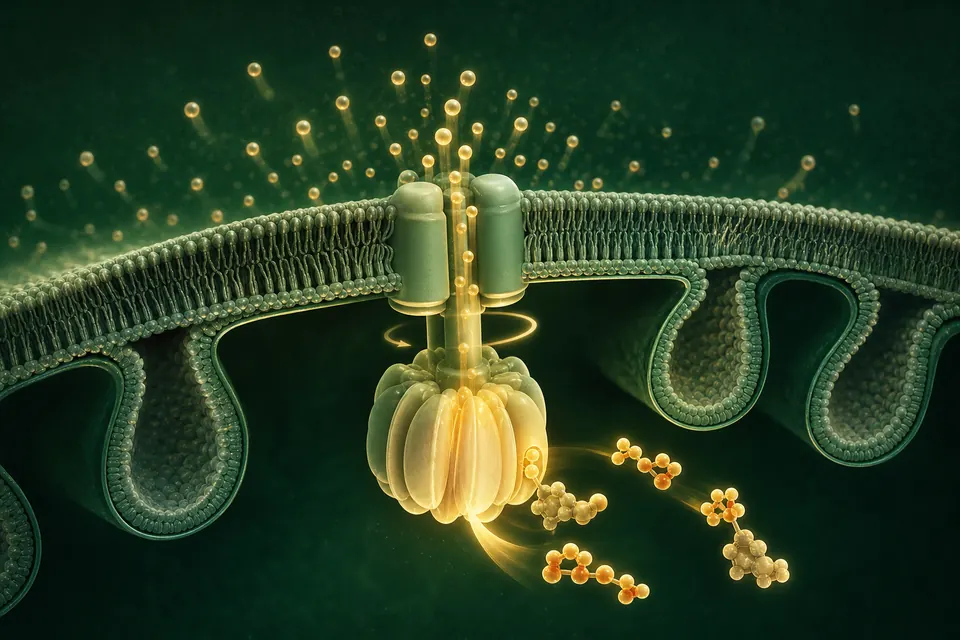
Oxidative phosphorylation is organised around respiratory complexes embedded in the inner mitochondrial membrane. NADH transfers electrons to complex I and succinate feeds electrons through complex II; ubiquinone carries them to complex III, cytochrome c to complex IV, and oxygen acts as the terminal acceptor. Complexes I, III and IV pump protons, producing an electrical potential and pH gradient. The F0F1 ATP synthase converts proton flow into rotation of its c-ring and central stalk, driving catalytic-site transitions that bind substrates, form ATP and release product.
How it works
Electrons from reduced carriers pass through respiratory complexes and ultimately reduce oxygen to water. Protons then flow back through ATP synthase. This molecular rotary machine couples proton movement to conformational changes that join ADP and inorganic phosphate to form ATP.
Measurement and research methods
Bioenergetic measurements combine oxygen-consumption assays, membrane-potential-sensitive probes, ATP production rates and targeted metabolomics. High-resolution respirometry uses substrate-uncoupler-inhibitor protocols to separate leak respiration, coupled phosphorylation and maximal electron-transfer capacity. Genetic or pharmacological perturbations help assign defects to particular complexes, while blue-native electrophoresis examines respiratory supercomplexes. Interpretation must account for mitochondrial abundance, substrate transport, cell type and the fact that uncouplers or fluorescent dyes can themselves alter the electrochemical state being measured.
Key ideas
- The proton-motive force combines electrical and concentration differences.
- The inner membrane's low proton permeability is essential for energy conservation.
- Respiration and ATP demand are regulated together rather than operating at one fixed rate.
Current research frontier
The current frontier concerns dynamic regulation rather than a single fixed efficiency. Mitochondria fuse, divide, move, exchange metabolites and are removed by mitophagy; these processes link quality control to tissue energy demand. Proton leak can lower ATP yield but generate heat or reduce highly reduced electron carriers that favour reactive oxygen species. Pathogenic variants in mitochondrial or nuclear DNA produce heteroplasmy and threshold effects that differ among tissues. Researchers are developing metabolic tracing, organelle-resolved imaging and therapies that address delivery, genome compatibility and long-term selection of mitochondrial populations.
Why it matters
ATP synthesis connects nutrient oxidation to cellular work, including movement, transport and biosynthesis. Defects in the respiratory chain can especially affect tissues with high and continuous energy demand.
Limits and open questions
The pathway also generates heat and reactive by-products, and it is not the only source of ATP. Mitochondrial function varies across tissues, developmental states and environmental conditions.
Explore through connected concepts
This article is indexed with 20 technical tags. Select a tag to explore the Wiki by concept.
You may also explore
Recommended from the technical tags shared with this article.
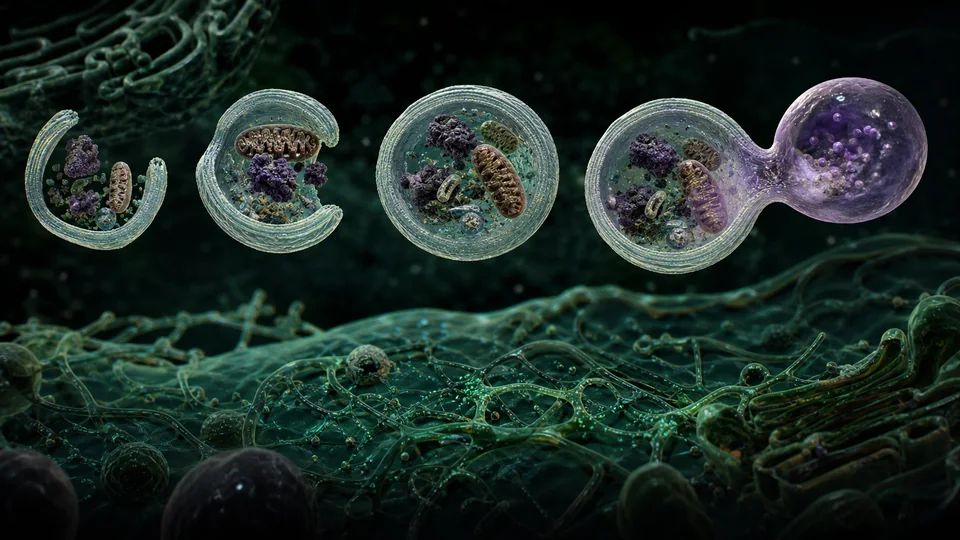
Autophagy
Cellular pathways that deliver cytoplasmic material to lysosomes or vacuoles for degradation, quality control and recycling.
Read article →